The Art of Travel· 12 min read·7 October 2024
How to Choose a Luxury Travel Agency in Peru: The Four Verifiable Questions
The descriptions agencies give of themselves are too similar to one another. The answers to these four questions are not — and they are what the traveller can verify before making the decision.
By Daniel Ramos
Every luxury travel agency in Peru uses the same vocabulary. Curated. Bespoke. Immersive. Off-the-beaten-path. The marketing language of the sector has converged to the point where descriptions are interchangeable between agencies with fifteen years of operational experience based in Lima and resellers operating from a coworking space in Barcelona who have never built a direct relationship with a single hotel in Cusco.
This convergence is not accidental. The words that perform well in search and in the first emotional impression are the same for everyone, because everyone has read the same marketing literature. What those words cannot substitute for is the answer to four specific questions. Those answers require knowledge that takes years to build, relationships that take decades to maintain, and a process that takes hours per client — none of which can be condensed into an adjective.
The framework below is the one Kada applies when assessing its own standards. It is also the framework any traveller can apply to Kada — or to any other agency operating in this market. The four questions address: who is actually running the trip, who designs versus who sells, what the first conversation reveals about the process, and whether the agency has specific opinions it is willing to defend. Each has a verifiable answer. None requires taking any agency's self-description on faith.
The descriptions agencies give of themselves have converged. The answers to these four questions have not.
The Structural Question: Who Is Actually Running the Trip?
Two operating models in the luxury Peru travel market use the same vocabulary to describe themselves.
The first model: agencies with their design and operations team based in Peru — in Lima, Cusco, or both. These agencies make real-time editorial decisions: which hotel has changed management, which lodge had a difficult season, which guide has returned from parental leave. Their knowledge is current because the people generating it live inside the market they are selling.
The second model: agencies based in London, New York, Madrid, or Melbourne that resell itineraries assembled in collaboration with Peruvian ground operators. The client is served by a team that may have visited Peru once or twice, works with a catalogue agreed with a local intermediary, and cannot make adjustments without consulting a party it may never have met in person. The brand is international; the operation is local and second-hand.
Neither model is fraudulent. The reseller model can deliver a competent trip when the client's requirements are clear and the local operator is reliable. What it cannot deliver is responsive editorial intelligence — the ability to know, this week, that the guest house in Colca Canyon has a new chef worth an extra night, or that the alternate route into the Sacred Valley is quieter in July because the tour coaches have not discovered it yet.
How to verify: Ask directly where the design team is based. Not where the company is registered — where the people who will write the itinerary live and work. An agency with design based in Lima or Cusco can answer this without hesitation. One that cannot, or that responds "we have partners on the ground in Peru," is describing the reseller model.
The second test in this category is personal relationships with properties. An editorial agency with genuine operational presence in Peru can tell the traveller the name of the general manager at each hotel it recommends, what the property's current strengths and known limitations are, and whether the relationship is recent or longstanding. These are not facts that appear in a press kit. They accumulate through visits, through dinners, through years of placing guests and debriefing with the property afterward.
An agency that cannot name a specific person at Inkaterra, at Belmond Cusco, at Sol y Luna, or at whichever hotel it recommends — and cannot offer a current observation about that property's condition — is recommending from a catalogue, not from direct knowledge. The distinction between the two is not always visible in the brochure. It becomes visible the moment something changes.
The Editorial Question: Who Designs, Who Sells?
Two numbers matter when evaluating an agency's editorial credibility. Only one of them appears in the marketing.
The number that appears: how long the agency has been operating. Fifteen years. Twenty years. These figures convey stability. They do not convey knowledge, because they measure the company, not the person doing the work.
The number that matters: how long the specific person who will design the itinerary has been working in Peru, and in this role. An agency founded fifteen years ago whose founding director retired in 2019 and whose current team began during the pandemic has, in practice, four years of operational depth — not fifteen. An agency founded three years ago whose director spent the preceding twenty years designing Peru itineraries has twenty years of useful knowledge under a three-year-old brand name.
How to verify: Ask directly: "How long has the person who will design my trip been working in Peru, specifically?" The answer should be a number and a name. If the answer is the company's founding date, press further. A credible minimum threshold is ten years. What distinguishes an editorial agency from a well-intentioned newcomer is fifteen to twenty-five years of accumulated knowledge of the same market, through several cycles of change.
The second editorial signal is the public body of work. An agency that thinks seriously about a destination publishes that thinking — not only testimonials and photographs, but articles that contain argument and data. The test is: read three pieces from the agency's journal or blog. What to look for is not production quality. Look for specificity: place names, times of day, counter-intuitive recommendations, opinions that are stated and defended rather than hedged.
If the writing says "Cusco is magical and the Inca citadel will leave you breathless," the agency has a marketing writer. If it says "The Sacred Valley works better than Cusco as an acclimatisation base for travellers arriving from sea level — the altitude differential matters, and the landscape rewards the extra time," the agency has someone who knows the difference.
The editorial portfolio is the most honest signal available before the first conversation. It is also the one most agencies neglect, because producing genuine editorial content requires time and knowledge that resellers do not have and that marketing writers cannot simulate over sustained reading.
The First Conversation: Two Signals the Initial Contact Reveals
The first conversation with a luxury travel agency reveals two things that no website can: how the agency understands the traveller's trip, and who in the organisation is responsible for it.
The duration of the first call is a direct signal of the operating model. A commercial operator needs fifteen to thirty minutes to take a brief: how many days, what budget, which destinations, which month. That information is sufficient to select and price an itinerary from a catalogue. An editorial agency needs sixty to ninety minutes for the opposite reason: it does not have a catalogue to match against the brief. It needs to understand who the traveller is — their reactions to previous trips, the dynamic with their travel companion, their threshold for discomfort, their appetite for the unexpected — before it can write something specific rather than something adapted from a previous client's experience.
The difference in duration is not a difference in thoroughness. It is a difference in model. The commercial operator is efficient because the work has already been done; the first call is a matching exercise. The editorial agency is slower in the first call because the work begins there; there is nothing to match until the traveller has been understood.
How to verify: Ask how long the first conversation typically lasts. "About thirty minutes" is an honest answer that describes a commercial model. "One to one and a half hours, depending on the complexity of the trip" is an honest answer that describes a design process. Both are accurate self-descriptions of the respective models. The question is which model the traveller wants.
The second signal is continuity of interlocutor. In a commercial model, the first conversation is conducted by a sales agent. The itinerary is assembled by a product team. Operations is managed by a logistics coordinator. The client interacts with three or four people across the process, none of whom has full context because each handles a single stage. In an editorial model, the person who conducts the first conversation designs the itinerary, presents the draft, manages the adjustments, and remains the contact during the trip. The design is coherent because it emerges from one intelligence, not assembled from departmental inputs.
Ask directly: "Will the person I speak with today be my contact from this conversation to the post-trip debrief?" The correct answer is yes, with a name. "The team will support you at each stage" is a courteous description of fragmentation — useful to know before committing, not after.
The Difficult Question: The Final Test
The first three questions can be researched before a conversation begins. The fourth requires a conversation to test — and it is the most definitive of the four, because the answer it is looking for cannot be manufactured without genuine knowledge.
Ask the agency a question that requires a specific opinion.
Not: "What hotel do you recommend in Cusco?" That question can be answered from any catalogue.
Ask: "Which hotel in Cusco do you prefer for a honeymoon couple, and why not the other?" The second half of the question is the test. It requires the agency to have a real judgment — a specific view about which option better serves a particular situation — and to be willing to defend it against the alternative.
A reseller's answer will contain generalities: "Both are excellent options," "it really depends on your preferences," "either would work beautifully for a honeymoon." These are not opinions. They are hedges that protect a seller who either does not know the difference or cannot afford to state one.
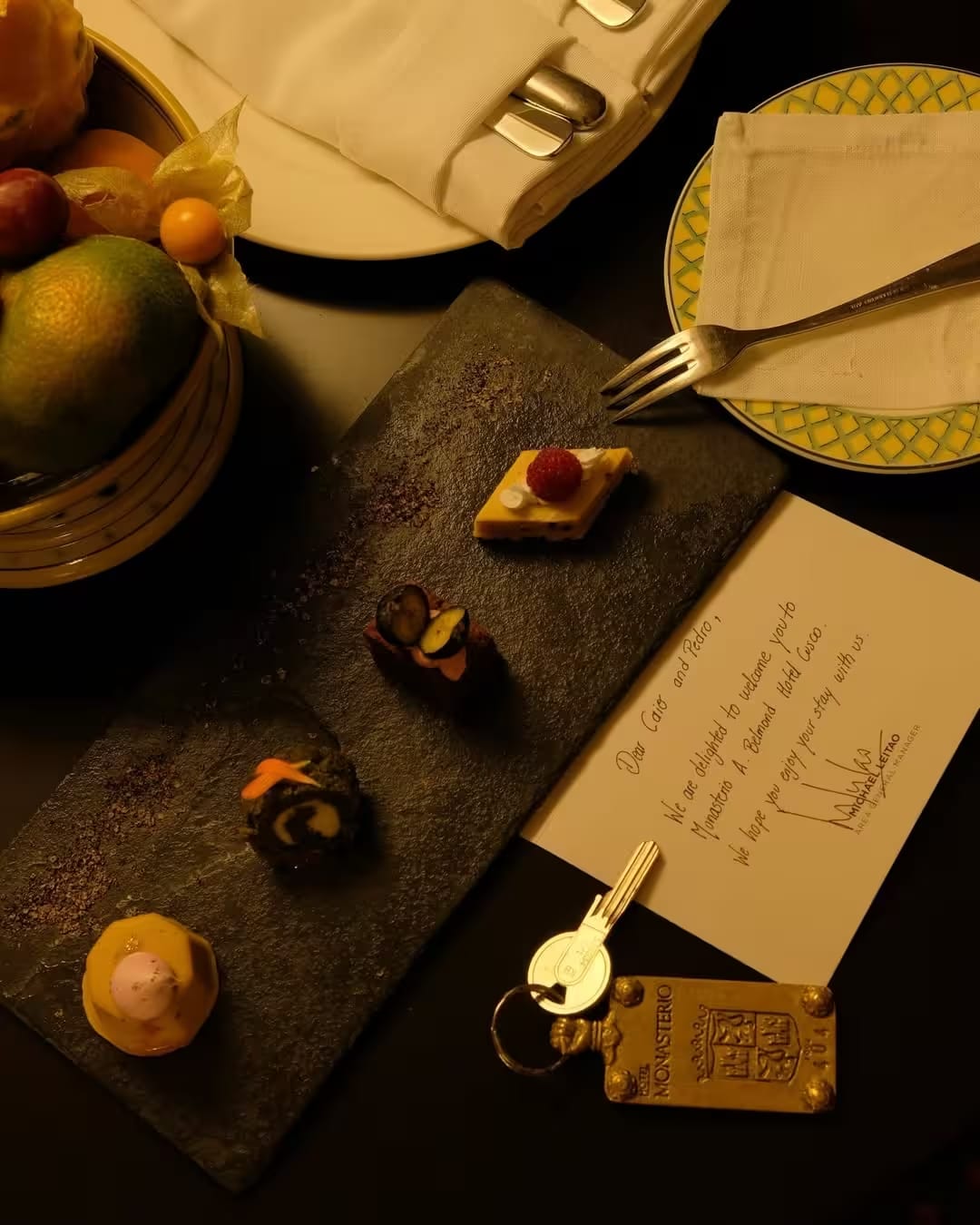
An editorial agency's answer will contain criteria. It will describe what the Monasterio offers in terms of architectural experience and historical weight, what it does not offer in room modernity, what the Palacio del Inka provides in comfort, and why the choice between them is a question of what the honeymoon is actually for — the sense of occasion, or the quality of the room. It will name a preference and explain it. That answer came from someone who has stayed in both properties, placed guests in both, and debriefed with those guests afterward.
A second version of this test: "When would you recommend Belmond Sanctuary Lodge at Machu Picchu, and when would you not?"
The honest answer distinguishes between the location advantage — real and singular; the only accommodation adjacent to the site — and the limitations a reseller would suppress: the room quality relative to price at this position in the market, the food programme relative to the Belmond benchmark at other properties, the constraint that staying there means not staying in the Sacred Valley, where many travellers discover they want more time than their itinerary allowed. An agency that can articulate that specific trade-off has placed guests there and processed the result. An agency that presents Sanctuary Lodge simply as the premium Machu Picchu option has not.
The willingness to state and defend a specific opinion is the hardest quality for a reseller to simulate, because it requires accumulated knowledge that cannot be acquired without years of direct experience and honest debriefing. It is also the quality that most directly predicts whether the itinerary the agency produces will be suited to the specific traveller, or generic enough to work for almost anyone.
When None of This Matters
The four questions above matter most when the trip justifies the additional cost of working with an editorial agency — and there are trips that do not.
A five to seven-day trip to Lima and Machu Picchu with clear preferences, an upper-mid budget, and no particular requirements for customisation will be well served by almost any competent operator with a serious reputation. The distinction between an editorial agency and a well-run commercial operator becomes most visible in complex, long, or emotionally weighted trips: a two-week itinerary that crosses multiple ecosystems, a honeymoon in which the sequence and pacing of experiences carry significance, a multi-generational trip in which members have different physical thresholds and interests, a return visitor who has already seen the standard route and needs someone who knows what lies outside it.
For trips below roughly USD 6,000 to 8,000 per person, the cost of the editorial model does not amortise efficiently. The design hours, the continuity of interlocutor, the real-time operational intelligence — these are worth paying for when the trip is complex enough to use them. They are an unnecessary premium when the itinerary is short, clear-objective, and executable by any competent operator.
This calibration is itself an editorial act. An agency that would argue otherwise — that every Peru trip benefits from bespoke design — is a seller, not an advisor. Knowing when to refer a traveller to a simpler option is part of what separates the two.
What This Looks Like at Kada
Applying the four questions to Kada produces answers the traveller can verify.
Structural: Kada's design and operations team is based in Lima. The founding directors have lived and worked in Peru throughout the company's existence. The property relationships Kada maintains are direct: the conversation with the general manager at Inkaterra Machu Picchu, with the ownership at Sol y Luna, with the Belmond Cusco management, happens between Kada's team and the property directly, not through an intermediary. Whether those relationships meet the standard this article describes is something the traveller can verify by asking Kada for a specific name and a current observation about any property under consideration.
Editorial: The journal the traveller is currently reading is the editorial portfolio. The pieces under Unfolded — the experience catalogue — are written by the guides, travel designers, and cultural interpreters who conduct the visits. The argument in any given piece can be agreed with or disputed; what it is not is generic marketing copy produced for search engines.
First conversation: Kada's first conversation runs sixty to ninety minutes. The person who conducts it is the travel designer who will write the draft and remain the contact through the end of the trip. The mechanics of the process that follows are described in a companion article — the Kada method — for travellers who want to understand it before the first call.
Difficult question: Kada has a specific opinion about every property in its catalogue. Whether Sanctuary Lodge is the right choice depends on whether the location adjacency justifies the cost relative to what the traveller gives up in the Sacred Valley — and Kada will say so explicitly when asked. Whether the standard Machu Picchu circuit is sufficient for a return visitor, whether the Q'eswachaka suspension bridge period merits a Sacred Valley detour, whether Colca Canyon rewards a second day when the first was fogged in at Cruz del Cóndor — these are questions Kada answers with specific criteria, not with reassurances.
The evaluation is the traveller's to make. The argument in this article is that the answers are there to be tested.
Expert Perspective
"I wrote this article because the luxury Peru travel market has a problem with its own vocabulary. Every agency uses the same words. None explains what those words mean in practice. If you are reading this in preparation for a trip, I ask one thing: apply these four questions to Kada with the same rigour you would apply to any other agency. Do not accept our answer on faith — test it. Ask which hotel we prefer for a honeymoon couple and why not the other. Ask where our design team lives. Ask how long the first conversation will be. The answers are what distinguish an editorial agency from a well-marketed reseller. The conclusion is yours."
— Daniel Ramos, Co-Founder & CEO, KADA Travel
A Practical Note
How many agencies to evaluate: Two to three. More produces a surplus of competing proposals that makes genuine comparison difficult and signals to each agency that a decision is unlikely. The comparison is most productive when focused enough to generate a clear preference.
What to ask for: Beyond the four questions, request a sample itinerary from a recent comparable trip — similar destination, duration, budget range, and traveller profile. The document reveals the agency's editorial register more reliably than its website: whether it reads as a logistics manifest or as a designed experience.
Timeline: For itineraries involving high-demand properties — Belmond Sanctuary Lodge, the Andean Explorer, the most sought-after Machu Picchu access windows — begin the evaluation six to eight months before departure. Three to four months is sufficient for most itineraries. Beginning fewer than eight weeks out constrains every category.
What to watch for: An agency that pressures for confirmation before the itinerary is complete, that cannot name a specific contact at the properties it recommends, or whose first conversation runs under thirty minutes is demonstrating its model before the contract is signed.
Written by Daniel Ramos
Frequently Asked
The structural difference is where the design team sits. Luxury OTAs with headquarters outside Peru typically work with a catalogue assembled in collaboration with a Peruvian ground operator. Their design staff may have visited Peru and established relationships with specific properties; they can produce high-quality itineraries. What they cannot provide is real-time operational intelligence — knowledge of what has changed this season, which guide is available this month, what the property's current condition is. An agency whose team lives in the market it sells operates with different information than one that accesses it periodically.
Virtuoso affiliation is a useful starting reference — it indicates the agency has met certain standards and has access to preferred-rate programmes at affiliated properties. It does not indicate editorial depth, design quality, or operational presence in Peru specifically. Apply the four questions regardless of affiliation. Some strong agencies are not Virtuoso members; some Virtuoso-affiliated agencies are structural resellers.
Ask for a specific name at the property and a current observation — not a published description, but something from a recent visit. If the answer is specific (the general manager changed in March; the renovated rooms in the east wing are materially different from the standard; the new sommelier at the restaurant has reoriented the wine list toward Peruvian producers), the agency knows the property from direct and recent contact. If the answer is a press-kit description, the relationship is transactional.
Less useful than the editorial portfolio. Testimonials are selected and curated by the agency; the editorial portfolio is public and arguable. The more useful form of social proof is a verifiable reference: a previous client with a comparable profile who is willing to speak directly. Any editorial agency with genuine client relationships can facilitate this without being asked twice.
For complex itineraries or those involving high-demand properties: six to eight months before departure. The constraint is not the evaluation itself — two to three conversations across two to three weeks is typically sufficient — but the booking window for sought-after properties. Belmond Sanctuary Lodge, the Andean Explorer, and the most-requested Machu Picchu access periods fill significantly ahead of season. Starting early enough to confirm before those windows close is the practical reason the timeline matters.
Design Your Journey
Design your bespoke Peru journey
We talk. We listen. Then we design an itinerary that belongs only to you.
Start Planning