Unfolded· 8 min read·14 July 2026
The Canyon's Two Peoples
A community visit to the Collagua and Cabana villages of the Colca valley — the distinct cultures that have inhabited the canyon's terraced walls for centuries, their textiles, their calendars, and what it means to receive a visitor.
By Kada Travel Editorial
The Colca Canyon is most often described by what it contains: the depth (3,270 metres at its greatest extent), the condors, the terraced walls. What is less often described, because it is harder to photograph and more difficult to summarise, is who made the canyon what it is and who continues to live in it.
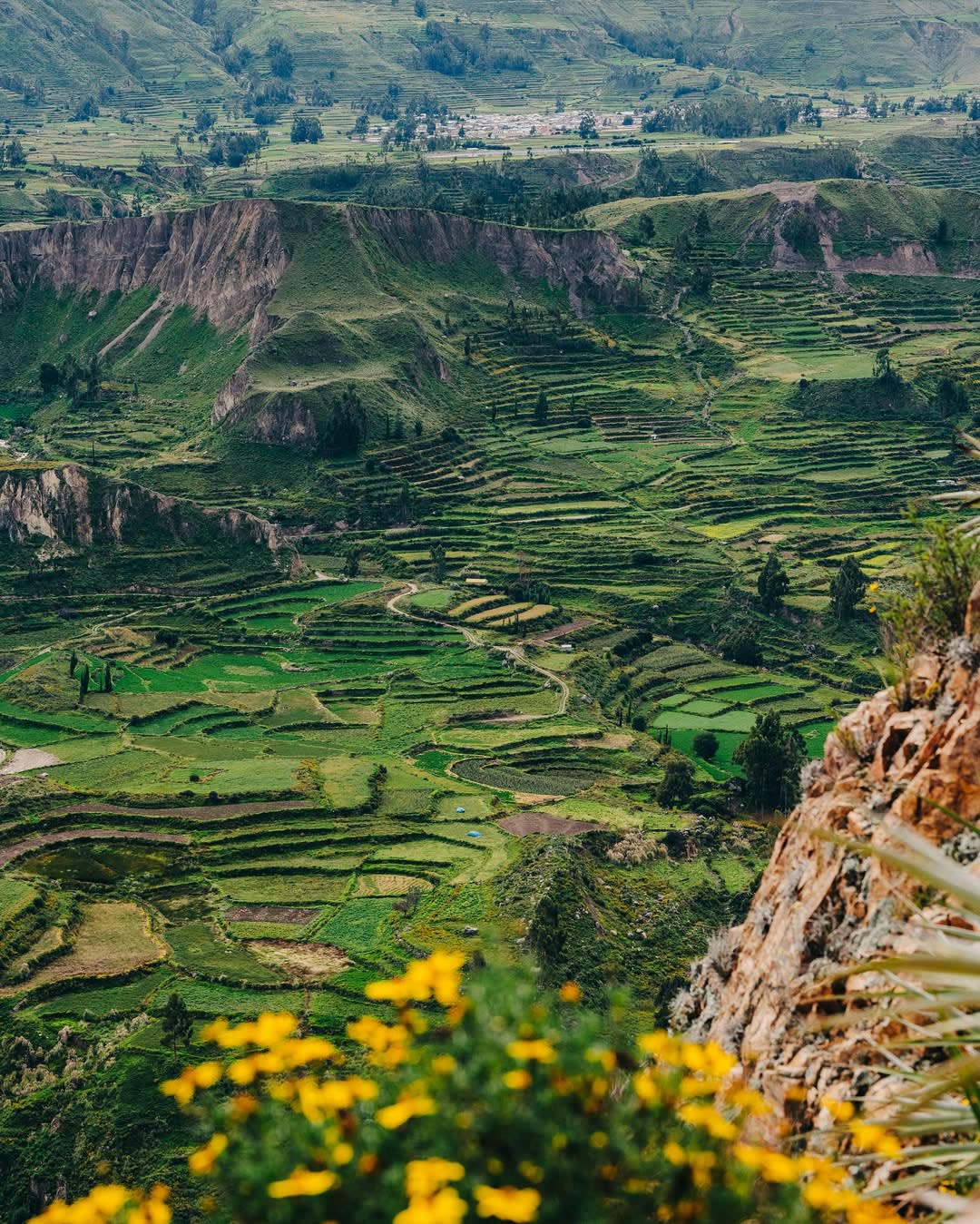
The canyon is inhabited. Not vestigially, not as a kind of human backdrop to a natural spectacle, but as a functioning agricultural landscape with communities that have lived here continuously for more than a thousand years. The andenes — the pre-Inca agricultural terraces that cover approximately 6,000 hectares of the canyon walls — are still cultivated. The Quechua spoken in the villages along the river is still the primary language of domestic life. The textiles produced by the women of the Collagua communities carry an iconographic system that has no precise equivalent anywhere else in the Andes.
The canyon has two peoples: the Collagua, whose communities extend through the upper valley — Yanque, Coporaque, Achoma, Maca — and the Cabana, whose communities occupy the lower canyon toward Cabanaconde. They are distinct. They are historically distinct, culturally distinct, and visually distinct in a way that is immediately legible to anyone who knows what to look for.
The standard Colca itinerary includes Cruz del Cóndor and a stop in one of the valley towns — a plaza, a church, perhaps a woman in festival dress who agrees to be photographed. That encounter is with the valley's surface. What Kada arranges is different in kind: a visit structured on the community's own terms, with a guide who speaks Quechua as a first language, and with the protocol of a relationship rather than the protocol of tourism. What becomes possible in that context — a conversation with a weaver about the iconographic system in her montera, access to the ritual space that is not normally open to passing visitors — is not available from the main road.
The Collagua and the Cabana
The chronicles of the Spanish colonial administration noted, in the sixteenth century, a practice among the peoples of the Colca valley that distinguished the two groups with unusual clarity: the Collagua modified the skulls of their infants to produce an elongated, conical shape; the Cabana produced a flatter, rounded form. These practices — carried out by wrapping and binding the skull before the bones had fully hardened — were long abandoned by the time of Spanish contact as an active intervention, though the chronicles record them as still visible in the skull shapes of the adult population. Archaeological evidence from the valley confirms them: skulls recovered from Collagua and Cabana burial sites show the two distinct deformation patterns at rates consistent with systematic practice across the population.
The purpose, as the chronicles record and as contemporary ethnographic research has elaborated, was identity rather than status: the Collagua identified with Collaguata, a volcanic peak to the northeast, whose conical form they replicated in their skulls; the Cabana identified with a rounded mountain and shaped themselves accordingly. The practice encoded belonging in the body — an identity that could not be removed or misrepresented.
The skull modification is no longer practised. What remains, and what the visit addresses, are the living cultural distinctions between the two peoples: their textile traditions, their hats, their ritual calendars, their dialects of Quechua, and their relationship with the landscape they have inhabited for centuries.
The Montera
The most immediately visible distinction between the Collagua and the Cabana today is the montera — the distinctive hat worn by the women of each group.
The Collagua montera is white, made from woven straw or fabric, and densely embroidered. The embroidery is extraordinary: floral and geometric forms in red, yellow, blue, and green thread, covering the hat's brim and crown with patterns that indicate, to those who can read them, the specific community and sometimes the marital status of the wearer. The density of the embroidery is functional as well as decorative — a woman's hat represents hundreds of hours of work, and it accumulates across a lifetime. An older woman's montera is typically more elaborately worked than a younger woman's; the hat is an ongoing project, added to over time.
The Cabana montera is more colourful — reds and pinks dominant, with different geometric forms — and structurally distinct from the Collagua version. The two hats are not interchangeable or confused in the valley. They are markers of specific community membership, worn throughout a woman's adult life for ordinary and festive occasions.
The weaving itself — the textile produced on the backstrap loom, from wool that may come from the community's own animals — carries geometric patterns that are distinct from the broader Andean weaving tradition. Some motifs appear to have pre-Inca origins; the colonial period introduced new thread colours (aniline dyes available from Spanish traders) without displacing the underlying compositional system.
The Community Visit
The visit Kada arranges is to Yanque and Coporaque — the two principal Collagua communities on the western side of the upper valley, both within a short distance of each other and of the river crossing. Yanque is the more visited of the two; Coporaque, slightly further from the main tourist road, has a quieter quality and a colonial church of particular architectural interest.
The visit is organised in coordination with the community, which means that it is not a drop-in to a village to look at people. It operates on a protocol established between Kada and the community: advance notice, agreed itinerary, direct economic retribution to the community rather than to an intermediary, and the condition that the visit is educational rather than folkloric. There is no performance staged for visitors. What guests encounter is the community going about its life, with a guide who explains what is happening and facilitates introductions to people who have agreed to be met.
This might include: a woman weaving who is willing to show the setup of her backstrap loom and explain the pattern she is working; the community's ritual space and its relationship to the agricultural calendar; the colonial church that replaced the pre-Inca ceremonial site (Yanque's church of the Immaculate Conception, 1730, is built directly over a prior Collagua sacred space — its foundations incorporate Inca stonework); the market day schedule and what it reveals about the economic relationships between the canyon communities and the larger regional economy.
The guide who accompanies this visit is from the Colca region and speaks Quechua as a first language. The directness of this communication — in the community's own language, not through multiple layers of translation — changes the quality of interaction with community members who choose to engage.
The Ritual Calendar
The Collagua and Cabana communities maintain a ritual calendar that overlays the Catholic liturgical year with agricultural cycles that predate it by centuries. The most significant festivals in the valley are those that mark the agricultural transitions: the planting season (October–November), the harvest (April–May), and the water ceremonies that mark the beginning of the irrigation season.
The water ceremonies — known in the valley as the limpieza de acequias (cleaning of the irrigation channels) — involve the entire community in the maintenance of the acequia system that distributes water from the glacial sources above to the andenes below. The canals are cleaned by communal labour, and the work is accompanied by ritual: prayers, offerings, and the participation of the community's authorities in a ceremony that acknowledges the water's source and asks for continued provision. The ceremony is agricultural necessity and cosmological statement simultaneously. The acequia system the community maintains during these ceremonies is, in places, the same system that was built by the Collagua before the Inca arrived.
Guests visiting during a festival period encounter a different Colca from the one available at other times of year. Kada can advise on the festival calendar and, for guests whose interests include the ceremonial dimension, recommend timing accordingly.
The limpieza de acequias and the planting ceremonies are not events staged for visitors and do not operate on a visitor's schedule. The guide's knowledge of the valley calendar — and the community's willingness to include guests in the day's rhythm when a visit is coordinated in advance — is what makes presence at those moments possible. Without the relationship, the calendar is visible only from the outside.
What Kada Arranges
The guide who accompanies this visit is from the Colca region and speaks Quechua as a first language. This is not a credential — it is a consequence of origin that changes what the visit can be. Community members who would not engage through a Spanish-only intermediary engage differently when the greeting and the initial exchange happen in the valley's own language. The translation layer that standard tourism operates through — Spanish to Quechua and back, with information inevitably compressed in the crossing — is not present here. What becomes audible and visible in that difference is difficult to replicate by any other arrangement.
The visit is coordinated through a protocol Kada has established with the Yanque and Coporaque communities: advance notice, an agreed itinerary, direct economic arrangement with the community distributed to participating members without an intermediary, and the explicit condition that the visit is not folkloric — no performance staged for the camera, no meeting that exists only for visitors. What guests encounter is the community as it operates, with introductions to people who have agreed to be met: a weaver who explains her work and the system of symbols in her montera, the community's ritual space and its relationship to the agricultural calendar, the colonial church built directly over the pre-Inca sacred site.
The practical arrangements: departure from Arequipa at 6:00 AM, arriving in the valley by 9:30–10:00 AM. The visit occupies the late morning and early afternoon. It pairs naturally with the condor visit (Article 6) as the dawn element of a two-day Colca programme, or with the andenes walk (Article 8) for a full-day cultural and agricultural programme in the same valley. Lunch in Yanque or Chivay is included.
Expert Perspective
"The question that comes up most often when guests learn about the skull modification practice is: why did they do it? The answer the community would give is not the same as the answer an anthropologist would give — though both are worth hearing. What I find most useful is what the practice reveals about how these peoples understood identity. They encoded who they were in the body, visibly and permanently. When I look at the montera — the embroidered hat that a Collagua woman wears every day, that she adds to over a lifetime, that marks her community and her status as clearly as the skull shape marked her ancestors — I see the same logic. The form has changed. The relationship between identity and material culture is the same."
— Jaime Ttito, Head of Guides & Cultural Interpreter, KADA Travel
A Practical Note
Photography: Photography of community members requires individual consent, which the guide facilitates. Do not photograph without asking, and accept refusal. The festival context is different from the ordinary daily visit context — community members in festival dress may be more or less willing to be photographed than on ordinary days; the guide will advise.
Language: Spanish is widely spoken in the valley alongside Quechua. Guests who speak Spanish will find direct conversation with community members more accessible than in most community visits in Peru. The guide facilitates introductions and provides context.
Time of year: The Colca valley is accessible year-round, though the rainy season (December–March) can affect road conditions in the canyon and reduces visibility for condor viewing. The festival calendar is denser in the planting and harvest periods (October–November, April–May); Kada can provide the specific dates for the current year.
Altitude: Yanque and Coporaque are at approximately 3,400 metres. Guests who have not yet acclimatised to Arequipa's altitude should plan the Colca visit for the third or fourth day of their Arequipa programme.
Community protocol: The visit operates on the community's terms. If the guide indicates that an area or activity is not available for guests on a given day, this should be accepted without negotiation.
Written by Kada Travel Editorial
Frequently Asked
The distinction is historical, cultural, and visual. The Collagua occupy the upper valley (Yanque, Coporaque, Achoma, Maca) and the Cabana the lower valley toward Cabanaconde. The most visible difference for visitors is the montera: the Collagua women's hat is white with dense floral embroidery; the Cabana version is more colourful with different geometric forms. The two groups also have distinct weaving traditions, dialect variations in their Quechua, and somewhat different festival calendars. They have lived as distinct peoples in the same canyon for more than a thousand years.
Kada's arrangement with the Yanque and Coporaque communities involves direct payment to the community organisation, which distributes it to participating members (the weaver who shows her work, the guide who accompanies the visit, the household that provides lunch if that is arranged). There is no intermediary tourism operator between Kada and the community. The amount paid and the distribution mechanism are part of the agreement Kada has negotiated with the community leadership, and can be explained to guests on request.
The practice of cranial modification ended during the colonial period, under pressure from Spanish authorities who found it disturbing and who associated it (not incorrectly) with pre-Christian cosmological practices. The chronicles suggest it was already declining by the late sixteenth century; by the early seventeenth it had ceased as an active practice. What the anthropological and archaeological record shows is that the practice was widespread among both groups — not a fringe tradition but a community-wide identity marker — and that it was systematically suppressed rather than naturally abandoned.
Yes. The church of the Immaculate Conception in Yanque (1730) is open to visitors during daylight hours and includes interior elements of significant interest — colonial paintings, carved stonework incorporating Andean motifs, and a floor plan that partially reflects the pre-Inca sacred space it replaced. The guide provides context for the church's construction history and its relationship to the Collagua community's religious life, which blends Catholic and Andean ceremonial elements in ways that continue to be visible in the annual festival calendar.
Design Your Journey
Design your bespoke Peru journey
We talk. We listen. Then we design an itinerary that belongs only to you.
Start Planning