Unfolded· 7 min read·13 July 2026
The Hour Before the Buses
A private dawn visit to Cruz del Cóndor in the Colca Canyon with a field biologist who monitors the condor population — arriving at 6:30 AM, when the thermals are forming and the canyon belongs only to the birds.
By Kada Travel Editorial
The tour buses from Arequipa reach Cruz del Cóndor between eight and nine-thirty in the morning. Kada arrives at six-thirty.
That ninety-minute difference is the entire experience. The birds that arrive at the Cruz del Cóndor viewpoint — at 3,287 metres on the canyon's southern rim — do not arrive on a schedule calibrated to tourism. They arrive when the thermal conditions in the canyon are right: when the valley floor, in shadow all night, has absorbed enough of the morning sun that the air above it begins to rise and the condors, resting on the canyon walls since the previous afternoon, can ascend without expending the energy that flapping would require. That process begins in earnest between six-thirty and seven-thirty, before the buses arrive and before the viewpoint becomes the particular kind of loud space that two hundred tourists in a confined overlook produces.
What the buses change is not the number of birds — the condors do not withdraw when the crowd arrives, though some move to quieter viewpoints downcanyon. What the buses change is the quality of attention available to the observer. The condor in a crowded overlook is a spectacle. The condor in a quiet canyon at dawn is something else.
The Bird
The Andean condor (Vultur gryphus) is a New World vulture — not a true vulture in the Old World sense, and not a raptor in the hunting sense, despite its physical authority. It is a scavenger of the highest order: a bird built not for pursuit but for sustained soaring over the largest possible area, locating carrion from altitude and descending when it does. The adaptations for this life produce the bird's most visible characteristics.
Wingspan: 3.0 to 3.3 metres in adults. Weight: up to 15 kilograms in males — the heaviest flying land bird in the world. The combination of weight and wingspan means the condor cannot sustain flapping flight for extended periods; it depends on thermals and ridge currents to remain airborne. At Cruz del Cóndor, where the canyon walls funnel upward air currents along both the northern and southern rims, the condors can soar for hours with no wingbeats at all — primary feathers spread and angled, body inclined into the current, making small adjustments with the tail and wingtip to maintain position. The soaring is not passive. It is a continuous negotiation with the air.
The condor's lifespan in the wild exceeds fifty years. They begin breeding at five to six years and are monogamous across decades; a pair that loses a chick will not produce another for two years, and the single annual chick requires parental attention for up to two years after hatching. This slow reproductive rate — one successful chick every two to three years per pair — makes the population extremely sensitive to mortality and habitat disruption. The Colca Canyon population is one of the largest remaining concentrations of Andean condors; precise counts vary by monitoring period, but the canyon regularly hosts several dozen birds across its length. The biologist who accompanies Kada's guests monitors individual birds across multiple seasons.
The slow reproductive rate and the span of individual lifespans mean that the biologist's multi-season knowledge of specific birds is not supplementary detail — it is the only way to watch a condor at Cruz del Cóndor and understand, specifically, what you are watching.
The Canyon
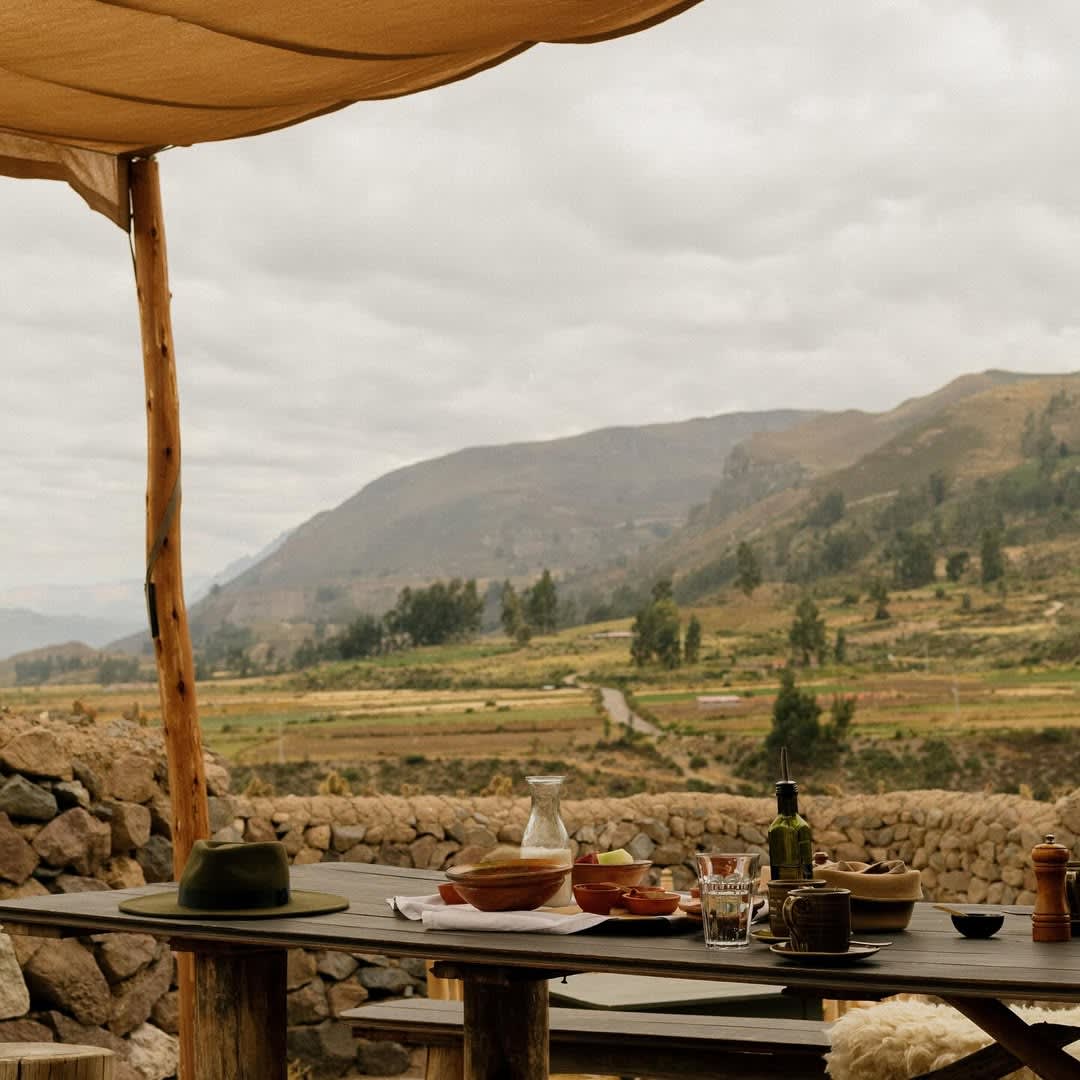
The Colca Canyon is not the deepest in the world — that distinction belongs to Cotahuasi, also in the Arequipa region, some two hundred kilometres northwest. The Colca reaches a maximum depth of approximately 3,270 metres from the canyon rim to the Río Colca at its floor. This is more than twice the depth of the Grand Canyon of the Colorado. The scale is perceptual rather than statistical: standing at Cruz del Cóndor, the river at the canyon floor is not visible — the depth exceeds what human vision can resolve in a single frame, and the condors ascending from the walls below the viewpoint pass through altitudes that feel, in sequence, like passing through separate atmospheres.
The canyon was formed by the Río Colca cutting through volcanic and sedimentary rock over geological time, aided by the tectonic uplift of the Andes. The same geological forces that produced the canyon created the conditions for the Collagua and Cabana peoples to develop terraced agriculture on its walls — the andenes that are visible from the rim on clear mornings, the light catching the retaining walls at an angle that reveals their geometry. These are not ruins. Many of the andenes in the Colca are still cultivated.
The drive from Arequipa to Cruz del Cóndor crosses the Patapampa pass at 4,910 metres — the highest point on the route, marked by an apacheta (a cairn where travellers add stones as an offering) and, on clear mornings, views of seven or eight volcanic cones simultaneously: Misti, Chachani, Ampato, Sabancaya (the one that is actively emitting). The altitude at Patapampa is significant. Kada structures the departure and route to allow for acclimatisation stops if needed.
The Biologist's Frame
The field biologist Kada works with has studied the Colca condor population across multiple seasons, contributing to monitoring programmes that track individual birds by plumage markings and GPS tags. The knowledge this produces is different from what a guide can offer from observation alone.
At the viewpoint, the biologist identifies individual birds by the patterns of their plumage — adult males have a white collar and a caruncle (the fleshy crest above the beak) that develops over years; females lack the caruncle; juveniles are grey-brown, darkening through five or six years to the black-and-white adult coloration. Recognising individuals allows the biologist to describe their histories: where this bird nests, its territory within the canyon, whether it has produced chicks in recent seasons, the range it covers — condors in the Colca corridor have been tracked travelling up to 200 kilometres from their nesting sites in a single day.
The biologist also explains the morning's thermal dynamics as they develop: the shadow line retreating up the canyon walls as the sun rises, the first updrafts forming where the wall geometry concentrates the warming air, the first condor leaving its roost ledge to test the rising current. The sequence has a logic that, once explained, becomes visible in the birds' behaviour. The early risers are typically the adults — dominant birds that take the best thermals first; juveniles and subordinates wait and observe before committing to flight.
What Kada Arranges
The biologist Kada works with is not a licensed guide who has memorised the condor's behaviour from a field manual. He is a field researcher who has monitored the Colca condor population across multiple seasons, contributing to tracking programmes that follow individual birds by plumage markings and GPS tags. The distinction matters in practice: at the viewpoint, he does not describe condor behaviour in the abstract — he describes the behaviour of specific birds he has watched across years. When a condor ascends from the wall below Cruz del Cóndor, a tour guide sees a condor. He sees a specific bird: whether this is the adult female that has nested in the lower eastern section of the canyon, whether she produced a chick last season, what this morning's timing and altitude tell him about her current condition. That specificity is not incidental to the experience. It is the experience.
The practical arrangements: Kada departs Arequipa at approximately 4:30 AM, allowing for the three-to-four-hour drive to Cruz del Cóndor with two acclimatisation stops on the route. The biologist joins the group at the canyon rim. The visit lasts approximately two hours — long enough to observe multiple ascent cycles as the morning thermals develop — and can extend to Mirador Antahuilque further along the rim, which offers a different canyon angle and is rarely reached by tour groups at any hour. For guests whose interests include the Cabanaconde end of the canyon, alternative viewpoints above that village provide different flight patterns and a longer canyon perspective. Return to Arequipa is typically mid-afternoon, with a late lunch in Chivay or Yanque on the return. Guests who are continuing to the Colca communities (Articles 7 and 8) can position the condor visit as the dawn element of a two-day Colca programme.
Expert Perspective
"I've been to Cruz del Cóndor many times, in different conditions. The first time I went at six-thirty rather than nine was with the biologist we now work with — he had been there since five monitoring a tagged female that had been nesting in the canyon below. What I saw in those early hours was not different in species from what the tour buses see. It was different in everything else: the quiet, the light, the ability to watch individual birds for extended periods rather than craning over other people's cameras. The condor at nine o'clock is the same condor. The experience of the condor is entirely different."
— Daniel Ramos, Co-Founder & CEO, KADA Travel
A Practical Note
Altitude: Cruz del Cóndor sits at 3,287 metres; Patapampa pass at 4,910 metres. Guests who have not acclimatised to Arequipa's altitude (2,335 metres) before this visit should plan at least two nights in the city first. Kada structures departure times and stops to minimise altitude stress.
Departure time: The 4:30 AM departure is not negotiable if the 6:30 AM arrival at the canyon is the goal. Guests who cannot manage the early start can arrive at the Cruz del Cóndor at 8:00 AM with tour groups; the biologist's presence and the private vehicle remain, but the dawn window is lost.
Weather and visibility: The Colca Canyon is most reliably clear from April through November. December through March (the southern hemisphere rainy season) brings cloud cover that can obscure the canyon floor. Morning cloud clears by 9–10 AM on most days, but the pre-bus window may be overcast. Kada monitors conditions and can adjust departure time accordingly.
Condor sightings: Condors are wild animals and their presence at Cruz del Cóndor is not guaranteed on any specific morning. The Colca Canyon hosts one of the largest remaining condor populations, and sightings are reliable across the season — but "reliable" means probable, not certain. The biologist can direct the visit to alternative viewpoints if the primary location is unproductive.
Cold: The Colca rim at 6:30 AM, at 3,287 metres, is cold. Thermal layers, a windproof outer layer, and gloves are required regardless of the time of year. Kada provides this information at booking; guests who arrive underdressed will be cold for two hours.
Written by Kada Travel Editorial
Frequently Asked
The canyon geometry at Cruz del Cóndor creates reliable upward air currents along the southern rim, which the condors use as a thermal launching point after their overnight roost on the canyon walls below the viewpoint. The combination of reliable thermals, accessible viewpoint, and condor nesting areas immediately below makes it the single most predictable condor observation point in Peru. The biologist can explain the specific aerodynamics of this section of the canyon and why the condors favour it over other parts of the Colca.
Adult condors (five or more years old) are black with a white ruff at the base of the neck and white patches on the upper wing surfaces. Adult males have a caruncle — a fleshy red-grey crest above the beak that develops with age. Females are identical in plumage but lack the caruncle. Juveniles are entirely grey-brown, darkening progressively through several years of moults to the adult pattern. At Cruz del Cóndor, all three plumage stages are typically visible on the same morning.
GPS tracking of Colca Canyon condors has documented daily ranges of up to 200 kilometres from nesting sites, with birds visiting the Pacific coast (approximately 150 kilometres from the canyon), the Cotahuasi canyon to the northwest, and high-altitude puna grasslands to the east. A condor observed at Cruz del Cóndor in the morning may have roosted the previous night somewhere in a territory spanning tens of thousands of square kilometres.
The Colca population is considered one of the more stable in Peru, with regular nesting activity and a consistent presence of birds across age classes. This is partly a consequence of the canyon's relative inaccessibility — much of the nesting habitat on the canyon walls is not reachable on foot — and partly of monitoring and protection efforts. The biologist who accompanies Kada's visits can describe the current status of specific nesting pairs and the year's breeding outcomes, which varies season to season.
Design Your Journey
Design your bespoke Peru journey
We talk. We listen. Then we design an itinerary that belongs only to you.
Start Planning