Unfolded· 7 min read·9 July 2026
The Night the Desert Becomes a Room
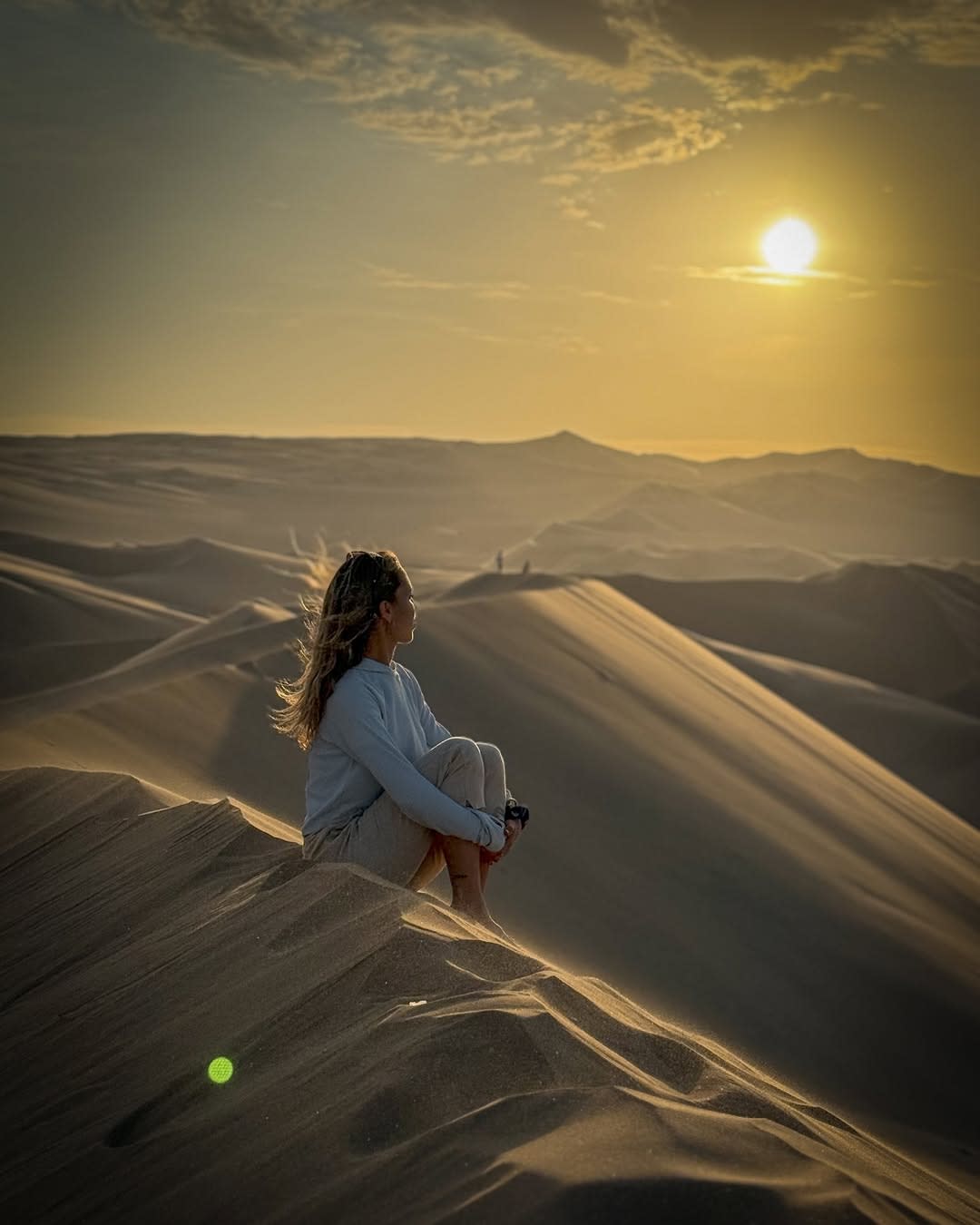
One night in the Ica desert dunes — a properly appointed camp in the sand, real bed and linen and table, dinner served in the dune field, and above it the dark sky of one of the least light-polluted desert environments in the Southern Hemisphere.
By Kada Travel Editorial
The Ica desert at night is one of the few places in Peru where the sky is the main event. Not as a poetic statement about open spaces — as a factual claim about what is overhead when you step out of the tent. The Ica coastal desert is classified as Bortle Class 2 on the light pollution index, meaning the Milky Way is visible to the naked eye in its full band, the Magellanic Clouds (satellite galaxies, visible only from the Southern Hemisphere) are present without optical aid, and the limiting magnitude — the faintest individual stars that can be resolved without a telescope — is above six. This is the sky as a pre-electric civilisation saw it, with the galactic structure of the Milky Way readable as texture rather than just light.
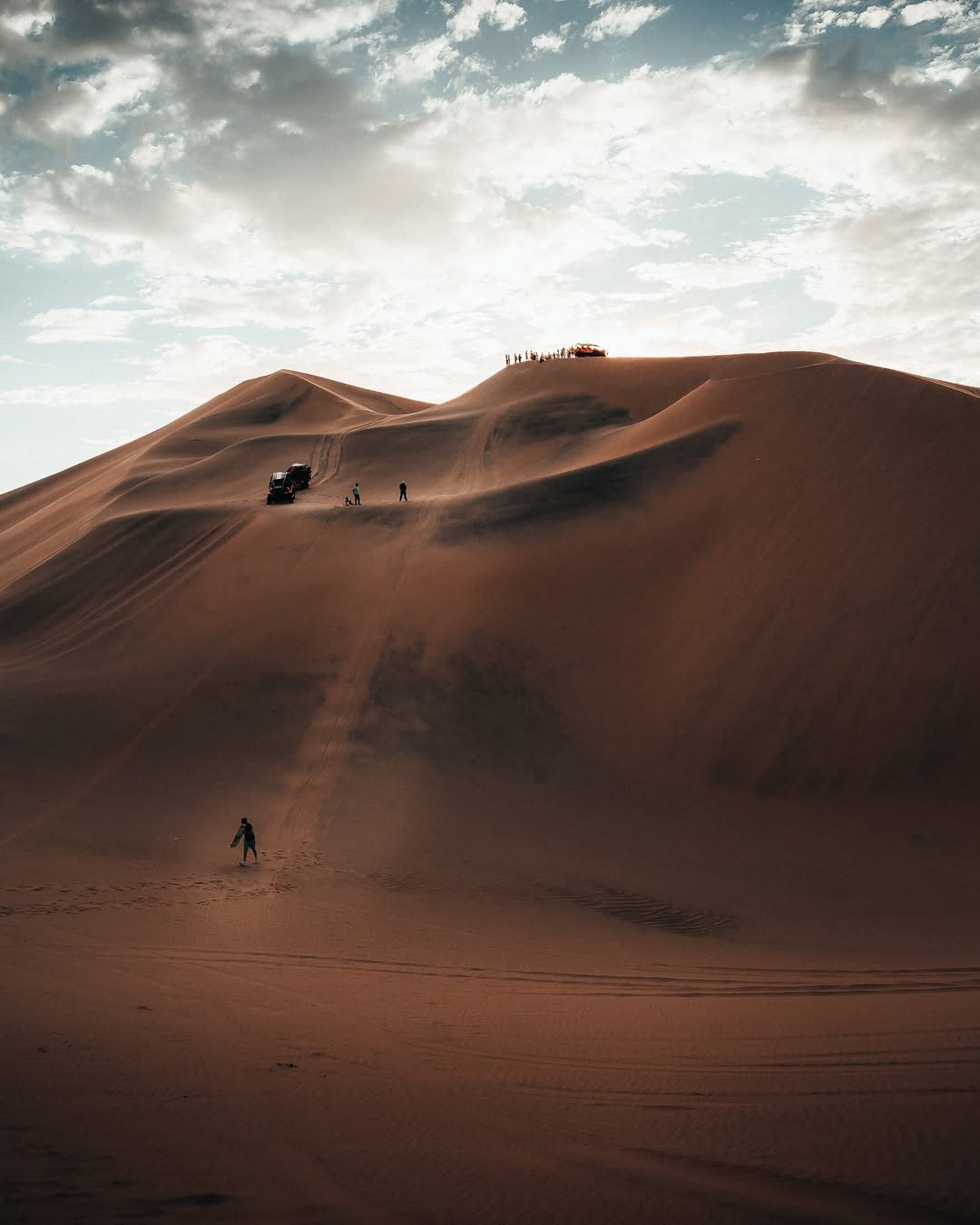
The reason the sky is this dark is the same reason the dunes are this white and the mummies at Chauchilla are this intact: the Ica desert does not have clouds, does not have rain, and does not have cities large enough to produce significant light domes within fifty kilometres of the dune field. The coastal aridity that makes the Paracas and Ica region extraordinary as a daytime landscape makes it extraordinary at night for precisely the same reasons.
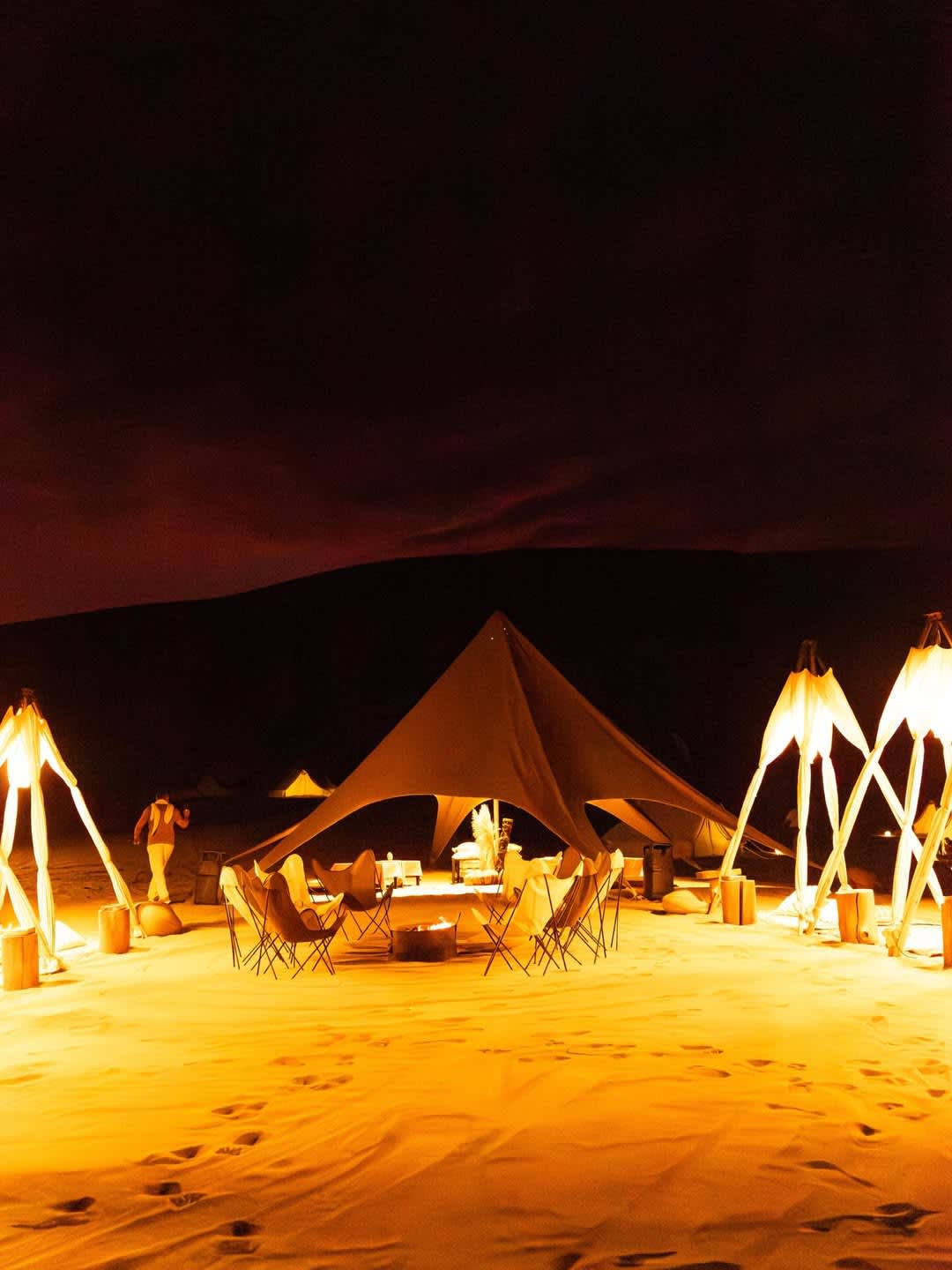
The glamping programme Kada designs in the dunes places a proper camp — real bed frame, mattress, fitted linen, furniture, a dining table — in the dune field at a position the logistics team has selected for visibility, wind exposure, and the specific view of the sky that the terrain provides. The camp is not a fixed installation; it is deployed for the group's specific night and retrieved afterward. The camp team arrives before the guests, sets up the full structure, and prepares the dinner. The guests arrive by 4x4 from Ica in the early evening, typically after the Huacachina afternoon programme, and find a camp that is already complete.
The Dune at Night
The Ica dune field after dark is a different landscape from the same dunes in the afternoon. The wind that shapes the dune ridgelines drops significantly after sunset; the sand surface, which shifts with each gust during the day, stabilises into the forms that the final wind direction produced. The silence that results is exceptional — the sand absorbs sound rather than reflecting it, and without wind, the dune field's acoustic quality is absolute in a way that most natural environments, including the open sea and the high altitude steppe, are not.
The temperature drops sharply after sunset. The desert has no thermal mass beyond the sand itself, which radiates its absorbed heat quickly; by ten in the evening, a clear-sky Ica night is typically between eight and fifteen degrees Celsius depending on the season. The camp is equipped for this: the tent retains body heat, the bedding is appropriate to the temperature range, and the dinner and any post-dinner time outside are served in a way that accounts for the cold. Guests who know they run cold should communicate this at booking; Kada adjusts the insulation accordingly.
The Sky as Curriculum
The Southern Hemisphere sky is not the Northern Hemisphere sky with different constellations. It is a different curriculum, built on different primary landmarks.
The Southern Cross (Cruz del Sur) — four stars forming a cross with a fifth outlier — is the Southern Hemisphere's equivalent of the Pole Star as a navigational reference: it points toward the South Celestial Pole. From the Ica latitude (fourteen degrees south), the Southern Cross is above the horizon for a significant portion of every night year-round. It is the star that appears on the flags of Australia, New Zealand, Brazil, Papua New Guinea, Samoa, and several other southern nations; it is the star the Polynesians navigated by across the Pacific; it is one of the stars the Nasca culture is hypothesised to have used in the alignment of some of the pampa's straight lines.
The Milky Way from the Southern Hemisphere is oriented differently than from the North: the galactic centre — the densest and brightest section of the galaxy, where the central bulge is visible as a concentrated white haze — is not a faint winter backdrop but a dominant summer sky feature. From the Ica desert in June through September, the galactic centre transits nearly overhead; the dark lanes in the Milky Way — the dust clouds that the Inca read as animals (the cosmic llama, the serpent, the toad, the fox) rather than reading the space between stars as constellations — are visible with enough resolution to begin to understand the Andean sky as a different kind of map.
The Magellanic Clouds — the Large and Small, satellite galaxies orbiting the Milky Way at distances of approximately 160,000 and 200,000 light years — are visible from the Ica latitude as two misty patches in the southern sky, easily mistaken for detached sections of the Milky Way. Ferdinand Magellan's crew documented them in their 1519-1521 circumnavigation; they are among the nearest objects in the universe outside our own galaxy. A ten-second exposure on a modern camera reveals their internal star field structure. With the naked eye, they are the most distant objects visible to humans without optical aid.
Dinner in the Field
The dinner is served at the camp's table, set with proper tableware, in the dune field. The menu uses produce sourced the same day from the Ica valley market and the Paracas coast: a cold opening, a warm main appropriate to the cooling air, a simple dessert. Wine and pisco from the valley bodegas. The camp team serves throughout; the logistics of temperature management and service in a field kitchen are handled before the guests arrive.
The specific quality of eating outdoors in the desert at night — the absolute dark beyond the candlelit table, the temperature falling as the meal progresses, the sky overhead accumulating stars as the eyes dark-adapt — is not replicable indoors or in an illuminated garden. The darkness is the condition, and it is available in the Ica desert precisely because the conditions that make it dark are also what the camp is designed around.
Optional astronomy session after dinner: Kada can arrange for a specialist with a portable telescope to join the camp for the post-dinner hours. The session covers the main Southern Hemisphere sky features, the basic techniques for dark-adaptation and star identification, and the Andean astronomical tradition of the dark cloud constellations. This is the option that connects the glamping night to the astronomy programme at Paracas (Article 12) — the Ica dunes and the Paracas coast are both extraordinary sites for this sky, with the dune field offering deeper darkness and the coast offering the additional meteorological stability of the marine air.
What Kada Arranges
The camp deployment team arrives at the dune position in the early afternoon; the full camp — tent, furniture, bedding, kitchen station, dining table — is in place by the time the guest vehicle arrives. Guests arrive at the dune field by private 4x4 from Ica, typically after the Huacachina programme, with luggage for one night transferred separately by the logistics vehicle.
Morning departure: the camp team arrives at dawn to begin the breakdown; guests have their overnight belongings packed the evening before. Transfer to the Ica hotel or onward to Paracas or Nazca is coordinated for mid-morning.
The glamping night works as a one-night intercalation between the Ica valley and Paracas/Nazca sections of the itinerary: arrive from Lima or elsewhere, spend the day at the hacienda and Huacachina, sleep in the dunes, continue to Paracas or Nazca the following morning. This sequence gives the Ica desert its full register — the oasis, the agricultural heritage, the overnight sky — without requiring a second hotel night in Ica.
Expert Perspective
"The question guests ask before the glamping night is usually about comfort: will it be cold, will I actually sleep, what if there's wind. The question they ask after is completely different. The most common thing people say after a night in the dunes is that they didn't expect the silence. Not just quiet — actual silence, with no background ambience, no traffic, no building sounds. And then the sky. Once you've dark-adapted in the Ica desert — after about twenty minutes outside with no light — you see something that most people in cities have not seen in their adult lives. The galaxy. I mean the structure of the galaxy, as an object, overhead. That is what the Ica desert night offers. The bed is comfortable; the sky is the reason."
— Gustavo Arenas, Guest Relations, KADA Travel
A Practical Note
Temperature: the Ica desert night temperature ranges from approximately 8°C to 15°C depending on the season, with the coldest nights in the austral winter (June-August) and the mildest in the summer (December-February). The camp is equipped for the expected temperature range; guests should communicate any specific thermal sensitivity at booking. Sleeping outside the tent is not recommended after midnight for temperature reasons.
Wind: the Ica desert wind drops significantly after sunset, making the early evening the windiest part of the experience. The tent is staked for dune conditions; minor movement from residual wind overnight is normal. Strong wind events that make the tent uncomfortable are rare but possible; Kada monitors conditions in advance and communicates any concern.
Dark adaptation: the quality of the sky experience depends on dark adaptation — the eye's adjustment to darkness, which takes fifteen to twenty minutes and is disrupted by any direct light source (phone screens, torches). The camp uses low-level red lighting to preserve dark adaptation after sunset. Guests should expect to avoid phone screens for the first hour outside; the camp team provides red-filtered torches.
Written by Kada Travel Editorial
Frequently Asked
Yes. The glamping programme is designed as a single-night experience; two nights in the same position would require moving the camp to find fresh dune terrain, which is logistically complex. One night captures the arrival into the desert, the first sky experience, and the dawn departure — all three of the register-changes that make the programme distinctive. Most guests find one night complete.
Ica is one of the driest places on earth — annual rainfall is typically below two millimetres. The probability of rain on any given night in the Ica desert is negligibly small; Kada has no contingency for rain because none has been needed. If extraordinary weather made the camp unsafe, the group would return to the Ica hotel for the night and the camp fee would be refunded.
The camp includes a portable toilet facility, set at an appropriate distance from the sleeping and dining area. It is a clean, functional installation appropriate to one night in a remote setting. Guests with specific requirements should indicate this at booking.
Yes. The optional astronomy session is arranged through Kada in advance; a specialist with portable telescope equipment joins the camp at the agreed time. The session runs one to two hours after dinner, covering the Southern Hemisphere primary sky features and the Andean astronomical tradition. The specialist leaves the camp at midnight; the rest of the night is for sleeping.
Design Your Journey
Design your bespoke Peru journey
We talk. We listen. Then we design an itinerary that belongs only to you.
Start Planning