Unfolded· 8 min read·11 July 2026
The Lunch That Has a Day of the Week
A private midday meal in a traditional Arequipa picantería, with the picantera who has cooked the same plates for decades — the rotating calendar, the clay pots, the chicha de jora, and the dish that does not appear on any other day.
By Kada Travel Editorial
The picantería is not a restaurant. Visitors who arrive expecting a restaurant — with a printed menu, a range of options, and the general principle that you can order what you want when you want it — will need to revise their expectations before the meal begins. The picantería operates by a different logic, one that is several centuries older than the restaurant as a concept.
A picantería is an institution. It was established in colonial Arequipa as a place where women — the picanteras — cooked and sold food and chicha, the fermented maize beer that Andean populations had produced since pre-Inca times. The colonial authorities periodically attempted to regulate, tax, or suppress picantería activity; the picanteras operated anyway, in houses and courtyards and eventually in purpose-built structures that preserved the domestic cooking logic while accommodating a larger clientele. By the nineteenth century the picantería had become the distinctive gastronomic institution of Arequipa — the place where the city's food culture resided, where the specific techniques and recipes of arequipeña cooking were maintained, and where the social mixing that a shared lunch in a good place produces had been happening, continuously, for several generations.
The institution is specifically arequipeña. There are no picanterías in Lima that are the same thing; there are no picanterías in Cusco in this specific form. The closest parallel in Peruvian food culture is the cevichería of the coast, which also has a particular social function and a particular product logic — but the picantería's combination of domestic cooking tradition, weekly calendar discipline, and the authority of the picantera has no direct equivalent anywhere else in Peru.
Most visitors who come to Arequipa eat arequipeña food — and eat it well, at restaurants that represent the tradition competently and serve it with genuine knowledge. What they do not encounter is the picantería as it operates for the families and neighbourhood regulars who have eaten there across generations: the same picantera, the same weekly calendar, the same accumulated judgment applied to the same ingredients in the same kitchen. The version Kada arranges is access to that institution as it functions for the people it was built for — not the restaurant approximation of it.
The Calendar
Each day of the week has its dish. This is not a historical curiosity; it is how picantería cooking works today, in the establishments that have maintained the tradition. Monday is chaque — a thick stew of dried corn (maíz mote) with pork, lamb, or beef, flavoured with ají panca and dried herbs. Tuesday is chairo — a stew of freeze-dried potato (chuño) with dried meat and vegetables, a dish whose technique of freeze-drying is pre-Inca, from the high-altitude communities where temperature variation could be used to dehydrate and preserve. Wednesday is chochoca — fresh corn stew, distinct from chaque in that it uses green or semi-dry corn rather than the dried mote. Thursday brings menestrón — Arequipa's version of minestrone, arrived via Italian migration in the nineteenth century, made with pork, cabbage, chickpeas, and a density of herbs and vegetables that has become thoroughly arequipeño over generations. Friday is chupe de camarones: the cream shrimp chowder that is the most celebrated and most technically demanding of the picantería's repertoire, built from Majes river camarones (Cryphiops caementarius, a freshwater shrimp endemic to the river basins of southern Peru), yellow ají, potato, corn, milk, egg, and queso arequipeño, cooked slowly and unified into a dish of considerable complexity. Saturday is adobo: pork ribs or shoulder marinated overnight in chicha de jora, ají panca, garlic, and cumin, then slow-cooked in a clay pot until the chicha has reduced and the pork has absorbed the fermentation's specific acidity. Sunday is variable — pebre (a spiced broth) or caldo blanco, the reset before the week begins again.
The logic of the calendar is practical: different cuts of meat, different techniques, different cooking times. The picantera has planned her week as a whole, not as a series of individual meals. The choque marinade begins on Friday night for the Saturday adobo; the chuño for Tuesday's chairo must be rehydrated from Thursday; the camarones for Friday's chupe arrive from Majes on Thursday morning. The calendar is a cooking system.
The picantera navigating this system is not following a recipe that could be handed to someone else — she is executing a week's worth of decisions that began on Thursday evening and will not resolve until Sunday's caldo blanco. To arrive at the table without understanding this sequence is to arrive in the third act of a performance that has been running since last week.
The Picantera
The authority in a picantería is the picantera. In the best-established picanterías, the knowledge is transmitted matrilineally — from mother to daughter, occasionally to niece or granddaughter, but rarely outside the family. This is not a formal apprenticeship with a documented curriculum; it is absorption, observation, repetition, and correction over years of proximity to the cooking. The recipes are not written. The techniques are not demonstrated as a teaching exercise; they are watched and internalised over the course of working alongside the picantera in the kitchen, beginning young.
The specific knowledge that the picantera holds is not replicable from cookbook research. The calibration of chicha de jora in an adobo — how much, how reduced, how the reduction interacts with the ají panca and the specific cut of pork — is a judgment she has made thousands of times, adjusted for the strength of the current batch of chicha, the fat content of this week's pork, the temperature of the day. What she produces tastes the same as what her mother produced, and what her grandmother produced before that, because the calibration is continuous and empirical. It cannot be reproduced exactly by someone who has not spent years inside that specific kitchen.
The private lunch Kada arranges includes time with the picantera herself — not a presentation or a formal explanation, but the ordinary conversation that happens when a person who takes food seriously is given time to talk about their work to guests who are genuinely interested. The picantera will explain her calendar, the sourcing of specific ingredients (the camarones, the rocoto, the chicha she either makes or sources from a specific producer), the differences she observes between her cooking and what other picantería establishments produce, and whatever else her own interests and the conversation naturally arrive at.
Rocoto Relleno — The Identity Dish
Every meal in a traditional picantería includes rocoto relleno as a standard presence. The rocoto (Capsicum pubescens) is a chili pepper native to the Andean highlands — substantially hotter than most commercial peppers, with thick walls, black seeds, and a fruity flavour that survives cooking better than the heat does. The arequipeño rocoto relleno is not simply a stuffed pepper: it is a technique for managing the pepper's heat while preserving its character, combined with a specific filling and a specific cheese, producing a dish whose flavour profile is fundamentally arequipeño and not reproducible with a substitute ingredient.
The technique: the rocoto is boiled multiple times (two to three changes of water) to reduce the capsaicin content to a manageable level while preserving the structural integrity of the pepper wall. It is then stuffed with ground beef cooked with onion, garlic, raisins, olives, and egg, packed tightly, topped with a slice of queso arequipeño (a semi-firm local cheese with specific salinity), and baked until the cheese colours and the pepper wall softens. Served alongside pastel de papas — a gratin of potato and queso arequipeño that functions as the starch and dairy counterpart to the pepper's heat.
The picantera's rocoto relleno is not a recipe that was ever written down. It was calibrated to the specific heat level of her local rocoto supply, the specific salinity of her cheese supplier, and the specific fat content of the beef she uses. These calibrations are invisible to a guest who has not eaten the dish many times from many different makers. They are visible to the picantera's extended family, who can tell immediately whether the filling ratio is right.
The Kada lunch is the occasion for guests to be shown what the family already knows — by the person for whom those calibrations have become, over decades, a form of precision she can no longer fully separate from instinct.
What Kada Arranges
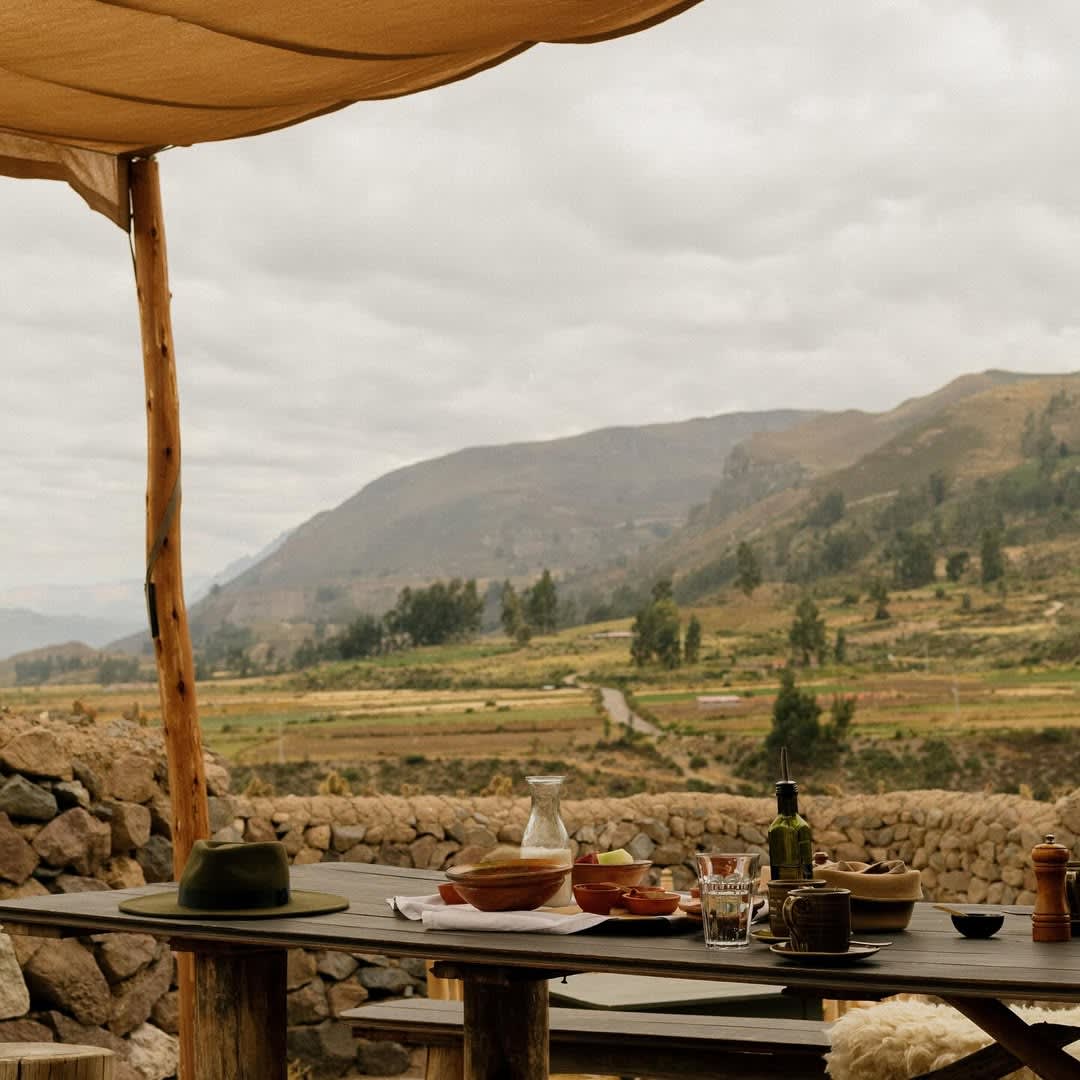
The access point is the picantera herself. Kada does not book a table in a restaurant that serves arequipeña dishes — we arrange time with a picantera with whom we have a direct relationship: a woman who has cooked the same weekly calendar for decades, in the same kitchen, with the same sourcing network, adjusting the same calibrations to the same ingredients year after year. What she offers the visit is not a demonstration or a presentation. It is a conversation about her work with guests who are genuinely there to listen: how the calendar functions as a cooking system, where the camarones come from and why that specific provenance matters, what makes the adobo on this Saturday the product of decisions that began on Friday night.
Kada selects the day based on the guest's itinerary and the picantera's availability — the calendar matters because it determines what is being cooked, and the experience of the Friday chupe de camarones or the Saturday adobo is different in kind from any other day's offering. The arrangement includes: the lunch itself (two to three courses, the day's programme, with rocoto relleno as a constant), chicha de jora, and the picantera's time during and after the meal. Lunch begins between 12:30 and 1:00 PM — the kitchen at full production, the dishes at their best — and lasts approximately two hours.
Expert Perspective
"I have eaten in picanterías in Arequipa my entire life. What I notice, every time, is that the quality of the dish on a given day is not random — it is the product of everything the picantera has been doing since the previous Thursday, or since last Friday, or since Saturday morning when the chicha went in. The adobo is not good because she is a good cook. It is good because the chicha was made correctly, the pork was the right cut, the ají panca was from the right harvest, and she made the same judgment about the heat and the reduction that she has made a thousand times before. That accumulation of judgment is not something you can hire or import or replicate. It exists in that kitchen, in that person, and nowhere else."
— Daniel Ramos, Co-Founder & CEO, KADA Travel
A Practical Note
The calendar matters: The most celebrated dish in the picantería rotation is the Friday chupe de camarones. The Saturday adobo is the most emblematic of arequipeño cooking. Kada recommends guests who have flexibility in their schedule plan the picantería visit to coincide with one of these two days. The other days produce excellent food; they are less likely to produce the dish that remains most present in memory.
Spice level: Arequipeña cooking is substantially hotter than most Peruvian cooking encountered in Lima or Cusco. Rocoto relleno at a traditional picantería is genuinely spicy. Guests with low capsaicin tolerance should inform Kada in advance; the picantera can prepare the filling with a reduced heat version in most cases, though she may have opinions about this.
Chicha de jora: The fermented maize beer served at picantería lunches is mildly alcoholic — lower alcohol than wine, with a slightly sour and earthy flavour that is specific to the arequipeña chicha tradition. Non-drinkers can request water or other non-alcoholic alternatives; chicha is not compulsory.
Group size: The private lunch format works best for two to four guests. Larger groups can be accommodated with advance coordination; the intimacy of the picantera's presence and the domestic cooking context works less well for groups over six.
Written by Kada Travel Editorial
Frequently Asked
The picantería serves what it has cooked that day, based on the weekly calendar, in the quantities it has prepared. There is no menu in the restaurant sense; there is a day's offering, and the guest eats that. The picantera's authority is absolute — she does not adjust her cooking to what the guest prefers; the guest's experience is to encounter what she has made. An arequipeña restaurant offers arequipeño dishes on a printed menu with choices and substitutions. The two experiences are not equivalent. Kada's access to a traditional picantería for a private lunch is not the same as a booking at an arequipeño restaurant.
In the traditional institution, yes. The role is gendered and has been so for the entirety of the picantería's history. There are male cooks who work in establishments that use the name "picantería," but the traditional institution is defined by the picantera — the woman cook — whose authority and knowledge define the establishment. Kada's partner picanterías are those where the traditional model is maintained.
Chicha de jora is a fermented beverage made from jora — maize that has been allowed to sprout (malted) before being dried, ground, cooked, and fermented. It is the pre-Columbian fermented drink of the Andes, still produced and consumed throughout highland Peru. The arequipeña version is darker and more acidic than chicha produced in the Sacred Valley of Cusco; the fermentation is also used as an ingredient in cooking, specifically in the adobo. Alcohol content varies by producer and fermentation duration but is generally in the range of 1–3%.
At Kada's partner picantería, brief time in the kitchen can sometimes be arranged — this is at the picantera's discretion and is not guaranteed. The cooking happens in the early morning, so the kitchen visit (if it occurs) would be before the regular service, which is a separate arrangement from the lunch itself. For guests whose primary interest is the cooking process, Kada recommends the cooking class experience (Art. 5) as the primary culinary experience, with the picantería lunch as the complementary traditional context.
Design Your Journey
Design your bespoke Peru journey
We talk. We listen. Then we design an itinerary that belongs only to you.
Start Planning