Unfolded· 7 min read·9 July 2026
A Private Jarana in Barranco
An evening of Afro-Peruvian music in a private courtyard — the cajón, the landó, and the tradition Lima invented and then nearly forgot.
By Kada Travel Editorial
The cajón was invented in Lima. This is not a claim in the Peru-Chile style — it is documented, accepted, and specific. Enslaved Africans brought to Peru's coast by Spanish traders found their drums confiscated by colonial authorities, who associated percussion with religious ceremony and feared what they could not control. What the community built instead, from the wooden crates and shipping boxes available on Lima's docks, was a box: a hollow resonating chamber you sit on and strike with your palms. The cajón. The instrument is now used in flamenco, in jazz, in music schools on every continent. Its origins are in the Afro-Peruvian necessity of making a drum from what the colonial order left available.
The private jarana we arrange in a Barranco courtyard begins with the cajón. It ends, two hours later, with something that our guests consistently describe as one of the most unexpected evenings of their travels — not because of spectacle, but because of presence.
What Lima Made
The music that arrived with the enslaved Africans brought to Peru's coast between the sixteenth and nineteenth centuries was not a single tradition. The communities that reached Lima came from West Africa — from the regions that produced the Yoruba, the Mandinga, the Bran, and others — and each carried different rhythmic vocabularies, different call-and-response patterns, different relationships between percussion, melody, and movement. What emerged in Lima over three centuries of adaptation to a coastal city, to the Spanish colonial structure, and eventually to independence and the republican era, was a distinct musical tradition: criolla and Afro-Peruvian music, two overlapping genres that share a genealogy and diverge in emphasis.
The landó is the root: a slow, weighted rhythm with West African antecedents, built on the cajón's bass and slap tones, with a guitar line that circles rather than drives. The festejo is its faster relation — a celebratory rhythm with handclapping (palmas) that lock into the cajón's pattern, a voice that declaims rather than sustains, and a physical immediacy that is difficult to be near without responding to. Música criolla — the broader tradition of coastal Peruvian popular song — encompasses both, alongside the vals criollo (the Peruvian waltz, descended from the European waltz but transformed in Lima into something rhythmically distinct) and the marinera, Peru's national dance, which carries the Afro-Peruvian and Spanish traditions in its two hands.
This music was nearly lost. By the mid-twentieth century, Lima's cultural establishment — oriented toward European and North American models — had largely marginalised the Afro-Peruvian tradition. The recovery came from within the community: artists and researchers who documented, performed, and preserved what the elite Lima institutions had overlooked. Chabuca Granda — the Lima-born composer whose La Flor de la Canela and Lima de Veras are the canonical texts of criolla music — was central to this recovery, bringing Afro-Peruvian rhythmic structures into the mainstream of Limeño song. The tradition she helped salvage is what the cajón player in the Barranco courtyard carries in his hands.
The Evening in the Courtyard
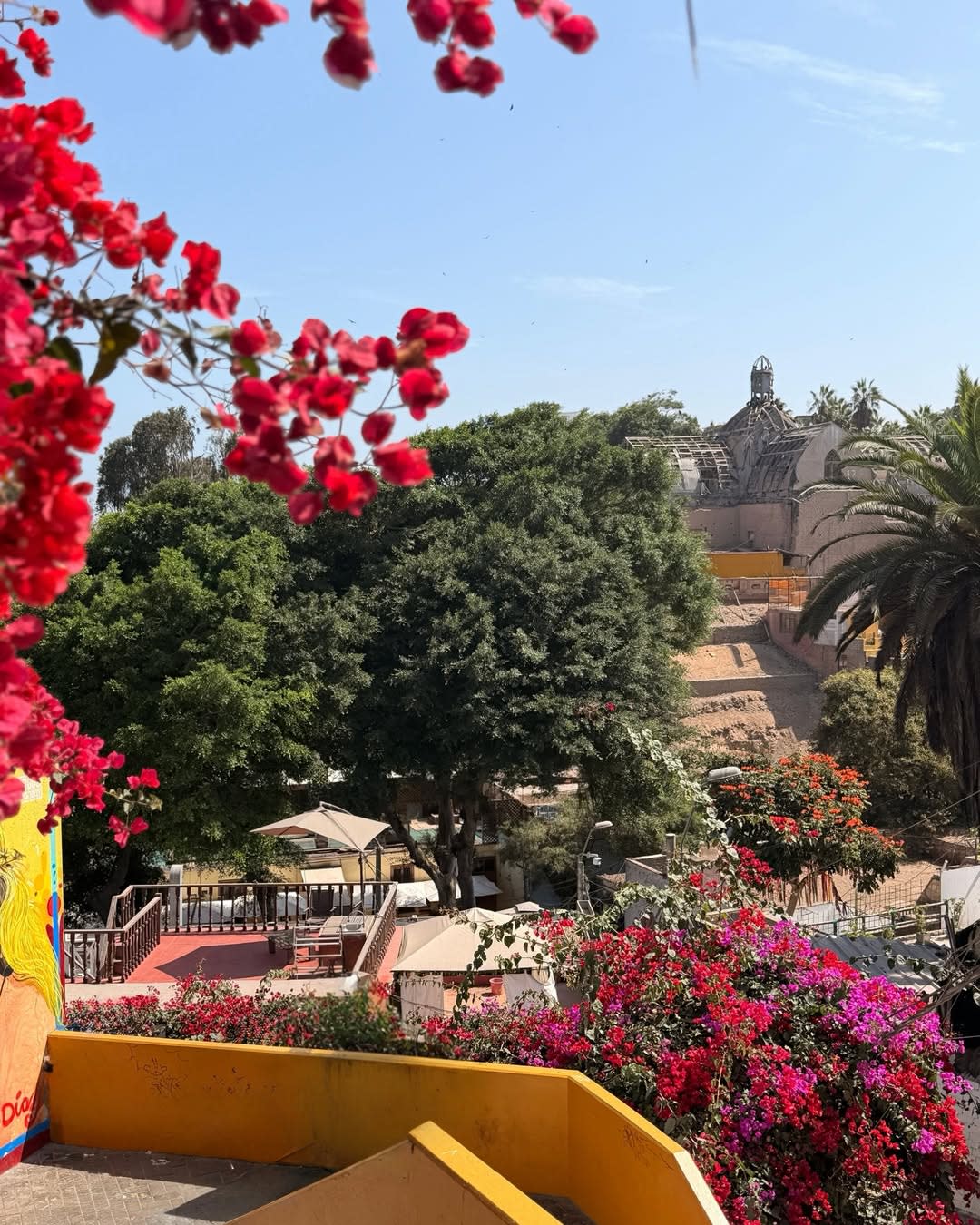
The venue is a private Barranco courtyard — a space that belongs to the kind of Lima house that still has interior gardens, colonial walls, and the acoustic particular to stone and bougainvillea: warm, direct, close. Not a stage. Not a restaurant with a performance section. A courtyard where the musicians set up, the chairs are arranged close, and the evening begins when it begins.
The ensemble is three: a cajón player, a guitarist, and a singer — sometimes two singers, when the arrangement calls for the pregón y respuesta (call and response) structure that the landó requires. The musicians we work with are professionals — conservatory-trained, with active careers in Lima's music scene — whose relationship to the Afro-Peruvian tradition is biographical as well as technical. The cajón player's family connection to the tradition goes back generations; the guitarist teaches at the conservatory and arranges contemporary Peruvian music for international festivals. They are not performing for tourists. They are playing for an evening, in a courtyard, for a small group who have been told what they are about to hear.
The two hours move through the tradition's main forms: landó, festejo, vals criollo, marinera. The musicians explain, briefly, what each form is and where it comes from — enough context to hear what is happening without substituting description for sound. At some point in the evening, the explanation stops and the music simply runs, which is the correct direction of travel.
What Kada Arranges
The private jarana is arranged in Barranco on evenings we confirm in advance with the musicians — typically Thursday through Saturday, when the ensemble is not committed to other performances. We arrange the courtyard, the seating, and a pre-performance dinner at one of Barranco's smaller restaurants so our guests arrive at the evening having already spent time in the neighbourhood's atmosphere.
The musicians we work with are permanent collaborators, not contracted guides. Their participation in the jarana reflects their genuine engagement with the tradition — they choose the repertoire, they control the pace, and they end the evening when the music is done rather than when a running time is up. This means the evening is occasionally shorter than two hours and occasionally longer. Our guests are told this at the briefing.
For guests with professional backgrounds in music — particularly those from traditions adjacent to Afro-Peruvian music (West African, jazz, flamenco, Brazilian popular music) — we arrange an extended evening that includes a more technical conversation with the musicians about the rhythmic structure of the cajón patterns and the relationship between the Afro-Peruvian tradition and those adjacent forms. This version of the evening is as much a musicological dialogue as a performance.
Expert Insight
"What I tell our guests before the jarana is: the first fifteen minutes, you will be listening as a visitor. After that, something changes. You stop categorising what you're hearing and you just hear it. That's when the music is actually doing what it's supposed to do. Every evening I've been in that courtyard, I've watched that happen — the exact moment when a guest stops being an audience and becomes a witness."
— Katherine Cjuiro, Founder & Travel Director, KADA Travel
A Practical Note
The Barranco courtyard is an open-air space. Lima's evenings are cool year-round — temperatures drop to 14–17°C at night in the winter months (June–September) and remain mild in the summer. We recommend a light layer regardless of season. The evening begins at eight and runs to approximately ten; we arrange transportation back to Miraflores hotels at the close.
The jarana is an intimate experience. The ensemble is three people; our guests are typically two to six. The music is not amplified — it is acoustic, in a stone courtyard, at close range. This is what makes it different from a concert and what makes the scale feel correct. Guests who arrive expecting a show find an evening instead, which is the intended distinction.
For guests whose Lima visit includes dinner at Central or Kjolle in Barranco, we schedule the jarana on a different evening — both experiences are better when they are not competing for attention on the same night. For guests whose visit does not include a Barranco dinner, the pre-performance meal we arrange at a neighbourhood restaurant provides the transition from the city to the courtyard.
Written by Kada Travel Editorial
Frequently Asked
The *jarana* is performed in Spanish, and the musicians offer brief explanations of each form in Spanish and English. But the music does not require linguistic comprehension — the rhythmic and melodic content carries the emotional information. Guests who speak no Spanish consistently find the evening as complete as Spanish speakers. The lyrics of the *vals criollo* and *landó* are translatable, and we provide written translations in our pre-visit briefing for guests who want to follow closely.
No. The musicians who work with us perform on Lima's concert and festival circuit and play the *jarana* in its traditional function — a private musical gathering, not a stage show for paying audiences. The distinction is audible within the first few minutes: the music is not adjusted for foreigners, the pace is not theatrical, and the evening ends when it ends rather than when a script concludes.
We arrange the *jarana* for guests aged fourteen and above. The music is not inappropriate for younger children, but the format — a two-hour evening gathering with acoustic music, at night, in a private courtyard — requires a level of sustained attention that we find works better with teenagers and adults.
El Carmen, in Chincha province approximately four hours south of Lima, is the most important centre of Afro-Peruvian musical practice outside the capital — home to master *cajón* players, the annual Festival Negro, and communities whose connection to the tradition goes back directly to the enslaved Africans who were brought to work the cotton and sugarcane haciendas of the Ica Valley. We arrange visits to El Carmen as part of a Lima-to-Paracas journey for guests whose interest in the Afro-Peruvian tradition extends beyond the single evening.
Design Your Journey
Design your bespoke Peru journey
We talk. We listen. Then we design an itinerary that belongs only to you.
Start Planning