Destinations· 9 min read·5 December 2024
Arequipa, the White City: A Premium Two-Day Guide
Sillar, monastery, picantería and volcanoes — how to read Arequipa without falling into the tourist script.
By Kada Travel Editorial
The first thing you notice in Arequipa, before the colonial architecture or the volcanoes ringing the city, is the light. It falls in a straight line on white stone —sillar, a volcanic tuff from El Misti— and produces, at five in the afternoon on any dry day, a phosphorescent white that no other South American colonial city has. That is why it is called the white city, and why it is better understood from the air than from the street.
The city was founded in 1540 by Garcí Manuel de Carbajal, in a valley at 2,335 metres between three volcanic cones —El Misti, Chachani and Pichu Pichu. The altitude matters: below three thousand metres, no altitude sickness; above Lima, already Andean light. It is, geographically, the transitional city between coast and highlands. That is why we always recommend two nights: one for the body, one for the city.
Day one: the monastery and the centre
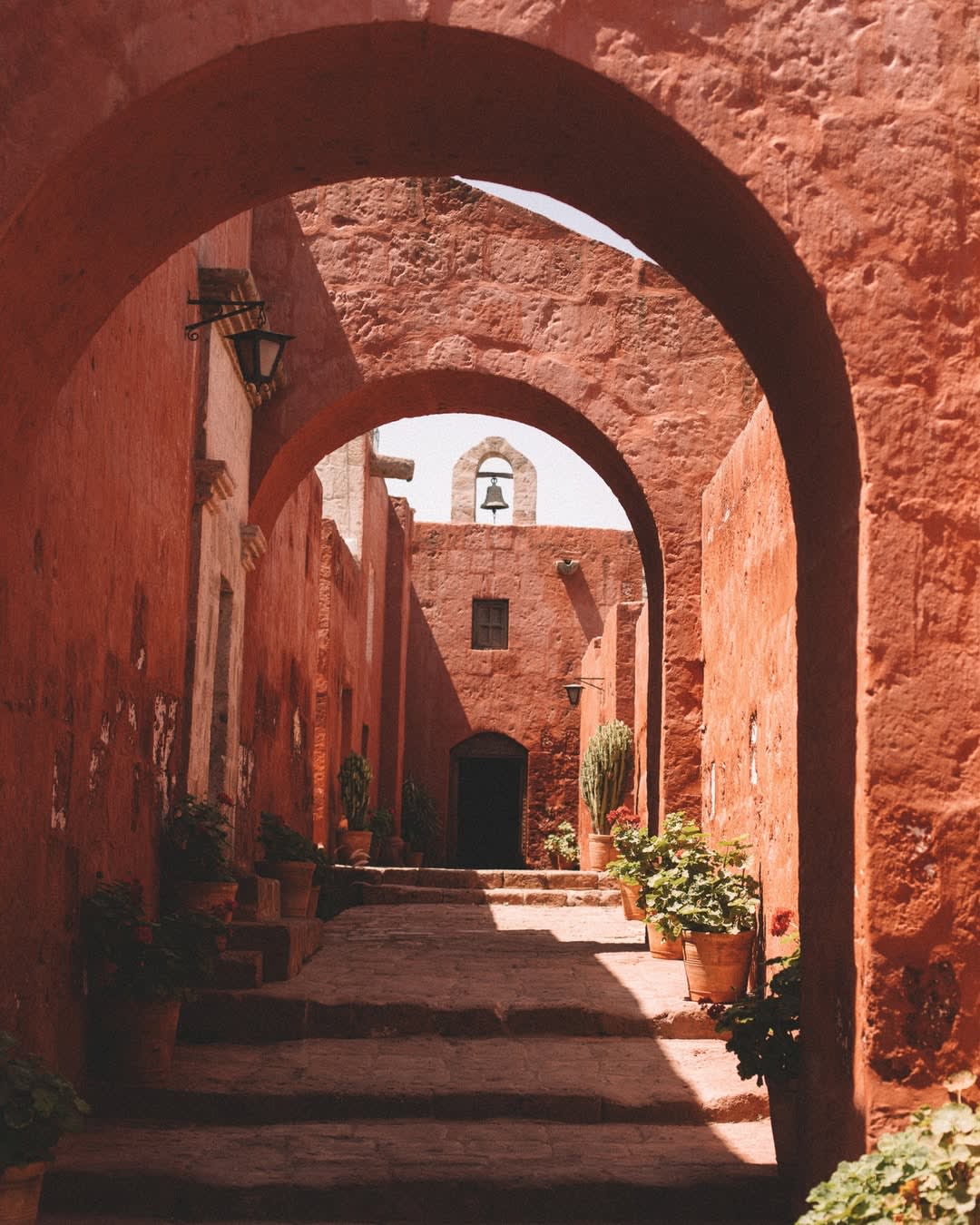
Day one enters through the Santa Catalina monastery. Twenty thousand square metres of monastic citadel founded in 1579 by Doña María de Guzmán, an encomendero's widow, for second daughters of the local nobility who could not inherit but could enter the convent with dowry. For three centuries up to four hundred nuns lived there in absolute enclosure —cooking, weaving, praying, no contact with the outside. The citadel has streets, squares, laundries, dining rooms, individual cells, chapels. Walking it feels like visiting a small Spanish town transplanted to the sixteenth century, lit by Peru's whitest light.
We always recommend the private guided visit —two hours, with a local guide— rather than the free walk. Without a guide, the cells look the same and the inner labyrinth disorients. With a guide, the history orders itself: the difference between novice cells (austere, shared) and professed nuns' cells (private, with their own kitchen, slaves), the nineteenth-century reforms that opened the monastery to the public, and the present-day coexistence with the thirty nuns still living in a cloistered section.
After the monastery, lunch at La Nueva Palomino, in the Yanahuara neighbourhood. It is the most respected traditional picantería in the city, open since 1893. Arequipa cooking in its uncompromising version: rocoto relleno with paria cheese, ocopa arequipeña, pork adobo, soltero de queso. The picantería —wooden tables, checkered tablecloth, pisco as aperitif— is the institution that best survives from Republican Arequipa. Eating here is the gastronomic experience travellers remember on returning home.
In the afternoon, walk the historic centre. Plaza de Armas, one of the best-preserved in Peru; the Cathedral, with its 1844 neoclassical facade after three earthquakes; the Compañía Church, with its seventeenth-century baroque portico in carved sillar; and the Casa del Moral, an eighteenth-century colonial mansion open to visit, with its original two-hundred-year-old mulberry tree in the courtyard. Close the day with a cocktail on the Casa Andina Premium rooftop —direct view of El Misti at sunset.

Day two: Yanahuara, museums and viewpoint
The second day begins in Yanahuara, the neighbourhood across the Chili river, founded by Indigenous farmers in 1750 and today preserving the best-kept historic core of Arequipa. The Yanahuara Plaza and viewpoint —with El Misti perfectly framed by sillar arches carved with hymns to the city— is the definitive postcard. We recommend arriving at eight in the morning, before the groups.
Then, two museums worth visiting. The Museo Santuarios Andinos houses Juanita, the fourteen-year-old Inca girl sacrificed on Mount Ampato around 1470 and discovered in 1995 by Johan Reinhard at the rim of an erupting Sabancaya. The mummy, perfectly preserved by the volcano's cold, sits in a climate-controlled glass case. The museum is small —forty minutes— but the visit stays. The Casa-Museo Mario Vargas Llosa, on Calle Parra, is the house where the Nobel Prize was born in 1936; preserved as a small literary museum, it deserves twenty minutes for readers.
For day-two lunch we recommend Chicha by Gastón Acurio, in the courtyard of a Republican mansion downtown. It is the refined version of Arequipa cooking —deconstructed rocoto relleno, ocopa with quinoa, pumpkin locro in deep Pucará-ceramic plate. Different from La Nueva Palomino on day one, complementary.
In the afternoon, visit the San Lázaro neighbourhood, the city's oldest —the core that existed before official foundation. Cobblestone streets, white tile-roofed houses, a sixteenth-century church. Then return to the hotel via Puente Bolognesi (an 1882 French construction over the Chili) and dinner at Zig Zag, the volcanic-stone steakhouse that is a city institution.
Arequipa is not Cusco with less altitude. It is a mestizo republic that never wanted to be part of Peru —the Peru that does not yet accept Lima, the highlands or the coast.
Kada Travel
Where to sleep: three options
Cirqa Relais & Châteaux is Arequipa's most considered hotel. In a sixteenth-century mansion restored with original sillar walls, eleven rooms, library, restaurant with tasting menu. The only Relais & Châteaux member in southern Peru, and the most expensive. For two nights, worth what it costs.
Casa Andina Premium Arequipa occupies the former Recoleta monastery. Fifty-eight rooms, three colonial courtyards, restored chapel, library. The intermediate option: real colonial architecture, international service, reasonable prices.
Casa de Cantabria, a nineteenth-century Republican house with twelve rooms, is the most intimate boutique option. No on-site restaurant (Yanahuara is five minutes on foot), with courtyard café and homemade breakfast. Recommended for couples who want atmosphere over service.
How to combine it
Arequipa pairs inevitably with the Colca Canyon: four hours by private car, two nights in Colca, return to Arequipa for two more, flight to Cusco or back to Lima. Total six or seven days from Arequipa.
For the full Peru trip, the natural sequence is: Lima (2-3 nights) → Arequipa (2 nights) → Colca (2 nights) → back to Arequipa (1 night, optional) → flight Arequipa-Juliaca and transfer to Puno (2 nights on Titicaca) → flight Juliaca-Cusco (4 nights Cusco-Valley-Machu Picchu). Total fourteen or fifteen days. The complete southern Peru trip.
One final note about Arequipa: the city is the only one in Peru with its own accent, its own national dessert (queso helado, a mix of milk, cinnamon and coconut frozen in copper moulds), and a separatist movement latent since independence. Arequipeños call themselves citizens of "the independent republic of Arequipa". The phrase is a local joke but the pride is real. And it shows: the traveller who spends two days here understands, on returning to Lima, that Peru is a country of regions, not a uniform nation. That lesson alone justifies the stop.
Written by Kada Travel Editorial
Frequently Asked
No. At 2,335 metres it does not cause altitude sickness in healthy people. It is the ideal altitude to prepare the body before Cusco (3,400) or Colca (3,700 at lodging, 4,910 at the condor viewpoint).
Two nights minimum, three optimal. Two nights leave a full day in the city and a morning for Yanahuara. Three nights allow an additional day for a campiña excursion or a Sachaca/Tiabaya picantería.
Yes. LATAM, Sky Airline and JetSmart fly daily from Lima (1h 25min) and from Cusco (50min). Rodríguez Ballón airport is 25 minutes from the centre.
May to October: dry season, guaranteed sun, cool nights. November to March is rainy —not torrential but daily. April is excellent: drying, sun, green landscape after the rains.
The historic centre, yes, until eleven. Yanahuara, yes. San Lázaro, yes but less lit. Other neighbourhoods outside the tourist core, we do not recommend. For dinner outside the centre, taxi or transfer.
For experienced mountaineers, yes: El Misti can be climbed in two days with a professional guide from base camp at 4,500m. For general travellers, the view from Yanahuara or the hotel rooftop is enough. The volcano is the city's postcard, not necessarily the destination.
Design Your Journey
Design your bespoke Peru journey
We talk. We listen. Then we design an itinerary that belongs only to you.
Start Planning