Culture & Stories· 8 min read·12 January 2025
Moche and Chimú Cultures: The Northern Civilisations That Preceded the Incas
A thousand years of ceramics, gold and war before the Inca Empire — the other history of pre-Hispanic Peru.
By Kada Travel Editorial
The Inca Empire lasted 95 years (1438-1533). Before it, on Peru's northern coast, two civilisations flourished for 1,300 combined years: the Moche (200-700 CE) and the Chimú (1100-1470 CE). Their art, architecture and social complexity rival or surpass the Incas. The cultural omission —few travellers visit the archaeological north— is unjustified. This guide describes both civilisations to understand complete pre-Hispanic Peru.
The Moche (200-700 CE) — masters of ceramics
The Moche culture (also called Mochica) occupied current Peru's northern coast, from Lambayeque to Casma valley. Their capital was near current Trujillo, at sites today called Huaca del Sol and Huaca de la Luna.
Four exceptional contributions:
First, portrait ceramics. The Moche are the only ones in pre-Columbian Americas creating individual ceramic portraits (not stylisations). Each "huaco retrato" vessel is the real face of a specific person with anatomical details: wrinkles, smallpox marks, scars, expressions. More than 1,000 portrait huacos survive today.
Second, narrative iconography. Moche ceramics tell stories: rituals, battles, mythological scenes, sexuality, daily life. It is like having "photographs" of the culture. The famous "Sacrifice Ceremony" (scene reproduced on hundreds of vessels) shows the Moche rite in precise detail.
Third, hammered metalwork. The Moche were the first Americans to master gold and silver work without moulds, only with hammering and soldering. The Lord of Sipán's funerary trousseau (discovered 1987) is example: 70-bead gold and silver necklace, funerary mask with turquoise inlays, 30 cm gold sceptre.
Fourth, monumental adobe architecture. Huaca del Sol (60 metres high, 320 metres long) and Huaca de la Luna (120 metres high, 230 metres long) are the two largest adobe pyramids of the Americas. Built with 100+ million individual adobes.
The Lord of Sipán — the discovery of the century
In 1987, Peruvian archaeologist Walter Alva received notice of huaqueros (illegal looters) seeking to plunder a tomb at the Sipán site. Alva arrived days earlier and found the tomb intact: the "Lord of Sipán", Moche ruler of approx. 700 CE.
The funerary trousseau is exceptional:
More than 2,000 pieces of gold, silver, copper, turquoise, lapis lazuli, sea shells and ceramics.
The ruler himself: 1.65 metres, 35-40 years old, military rank evidence.
Tomb companions: 2 women (consort and secondary wife), 3 armed guards, 1 dog, 1 child, 1 priest.
The discovery revolutionised Peruvian archaeology. Comparable in importance to Tutankhamun (Egypt) or Xi'an terracottas (China).
Today exhibited at Royal Tombs of Sipán Museum in Lambayeque, one of Peru's most impressive cultural institutions.
The Chimú (1100-1470 CE) — masters of mud
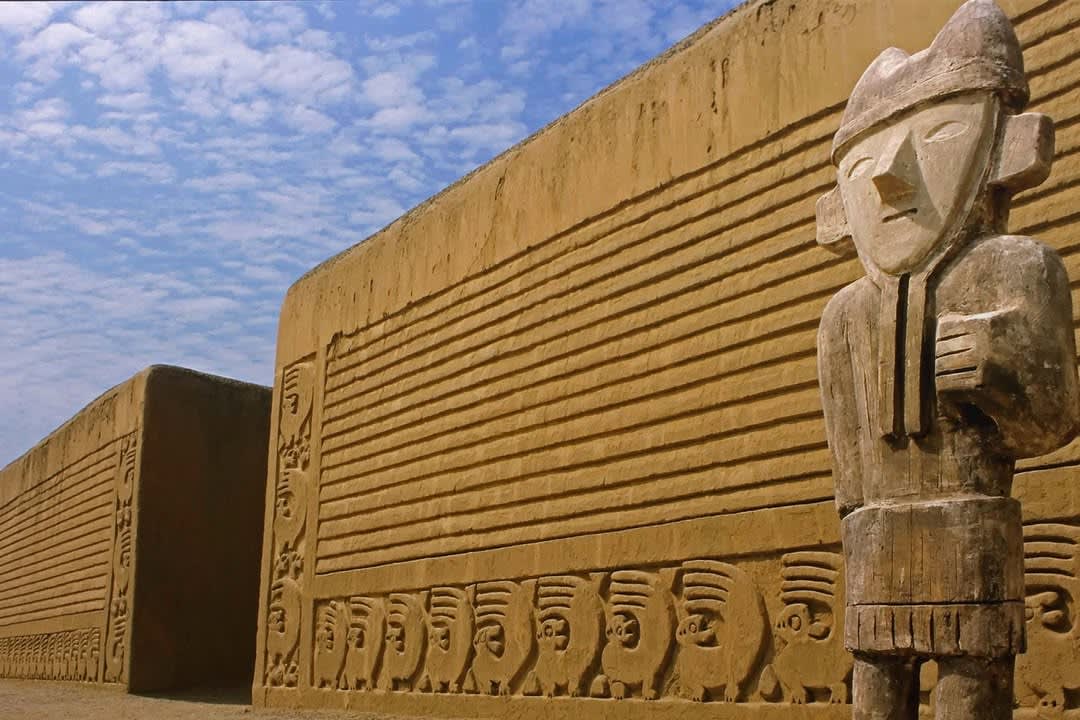
After the Moche, another culture emerged in the same region: the Chimú. Their capital, Chan Chan, was the largest mud city of the Americas: 28 km² area, 100,000 inhabitants at peak.
Four distinctive contributions:
First, massive mud urbanism. Chan Chan had 9 walled royal citadels, one for each ruler. Walls reach 12 metres high. Without stone: only mud, straw and mortar.
Second, hydraulic engineering. The Chimú brought water from Moche river from 50 km away with underground canals. In desert region, this was advanced engineering.
Third, decorative mud friezes: kilometres of walls with low reliefs of fish, sea birds, nets, waves. Chimú aesthetic is maritime (unlike Moche).
Fourth, refined metalwork. The Chimú continued and perfected the Moche tradition of gold work. When the Incas conquered the Chimú kingdom in 1470, they brought Chimú goldsmiths to Cusco to produce pieces for the empire. Most Inca gold seen by Pizarro was combined Chimú-Cuzco work.

Moche ritual sacrifice — blood as water
The Moche practised ritualised human sacrifice. What is known (from ceramic iconography + archaeological tomb analysis):
After battles with neighbours (not with conquerors), defeated warriors were captured, taken to ceremonial site, and ritually sacrificed in presence of religious leaders.
The rite included: ritual throat cut over ceremonial vessel, blood collection, offering to deities. Some bodies were buried in pyramids; others preserved as votive mummies.
Although uncomfortable for modern visitor, the Moche rite was integrated into their cosmovision: human blood was offering equivalent to irrigation water. In desert region, this had symbolic logic.
The most striking discovery: Huaca de la Luna tombs with bodies of 75-100 sacrificed, dated approx. 600 CE, possibly coinciding with an El Niño period that devastated Moche agriculture.
Why they disappeared
The Moche (700 CE) and Chimú (1470 CE) fell for different reasons:
The Moche: climate defeated them. Approximately 600-700 CE, two catastrophic El Niño events combined with prolonged drought destroyed agriculture. Moche society collapsed internally. There was no conquest; it was climatic collapse.
The Chimú: fall by conquest. In 1470, the Incas under Tupac Yupanqui invaded from the south. The Chimú resisted but their king Minchançaman was captured. Capital Chan Chan was absorbed; the civilisation integrated into the Inca empire during the next 65 years until Spanish conquest.
How to visit Moche and Chimú today
Three main sites with different character:
Trujillo (coastal Moche/Chimú zone). Visit Huaca del Sol and Huaca de la Luna (Moche sites, USD 8 entry), Chan Chan and Huaca Arco Iris (Chimú sites, USD 6), Chan Chan Site Museum, Emancipation House. With specialised guide, 2-3 days are sufficient for serious immersion. Hotel: Hotel del Pilar (5*) or Casa Andina Premium.
Lambayeque/Chiclayo (royal Moche zone). Visit Royal Tombs of Sipán Museum (essential, 3-4 hours with guide), Huaca Rajada (site where Sipán was discovered), Bruning Museum, Túcume sites. 2 days are sufficient. Hotel: Casa Andina Premium Chiclayo.
7-8 day Archaeological North combination: Lima → Trujillo (3 nights) → Chiclayo (2 nights) → optional Cajamarca (2 nights) → return. Complete pre-Hispanic non-Inca Peru itinerary.
The Moche knew gold like no other American people before the conquest. The Chimú mastered mud like no other. The Incas inherited and combined both traditions. Visiting only Cusco-Machu Picchu is reading the last chapter of a thousand-page book. The archaeological north is where the previous chapters were written.
Kada Travel
Recommended reading and context
To deepen:
"The Royal Tombs of Sipán" by Walter Alva (1995): the discoverer narrates the finding and description of the Lord of Sipán. Trilingual edition at museum.
"The Moche of Ancient Peru: Media and Messages" by Jeffrey Quilter (2010): contemporary archaeological analysis of Moche culture.
"Kings and Kingdoms of Ancient Peru" by John Verano (2014): Smithsonian manual on all pre-Inca Peruvian cultures.
Comparison with Incas
Three key differences between Moche/Chimú and Incas:
First, geography. Moche/Chimú are desert coastal cultures. Incas are highland Andean culture. Their problems and solutions differ.
Second, art. Moche/Chimú excelled in figurative ceramics and metalwork. Incas excelled in stone architecture and textile. Complementary traditions, not competitive.
Third, politics. Moche/Chimú were regional societies with a single ruler. The Incas created a multinational empire with 200+ ethnicities. Different scale of political complexity.
To understand pre-Hispanic Peru, we need all three: Moche for art and gold, Chimú for urbanism and mud, Incas for empire and stone. Without one of three, the picture is incomplete.
Written by Kada Travel Editorial
Frequently Asked
Yes, indirect. The Chimú are cultural (not exactly genetic) descendants of the Moche in the same region. The Incas conquered the Chimú in 1470 and absorbed their culture. Today, Peruvian descendants from the north combine heritage from all three cultures.
Minimum 5 days for Trujillo + Chiclayo + Lambayeque. Recommended 7-8 days to include Cajamarca and calm exploration. More than 10 days requires strong archaeological priority.
Minimal. Most visitors are Peruvian or regional. This means: more authentic experience, less saturation, but less tourist infrastructure for foreign comforts.
For archaeology lovers, yes. It is radically different Peru: coastal climate (vs. highland), distinct culture (Moche/Chimú vs. Inca), distinct art. Complements but does not repeat Cusco trip.
Huanchaco (fishing village, surf, ceviche), Trujillo Historic Centre (colonial architecture), northern coastal gastronomy (ceviche, sudados, arroz con pato). Gastronomic and archaeological combination.
Yes, with standard urban precautions. Trujillo and Chiclayo are medium cities (500,000+ inhabitants) safe in tourist and commercial zones. Peripheries require caution.
Design Your Journey
Design your bespoke Peru journey
We talk. We listen. Then we design an itinerary that belongs only to you.
Start Planning