Unfolded· 8 min read·1 July 2026
The Capital That Chose to End
Cahuachi, 28 kilometres west of Nazca — one of the largest ceremonial complexes in the pre-Columbian Americas, built by the Nasca as a pilgrimage destination rather than a residential city, then deliberately buried around 450 CE, with ongoing Italian archaeological investigation that has transformed understanding of Nasca religious practice over four decades.
By Kada Travel Editorial
The first view of Cahuachi from the access road is not dramatic. The site occupies a low bluff above the Nazca River — the dry wash that carries water occasionally, when the Andes deliver rain — and what is visible above the desert floor is a sequence of rounded hills, brown and eroded, that could be natural topography. This is not accidental. What the Nasca built at Cahuachi was a ceremonial complex of pyramidal mounds on natural hills, amplifying existing landforms rather than constructing from flat ground. The distinction matters because it means that most of Cahuachi, even after forty years of Italian archaeological investigation, still looks like desert. The site is there; it has simply chosen not to announce itself.
The scale, once understood, is the operative fact. Cahuachi extends across approximately twenty-four square kilometres of the Nazca River valley, with over forty mounds of varying scale. The tallest pyramid — the Grande Pirámide — rises approximately twenty-eight metres from its base, covering a natural hill with six stepped adobe terraces. The complex as a whole is one of the largest ceremonial sites in the pre-Columbian Americas; it is comparable in extent to the great religious centres of the ancient world. It is also, outside of specialist circles, almost completely unknown.
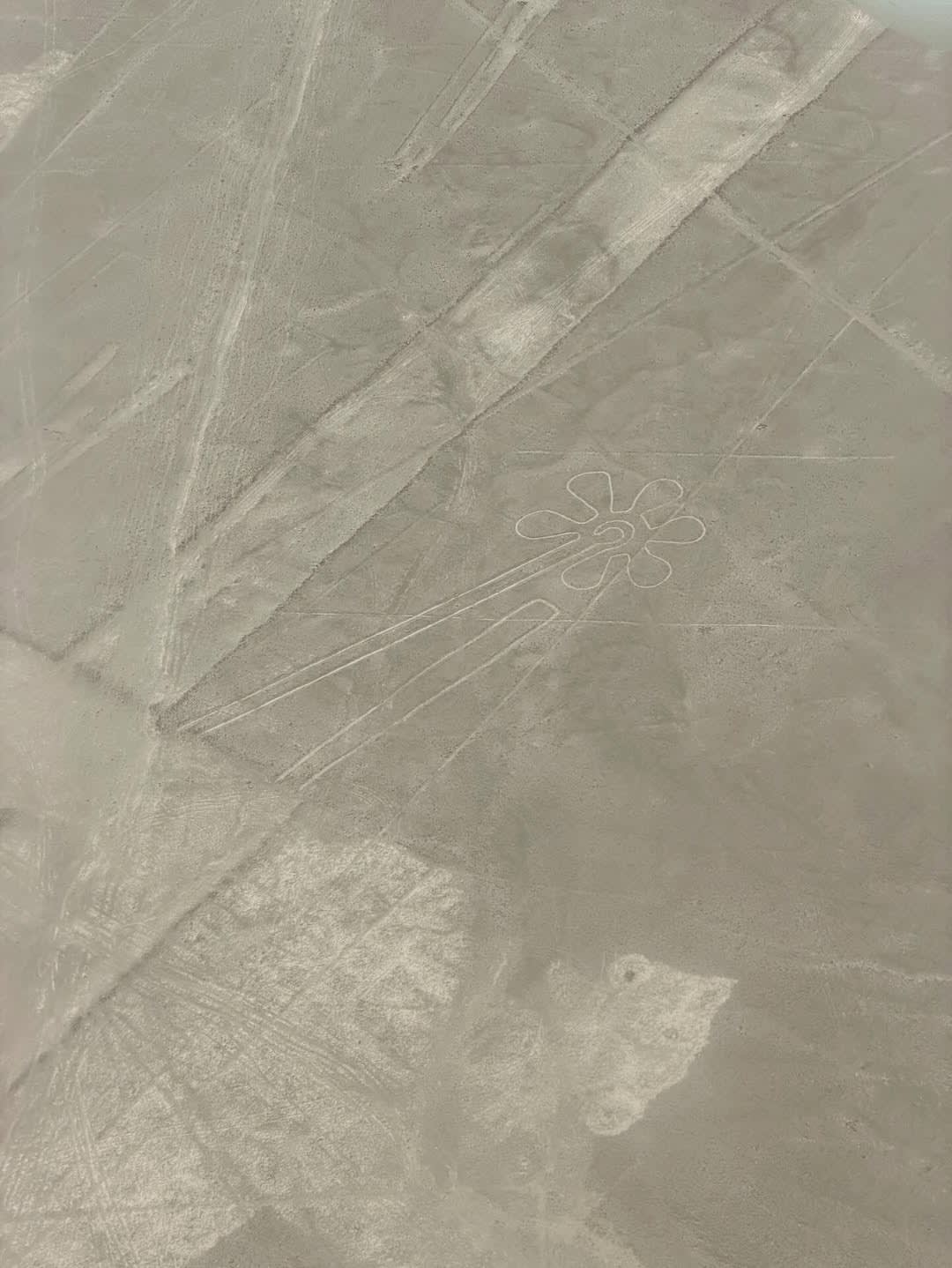
The reason is partly that no one lived here. Cahuachi was not a city in the residential sense; current archaeological evidence finds no permanent population, no domestic quarters, no kitchen middens of the kind that mark lived-in urban settlement. What it has, in its excavated sectors, is ceremonial infrastructure: offering deposits, processional pathways, areas of concentrated ceramic and textile deposition, evidence of large-scale ritual feasting, human burials of a non-domestic character. Cahuachi was a pilgrimage destination — the place people came from the surrounding pampa and valley communities for religious events, and from which they returned. This interpretation places the straight lines of the Nazca pampa in a new context: some of the major lines appear to converge toward Cahuachi, suggesting they functioned as processional routes leading to the pilgrimage centre rather than lines to be read from above.
What Was Built Here
Adobe — mud brick — is the primary construction material at Cahuachi, appropriate given the scarcity of stone in the coastal desert and the abundance of alluvial clay in the river deposits. The construction method used natural hills as cores: existing topographic features were selected, and stepped adobe terrace systems were built on and around them, converting the organic landform into architectural space with processional access on the cardinal faces. The result is a hybrid landscape where the distinction between built and natural is deliberately obscured — the monument blends back into the desert rather than declaring itself against it.
The court spaces between the mounds — the plazas and processional areas — are where the evidence of large-scale ritual activity concentrates. The Italian mission has found, in these areas, deposits of ceramic offerings in the hundreds: complete polychrome vessels placed in organised arrangements, whole and intentionally broken, in patterns that suggest repeated ritual cycles rather than single episodes. The Nasca polychrome style — some of the most technically complex pottery in pre-Columbian Peru, with its multi-colour slip painting and its figurative vocabulary of supernatural beings, trophy heads, and agricultural symbols — is present at Cahuachi in its finest documented examples.
Trophy heads — real human skulls modified for suspension and display — are the most discussed element of the Cahuachi excavation material. The skulls have been found in sealed offering contexts and in burials; some were modified with frontal perforations for cord suspension. Their presence in large numbers at a ceremonial site confirms what the Nasca ceramic iconography suggests: that the trophy head was a central element of Nasca religious practice, with possible ancestral veneration, war commemoration, and sacrificial dimensions. The Italian mission's work on this material is the most substantial archaeological analysis of Nasca trophy head practice in the literature.
The Deliberate Closing
Cahuachi was not abandoned. The distinction is essential, and it is the detail that the standard overview almost universally misses. Around 450 CE, after several centuries of active ceremonial use, the complex was systematically closed: the principal ceremonial spaces were filled with deliberate deposits — broken ceramics, organic material, earth — and the adobe terracing of the major mounds was covered with additional fill. The site was not left standing. It was buried.
The interpretation of this act remains debated. A major El Niño event is documented in the archaeological record from approximately this period, causing significant flooding of the river valley; some researchers argue the site was damaged by flooding and subsequently closed. Others argue the closing was a deliberate ceremonial decommissioning — the site ritually retired rather than physically destroyed. The physical evidence argues for intentionality: the deposits used to fill the ceremonial spaces are not flood debris but organised refuse, which implies a decision rather than a disaster.
Giuseppe Orefici, the Italian archaeologist who has directed the excavation at Cahuachi since 1983, has described the closing as a "ritual burial of the sacred space" — the Nasca ending the ceremonial life of the complex in a manner analogous to their treatment of their own dead. The comparison is not metaphorical; the fill deposits and the treatment of the mound surfaces share formal characteristics with the funerary deposits at Chauchilla. Cahuachi died, and its death was organised.
The Italian Mission's Four Decades
The Missione Archeologica Italiana a Nazca (MAIN), affiliated with the University of Rome La Sapienza, has conducted systematic excavation at Cahuachi since 1982 under Orefici's direction. It is one of the longest-running continuous archaeological field projects in South America. The mission's work over forty-plus field seasons has documented and partially excavated approximately fifteen percent of the site's total area — a figure that conveys the scale of what remains unknown.
What the mission found, progressively, was a site of greater architectural complexity and ceremonial intensity than its surface appearance suggested: not a settlement reduced to ruins but a ceremonial system intact beneath its deliberate fill, with the offering deposits and architectural sequencing of a major religious centre. The polychrome ceramic assemblage alone — documented in thousands of individual vessels from secure contexts — constitutes one of the most significant Nasca material culture collections in existence.
The site's relationship to water — in one of the world's driest environments — is the most active current research question. The Nasca puquios, the underground aqueducts that brought subterranean water to the valley surface, are associated with Cahuachi in their distribution and scale; some researchers propose that the ceremonial function of the site was partly hydraulic — that the rituals performed here were water petitions directed at the cosmological forces the culture believed controlled the underground sources. The processional lines of the pampa, converging toward the site, are consistent with this interpretation: the lines as paths walked in ritual approach to the place that held access to water.
The Three-Site System
The standard approach to Nazca treats the Lines, Chauchilla, and Cahuachi as three separate attractions. The Kada approach treats them as a connected system whose parts become intelligible only in relation to each other.
The Lines — the aerial dimension of the system — are the processional infrastructure: paths walked in ritual approach toward the ceremonial centre at Cahuachi, readable from altitude as the map of a landscape-scale religious practice. Chauchilla — the mortuary dimension — is the archive of the people who performed these rituals: the funerary bundles and the grave goods preserve the social structure, the craft traditions, and the cosmological beliefs of the same culture. Cahuachi is the institutional logic that organises the other two: the centre from which the processional paths radiated and to which the living came, and from which the dead were, in some sense, linked.
The guide for the Cahuachi programme holds this three-site framework as the interpretive backbone of the visit. The result is that Cahuachi, which is the hardest of the three sites to read and the most rewarding when properly understood, does not arrive without context. The overflight and the Chauchilla visit have already established the system's other two components; Cahuachi is the third point that makes the triangle stable.
What Kada Arranges
The Cahuachi visit requires specialist context. The site does not have the visual drama of a well-excavated archaeological park; it requires someone who can read the landscape — the difference between a natural hill and an excavated pyramid, the distinction between organic desert surface and a mound that has been filled and re-covered. The guide for the Cahuachi programme is an archaeologist with direct research contact with the Italian mission, or a Peruvian researcher who has worked on the site and holds the current literature.
Private vehicle from Nazca: twenty-eight kilometres west on the road toward the coast, including an off-road approach to the site. The visit runs three to four hours and covers the principal excavated sectors: the Grande Pirámide, the court complexes where the ceramic offering deposits were found, and the areas where the mission's most significant mortuary and processional evidence was identified.
Kada designs the Cahuachi visit as the third component of the three-site Nasca programme — after the overflight and Chauchilla — so that the ceremonial function of the lines and the evidence of the burials have already been established when the pilgrimage centre is encountered. In this sequence, Cahuachi becomes the institutional logic that organises the other two.
Expert Perspective
"I always save Cahuachi for last in the Nazca sequence because it is the hardest to read and the most important to understand. The Lines and Chauchilla are visually immediate — the geometry from the air, the preservation at the cemetery — both give you something right away. Cahuachi requires patience. The first twenty minutes, guests are usually looking at hills and wondering what they're supposed to see. Then you climb the Grande Pirámide and stand on the first terrace and you understand the view the builders were constructing — the relationship between the mound, the river valley below, the pampa extending east where the lines are. That moment of spatial understanding is what makes the sequence work. Cahuachi is where the system makes sense."
— Jaime Ttito, Head of Guides & Cultural Interpreter, KADA Travel
A Practical Note
Access: Cahuachi is 28 kilometres west of Nazca on the road toward the coast. The approach to the site involves an off-road section; a 4x4 or high-clearance vehicle is appropriate, and Kada arranges this as standard for the programme.
On-site conditions: the site has no shade and no facilities. Morning visit (before eleven) is strongly recommended for temperature; afternoon heat on exposed adobe terracing is significant. Water, sun protection, and closed footwear for uneven desert terrain are essentials.
Access coordination: the site is not currently staffed as a standard tourist attraction; access is arranged with relevant permissions coordinated by Kada. The visit does not follow a marked tourist circuit but is guided by the archaeologist through the excavated and accessible sectors.
Physical demand: moderate. The climb to the terrace of the Grande Pirámide involves steep, uneven adobe steps. Guests with significant mobility limitations should discuss the programme with Kada before booking; modified routes can be arranged.
Written by Kada Travel Editorial
Frequently Asked
The site is accessible with coordination and appropriate permission; it is not developed with the visitor infrastructure of major Peruvian heritage sites. Kada arranges access through archaeologist contacts, who coordinate with the Ministerio de Cultura. Visits are private, not part of any standard tour circuit.
The Missione Archeologica Italiana a Nazca (MAIN), affiliated with the University of Rome La Sapienza, has conducted systematic excavation at Cahuachi since 1982 under the direction of Giuseppe Orefici. It is one of the longest-running continuous archaeological field projects in South America. Its published materials are the primary scholarly source on Cahuachi and Nasca ceremonial practice.
The Lines are visible from light aircraft without specialist knowledge and are UNESCO-listed; they became internationally known through aerial photographs in the twentieth century. Cahuachi does not photograph dramatically and requires ground interpretation to understand. The absence of visual spectacle has kept it in the specialist literature rather than the popular imagination — which, for the purposes of the Kada visit, is an advantage.
The spatial analysis of the principal Lines shows alignments that converge toward Cahuachi's location; some researchers interpret these as processional paths. The ceremonial function of the Lines — as paths walked in ritual approach rather than objects viewed from above — is consistent with Cahuachi as the terminus of the procession. The aerial view of the Lines and the ground view of Cahuachi are, in this reading, two perspectives on the same religious system.
Design Your Journey
Design your bespoke Peru journey
We talk. We listen. Then we design an itinerary that belongs only to you.
Start Planning
