Unfolded· 8 min read·10 July 2026
The Code Behind the Canvas
Cusco Cathedral and the Escuela Cusqueña — the largest collection of colonial religious painting in the Andes, decoded by an art historian as a four-century record of Andean thought inside Catholic form.
By Kada Travel Editorial
In the Last Supper painted by Marcos Zapata for the Cusco Cathedral in the eighteenth century, Christ and his twelve apostles are seated at a long table. The tablecloth is white. The apostles are wearing robes. It is, in every formal element, the Last Supper — the scene that Leonardo da Vinci painted for Milan three centuries earlier, the scene that appears in hundreds of churches across the Christian world.
At the centre of the table, in place of the lamb that the biblical Last Supper text places there, is a roasted cuy. The apostles' cups hold chicha. The serving plates contain potatoes, hot peppers, and the local fruits of the Cusco valley. The Andean feast is inside the Last Supper, and it is not a joke, an error, or a local adaptation made without awareness of what it was doing. It is the Escuela Cusqueña's argument, made in the most public and prestigious commission available in eighteenth-century Cusco, that the Andean world and the Christian world occupied the same divine frame — and that the Andean world's own food, drink, and material culture belonged at that table.
This is not the reading most visitors give the Zapata painting. Most visitors who encounter it treat it as an amusing detail — the guinea pig at the Last Supper, the curiosity worth photographing. But the painting is not a curiosity. It is a position, maintained in canvas across four centuries of production by the Escuela Cusqueña, in the most consequential art collection in the Andes.
The Cathedral
Cusco Cathedral was built between 1560 and 1654 on the site of the palace of the Inca Viracocha — one of the great Inca emperors, whose palace occupied the northeastern edge of the main plaza. The colonial construction used stone from Sacsayhuamán, transported down from the fortress in the decades when the Inca walls were being systematically dismantled for building material. The foundations of the Cathedral incorporate Inca stonework from both the palace and the fortress, and the earthquake history of the building tells the same story as Qoricancha: the colonial masonry has cracked and been rebuilt multiple times; the Inca foundations beneath it have not shifted.
The Cathedral is the largest colonial church in the Americas in terms of internal volume. Its nave and two flanking naves contain fourteen chapels and a collection of approximately four hundred paintings, most of them attributable to the Escuela Cusqueña and most of them dating from the seventeenth and eighteenth centuries. The collection is not comprehensively catalogued by museum standards — many pieces lack documentation, attribution is contested in the scholarly literature, and the conditions of storage and lighting in the side chapels have caused significant conservation issues. What the Cathedral holds is, simultaneously, the most important collection of colonial Andean art in Peru and one of the least systematically studied.
The sillería del coro — the carved wooden choir stalls — runs across the rear of the nave in two facing rows, each stall carved with the figure of a saint or blessed. The carving is in the same Andean Baroque tradition as the San Blas pulpit: European iconography, executed with Andean faces and ornamental sensibility, in a standard of craft that reflects the full capacity of the San Blas guild system working at maximum commission.
The Escuela Cusqueña
The Escuela Cusqueña is not a single institution or a formal school in the modern sense. It is the term used to describe the body of painting produced in the Cusco region from the late sixteenth century through the early nineteenth century by indigenous and mestizo artists working within the Catholic commission system — and doing something within that system that their European counterparts were not doing.
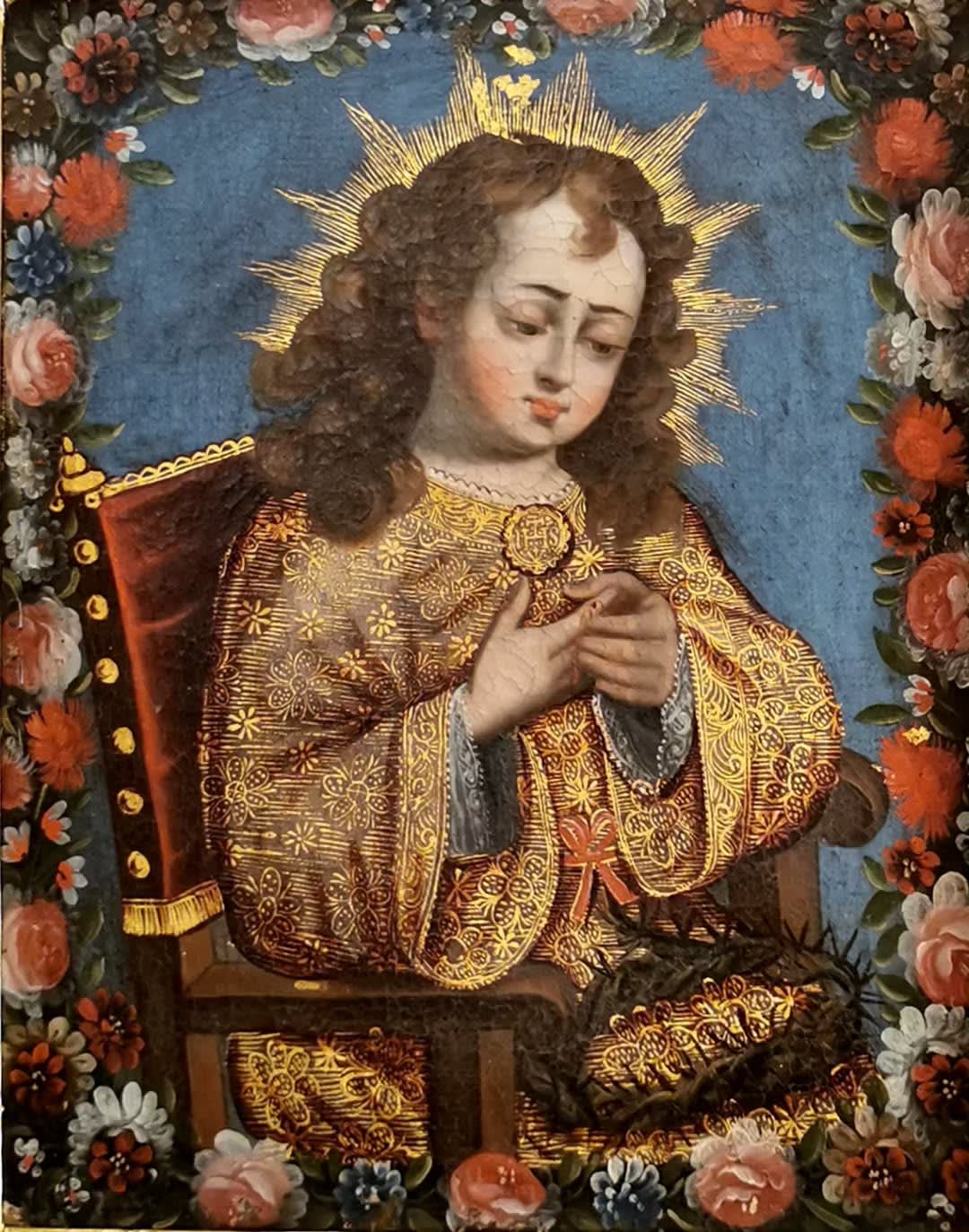
The visual markers of Escuela Cusqueña painting are recognisable: frontal compositions rather than the spatial depth favoured in European Baroque; gold brocade on figures' robes, applied in a technique called brocateado that creates a textile effect on the painted surface; local plants and animals — the cantuta flower, the Andean condor, the cuy, the local deer — appearing in backgrounds that European iconography would fill with Italian cypresses and Flemish oak. The faces of biblical figures, angels, and saints are Andean — not consistently, not in every work, but in a significant portion of the output across the two-century period.
What the art historian we work with brings to this material is the argument that the Escuela Cusqueña was not a case of indigenous artists awkwardly adopting European techniques. It was a case of indigenous artists using European techniques fluently, and within that fluency, encoding — sometimes deliberately, sometimes as an inherited habit of the tradition — a visual logic that derives from the Andean world rather than the European one. The brocateado technique, which European painting does not use, derives from Andean textile aesthetics. The frontal composition, which European Baroque had largely abandoned, is consistent with pre-Hispanic Andean visual representation. The local fauna in the backgrounds is not error; it is placement.
This argument has had a significant reception in the art-historical literature since the 1980s and is now the dominant scholarly position. It is not universally settled. The art historian presents both the evidence and the ongoing scholarly conversation around it.
The Paintings
The specific works the art historian reads during the Cathedral visit are selected based on what is currently accessible and best illuminated on the day. The standard sequence includes:
Diego Quispe Tito's work in the Sagrada Familia chapel — the most technically accomplished of the Escuela Cusqueña painters, whose canvases show the Flemish influence absorbed through prints circulating in colonial Cusco alongside the specifically Andean modifications he applied to the conventions. His birds and flowers are not European species; his spatial construction is closer to Flemish panel painting than Italian fresco, a consequence of which models reached Cusco in the seventeenth century.
The Marcos Zapata Last Supper, in the Capilla de la Eucaristía to the left of the high altar. The art historian reads this painting not as a regional oddity but as the terminal statement of the Escuela Cusqueña argument — the moment when the tradition was confident enough in its own synthesis to put a roasted cuy at the biblical table and submit it to the Cathedral commission as a finished work. The painting was accepted and installed. It is still there.
The anonymous works in the side chapels — the paintings without attributions, in various states of condition — are in some respects the most interesting section of the collection, because they represent the full range of the tradition rather than its peaks. The art historian uses these to show what the Escuela Cusqueña looked like as a habitual practice, not as a virtuosic exception.
What Kada Arranges
The visit runs two to two and a half hours, beginning at the Cathedral's opening and including both the general collection and the restricted areas. Private access at Cusco Cathedral includes the sacristía — the cathedral sacristy, which contains significant works on canvas and in silver that are not part of the general visitor circuit — and the upper section of the choir stalls, accessible by a stair that is normally closed.
I coordinate this visit with the art historian personally; the two of us have discussed the Escuela Cusqueña argument extensively, and the session at the Cathedral is structured around the specific works that best illustrate the positions in that argument. When I am not present for the Cathedral visit itself, I attend the briefing with the art historian and with our guests the evening before — a thirty-minute conversation at dinner that gives guests the frame before they encounter the collection.
Maximum group size is four to six for the full private access component. Photography in the Cathedral is subject to the institution's current regulations; the conditions have changed several times in recent years and we advise at the time of the visit. The general admission is ticketed; the private access components are arranged in advance.
Expert Perspective
"What strikes me every time I take guests to the Cathedral is the moment when they stop seeing the Last Supper painting as a funny anecdote and start seeing it as a statement. That shift — from 'the guinea pig is amusing' to 'the guinea pig is an argument' — is the same shift the Escuela Cusqueña requires across its entire output. Once you see it as a tradition that was doing something intentional, rather than a tradition that was adapting European models imperfectly, the entire Cathedral changes. You are no longer looking at colonial art with indigenous elements. You are looking at Andean art in Catholic form. The difference is not subtle. It is the difference between a collection that records what was imposed and a collection that records what survived inside the imposition."
— Katherine Cjuiro, Founder, KADA Travel
A Practical Note
Cusco Cathedral is on the Plaza de Armas — the most central location in the city, a short walk from any accommodation in the historic centre. The building is at 3,399 metres standard Cusco altitude. The interior of the Cathedral is dim; the side chapels where the most significant paintings hang are lit by natural light from high windows and supplemented by artificial lighting of variable quality. The art historian carries a pocket light for reading specific works in the darker chapels.
The Cathedral is an active religious building. Morning masses occur before 9:00 AM; the general visitor access runs from approximately 8:30 AM in the dry season. We begin the visit at opening to have the nave and side chapels to ourselves before the first tour groups arrive. The Cathedral is most crowded between 10:00 AM and noon; the pre-rush window is material, not aesthetic.
The sacristía access and the choir stall access are coordinated with the Cathedral administration through our institutional arrangements; they require advance booking and cannot be accessed on the day without prior arrangement.
Written by Kada Travel Editorial
Frequently Asked
A minority. The *Escuela Cusqueña* collection as a whole is poorly documented by modern museum standards, and the Cathedral's portion of it is particularly uneven in its attribution record. Quispe Tito and Zapata are the most thoroughly documented because their work was significant enough to attract colonial-era attention; many of the works in the side chapels are attributed to workshops or periods rather than individuals. The art historian is candid about attribution uncertainty — part of the session's value is understanding what "attributed to the Escuela Cusqueña" actually means and what it does not.
It has been conserved periodically, and it is currently in reasonable condition given its age and the humidity of the chapel. Large-format eighteenth-century canvases in an Andean church are subject to conditions that challenge even well-maintained collections: fluctuating humidity, limited climate control, and the sheer scale of the work — Zapata's Last Supper is monumental, covering most of the chapel wall. The art historian discusses the conservation history during the visit.
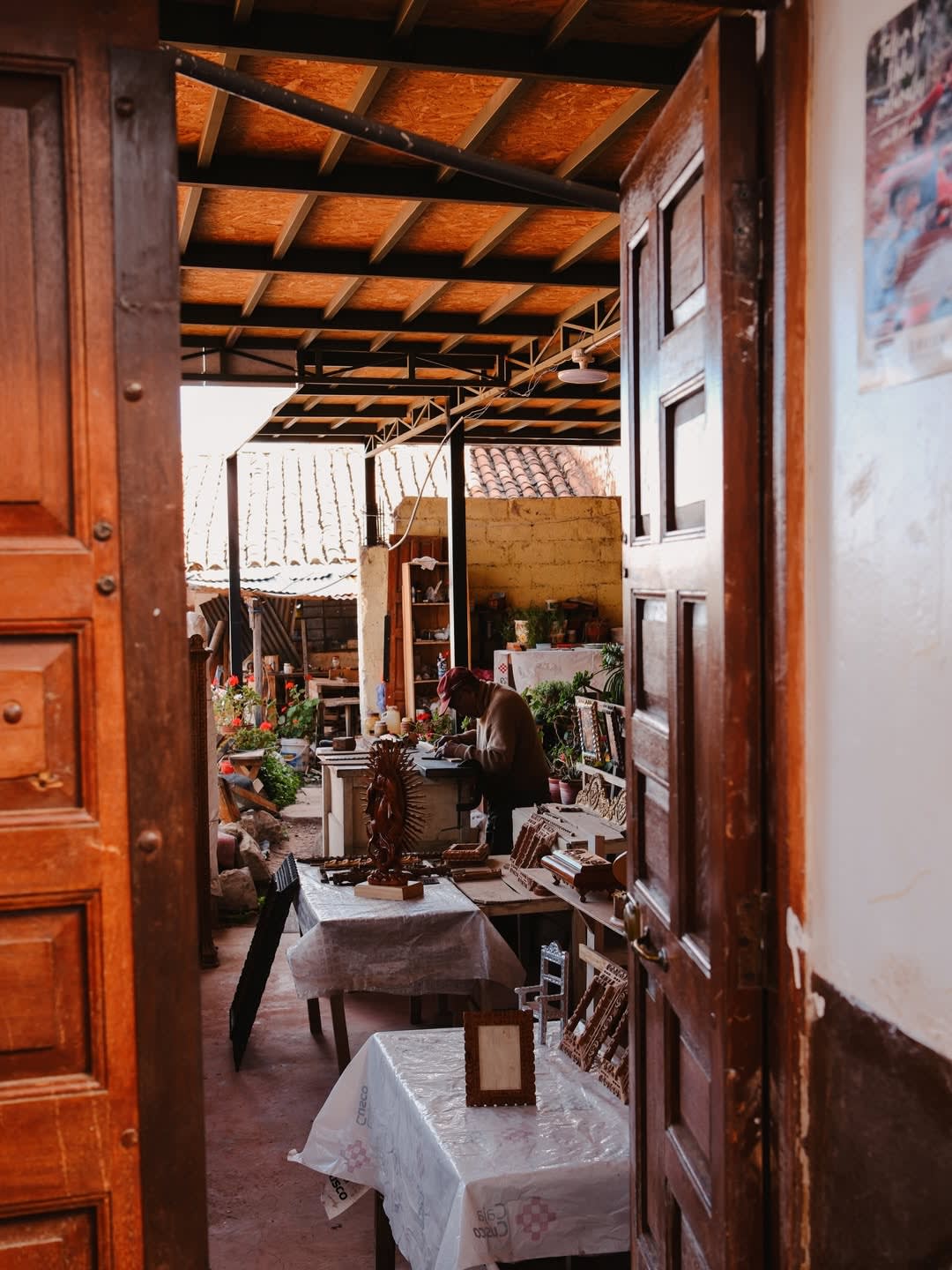
San Blas — the artisan district where the *Escuela Cusqueña* tradition was produced and is still practiced. The sequence Cathedral-then-San-Blas, or San-Blas-then-Cathedral, allows guests to encounter the tradition both as a finished art object (the Cathedral paintings) and as a living craft practice (the workshops). The two visits together constitute the most complete encounter with the *Escuela Cusqueña* that Cusco offers. We often arrange them on consecutive mornings for guests with sufficient time in the city.
Yes, and they are openly discussed in the Peruvian cultural heritage community. The Cathedral holds a collection of major national significance in conditions that a European or North American museum would consider inadequate — limited climate control, uneven lighting, the challenges of an active religious building whose primary function is not preservation. Several significant works have suffered damage in the past decade. The Ministerio de Cultura and the Cathedral administration have ongoing conservation programmes, but the resources available are not proportionate to the scale of the collection. The art historian addresses this directly; it is part of the honest picture of what the Cathedral is.
Design Your Journey
Design your bespoke Peru journey
We talk. We listen. Then we design an itinerary that belongs only to you.
Start Planning