Unfolded· 8 min read·22 July 2026
The River That Became the Forest
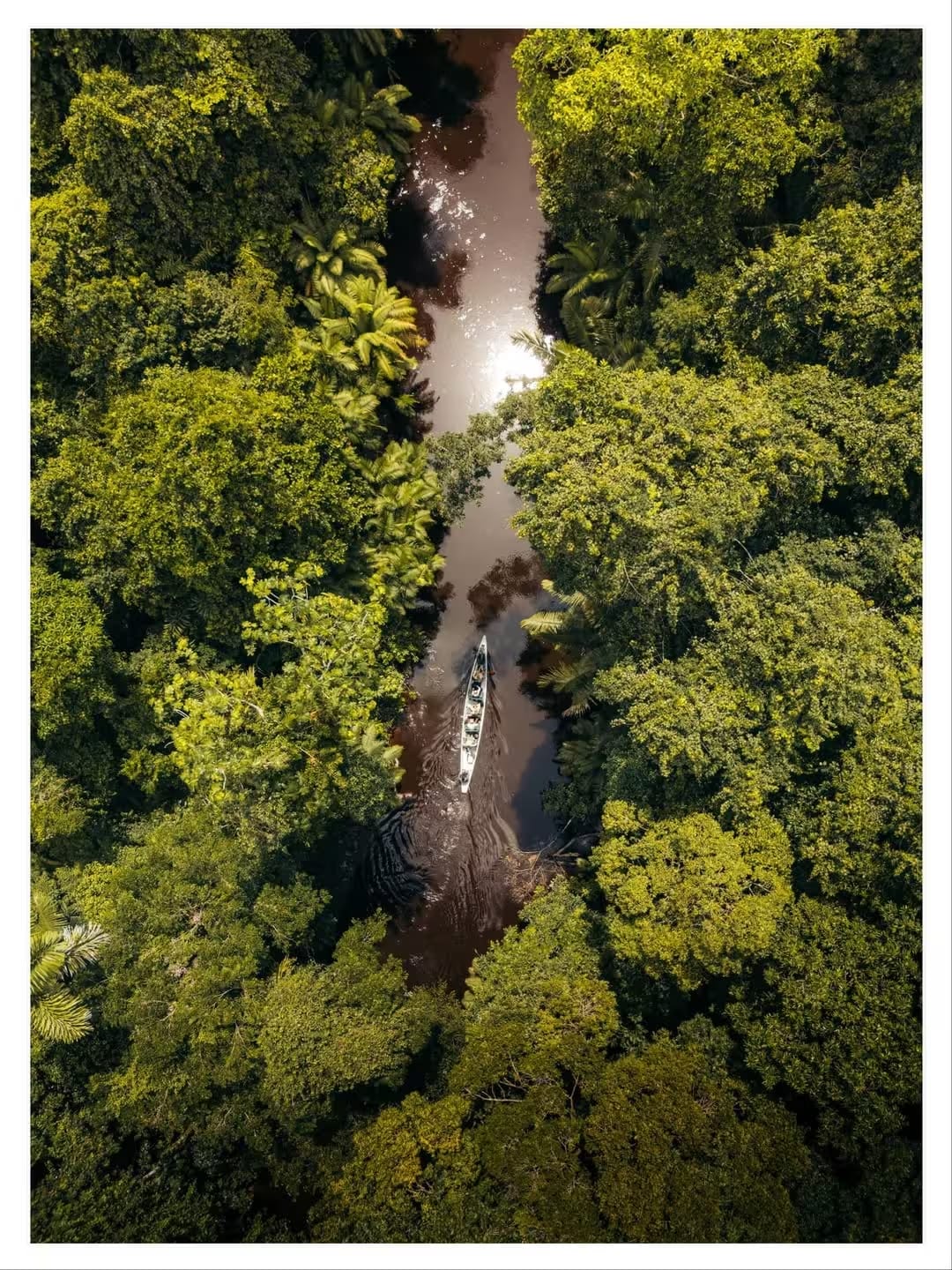
Pacaya-Samiria National Reserve — 2.08 million hectares of seasonal várzea in the northern Peruvian Amazon, where the Marañón and Ucayali rivers converge and the forest floods four months each year. Four to seven days by river vessel in the reserve interior, with skiff departures at dawn and dusk, a resident naturalist, and the pink boto dolphin in the still water of the oxbow lakes. No roads. No airport. The only way in is the river.
By Kada Travel Editorial
The Pacaya-Samiria National Reserve is the largest protected natural area in Peru. At 2.08 million hectares — roughly the territory of El Salvador and Nicaragua combined — it occupies the interior angle between the Marañón and Ucayali rivers where they converge north of Iquitos in the Loreto department. It is the only Peruvian reserve designated under the Ramsar Convention as a wetland of international importance. It has no roads. It has no airport. The only entrance is the river, and the river changes the forest twice a year.
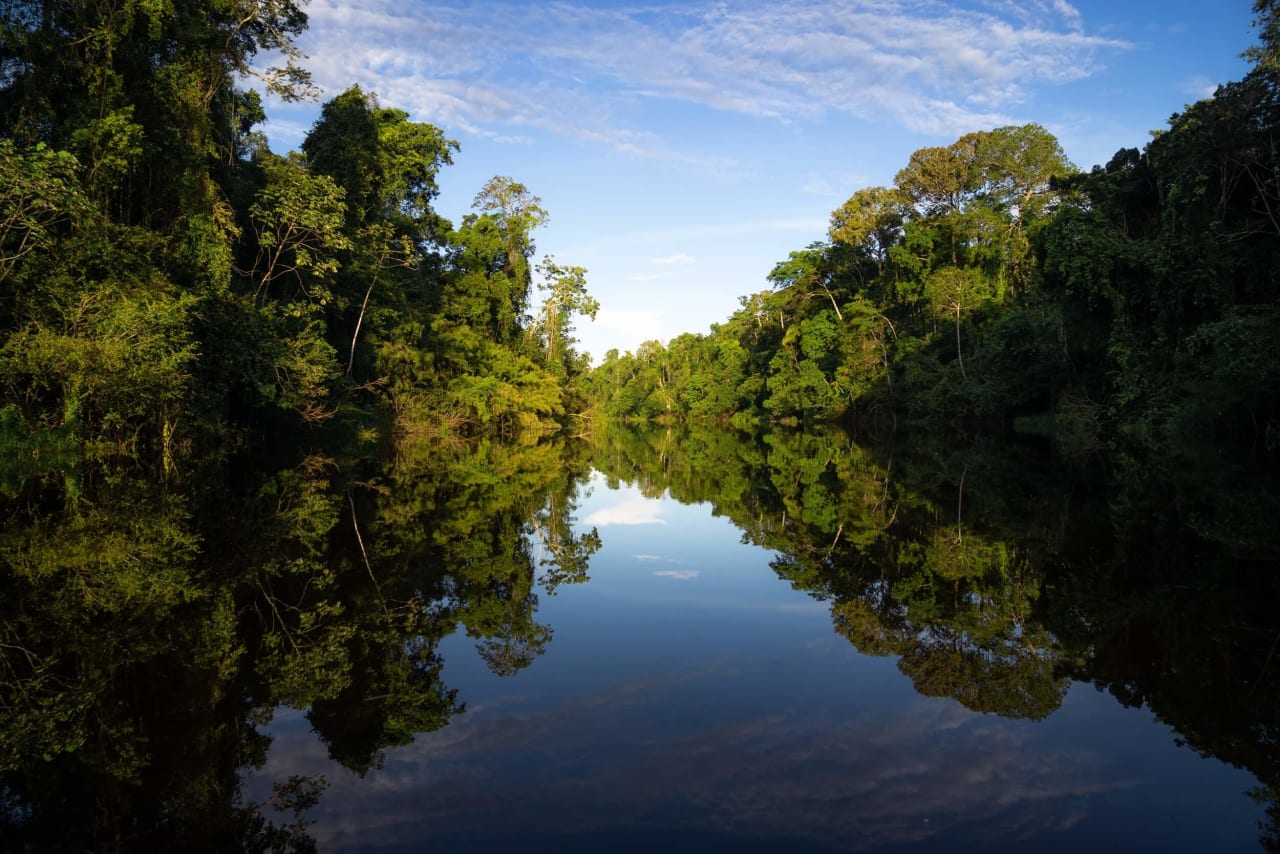
The ecological signature of Pacaya-Samiria is the várzea — the seasonally flooded white-water forest that covers most of the reserve's interior. Between December and April, the rivers rise four to eight metres above their dry-season level. When this happens, the forest does not recede. The water enters it, flowing through the tree bases and carrying the suspended silt that the Andean rivers transport from the mountains. The fish follow the water into the forest, feeding on the fruit and insects that fall from the submerged lower canopy. The dolphins follow the fish. The anacondas coil in the submerged root systems. The trees stand in water to their lower branches, their canopies still in full leaf above the water surface. This is the igapó and várzea system — the flooded-forest ecology specific to the Amazon's white-water rivers and absent from any other biome on Earth.
In the dry season (June through November), the water retreats. Fish concentrate in the rivers and oxbow lakes — the cochas — rather than dispersing through the flooded forest interior. The dolphins follow the concentration. The pink boto surfaces in the cochas with a frequency that approaches predictability, which is rare in any form of wildlife observation. Both seasons are legitimate, with different signatures, and Kada is honest with guests about what each one provides.
The Vessel
The cruise vessels Kada uses for Pacaya-Samiria access have between eight and twenty cabins — small enough to navigate the reserve's internal channels and operate with the logistical flexibility that expedition cruising requires, large enough to provide a material standard that the guest experience demands. Aria Amazon, Aqua Nera, and the Delfin fleet (Delfin I, II, and III) are the primary options, with cabin configurations and departure calendars that Kada matches to the group, the season, and the guest's specific interests. The vessels provide air-conditioned private cabins — the northern Amazon is meaningfully hotter and more humid than Tambopata or Manu, and thermal management of the accommodation is not optional — a single-service dining room, and resident naturalists whose qualifications Kada verifies before recommending a vessel.
The programme on board runs on the logic of the river and the reserve, not on a fixed commercial itinerary. Dawn skiff departures begin at 5:30 AM — the same morning window that governs productive wildlife observation across the Peruvian Amazon, because the dawn thermal and metabolic logic of the ecosystem operates at the same hour regardless of which reserve it is in. Afternoon skiff sessions depart at 3:30 PM, when the midday heat has passed and the afternoon species begin their activity cycle. Evening sessions — specifically for caiman eye-shine observation by spotlight — depart after dinner. The main vessel repositions during midday hours while guests rest, read, or participate in on-board presentations.
What the Reserve Produces
The boto — the pink river dolphin (Inia geoffrensis) — is the ambassador species of Pacaya-Samiria, but the encounter requires honest framing. The boto does not perform or leap. It surfaces to breathe — a rolling emergence, the bulbous forehead visible for a second above the waterline before the animal descends again — in patterns that are influenced by feeding activity, social behaviour, and conditions the observer cannot predict from the boat. In a productive cocha at the right hour of the dry season, a single skiff session can produce a dozen boto surfacings within twenty metres of the boat. In the wet season, the dolphins are distributed through the flooded forest interior and their surfacing patterns are different — visible but more dispersed. The biologist's knowledge of current survey data from the reserve determines which cocha, on which morning, gives the session the best conditions.
The anaconda (Eunectes murinus) is present in Pacaya-Samiria in one of the largest known concentrations in Peru. Anacondas use the flooded-forest root systems as thermal substrate — submerged roots retain warmth that the morning air does not — and are locatable by experienced naturalists scanning the vegetation at water level from a slow-moving skiff. These are not staged encounters. They occur in the context of navigation and require the biologist to distinguish the body form of the snake from the background of roots and submerged vegetation. They are reliably present; they are not reliably visible on any given session.
The Amazonian manatee (Trichechus inunguis) is the most difficult of the reserve's signature mammals to observe. The species is critically threatened across its range; Pacaya-Samiria holds one of the last viable populations in Peru. The biologist monitors the manatee population as part of the reserve's ongoing survey work. Guests who are present during a manatee surfacing — distinguished from a boto by the horizontal tail flukes and the absence of a dorsal ridge — are in the field of one of the genuine rarities of an Amazonian season.
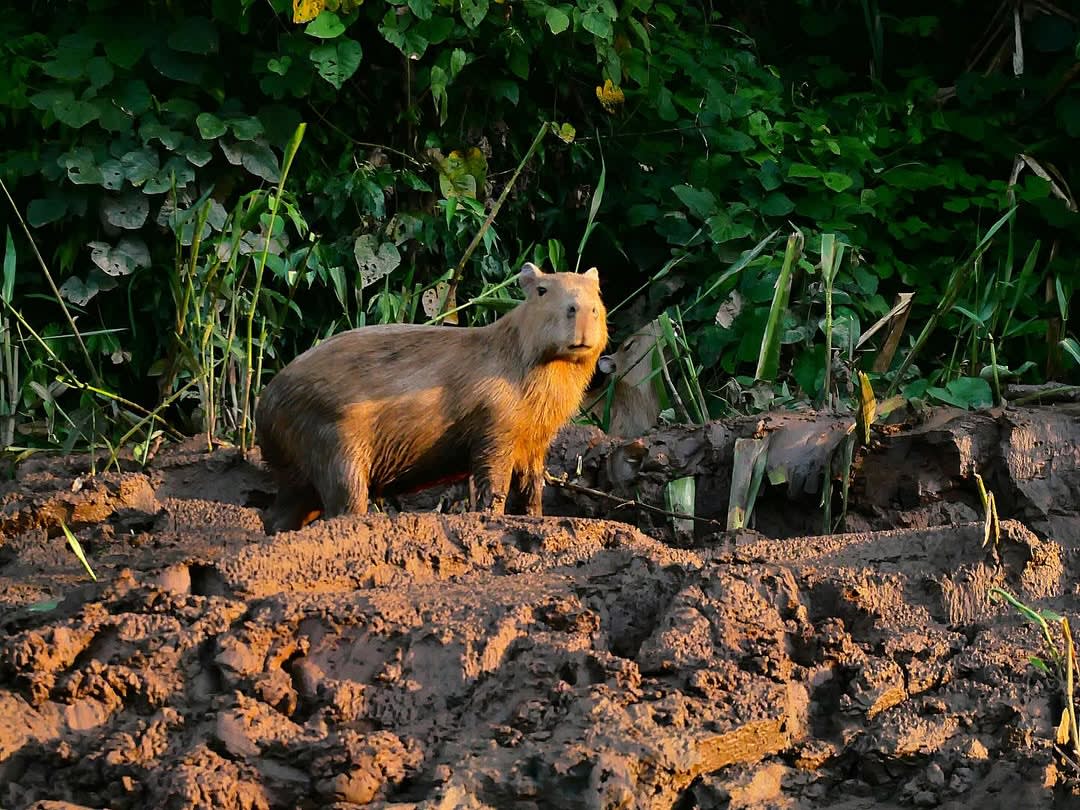
The bird density in Pacaya-Samiria is among the highest in the Amazon basin. The hoatzin (Opisthocomus hoazin) — the prehistoric-looking bird whose juveniles retain clawed wings from an earlier evolutionary stage and whose digestive chemistry produces the fermented-leaf smell that local communities call "the stinky bird" — is present in every flooded-tree margin in the reserve. The jabiru stork (Jabiru mycteria), the tallest flying bird in the Americas, nests in the reserve's large ceiba trees. A single skiff session in the dry season flooded-forest edge can produce sixty to eighty bird species in under two hours.
What Kada Arranges
Access to Pacaya-Samiria begins in Lima. Flights connect Lima to Iquitos in approximately ninety minutes — this is the northern route of the Peruvian Amazon and does not require a connection through Cusco. From Iquitos, the transfer to the embarkation point is approximately two hours by road to Nauta, the port closest to the reserve boundary. Kada coordinates the Lima-to-Iquitos flight, the Iquitos hotel accommodation before embarkation (typically two nights, used for the city programme if the guest wants it), the Nauta transfer, and the vessel selection.
Cruises range from four nights (the minimum viable for reaching the reserve's interior) to seven nights (recommended for guests who want to cover the full ecological range, including the upper Pacaya and Samiria river channels). Kada does not default to the minimum programme when conditions and guest interest support a longer stay; the recommendation is honest about what each duration produces.
The naturalist-to-guest ratio on skiff excursions from the vessels Kada uses is capped at four guests per biologist. Skiffs are equipped with binoculars, are electric-motor or paddle-only in sensitive zones designated by SERNANP, and carry a hydrophone for underwater cetacean observation.
Expert Perspective
"The guests who are surprised by Pacaya-Samiria are the ones who came expecting tropical heat and got tropical heat, but also got something they didn't expect: a quality of quiet. The flooded forest absorbs sound. The skiff moves through trees that are standing in water up to their lower branches, and the canopy above closes the sky to a broken pattern of light, and there is no sound except the water and the birds. I've been in the reserve in the wet season with the water so high we navigated between tree trunks in what would have been a forest trail, and the boto surfaced three metres from the boat without any signal. The biologist and the guest both went completely still. That's the experience — not the itinerary. The moment when the forest and the river are the same thing."
— Daniel Ramos, Co-Founder & CEO, KADA Travel
A Practical Note
Season: Pacaya-Samiria has two distinct seasons with different optimal programmes. High-water season (December through April) provides access to the flooded-forest interior — skiff navigation through the trees, wildlife distributed through a vast water-and-forest landscape — and is the season for the flooded-forest experience that defines the reserve's unique ecology. Dry season (June through November) concentrates fauna in the rivers and cochas and produces the highest probability of boto encounters at close range and anaconda visibility in exposed root systems. Kada advises on which season aligns with what the guest is primarily there to see.
Heat and humidity: The northern Amazon around Iquitos and Pacaya-Samiria is consistently hotter and more humid than Tambopata or Manu. Daily temperatures range from 28°C to 35°C with year-round humidity above 85%. The vessels have air-conditioned cabins and common areas; skiff excursions are in open conditions. Lightweight, breathable clothing, aggressive UV protection (SPF 50 or above), and full insect protection are essential on every excursion. Guests with medical conditions exacerbated by sustained heat should consult with Kada before booking.
Medical requirements: Yellow fever vaccination is required for entry into Pacaya-Samiria. Malaria prophylaxis is standard for all stays in the reserve. The vessels maintain satellite communication with Iquitos and carry first-aid provisions. Medical evacuation from the reserve interior to Iquitos takes a minimum of four hours by fast boat; Kada carries guest information that would be needed in a medical situation.
Written by Kada Travel Editorial
Frequently Asked
The distinction is legal and meaningful. A national park (parque nacional) prohibits all extractive use. A national reserve (reserva nacional) permits sustainable use by local communities — fishing, limited plant harvest — within SERNANP-regulated limits. Pacaya-Samiria was designated as a reserva nacional specifically to accommodate the riparian communities that have fished and lived in the area for generations. The practical experience for a visitor is similar to a national park in terms of wildlife density and protection level; the legal structure reflects a different philosophy about conservation and indigenous community rights.
Both species are present in Pacaya-Samiria. The boto (Inia geoffrensis) — the pink river dolphin — is the larger species: adults reach up to 2.5 metres in length and up to 185 kilograms in weight. The boto has a pronounced bulbous forehead (melon), a flexible neck that allows lateral head movement, and the distinctive pinkish colouration of adult males. The tucuxi (Sotalia fluviatilis) is smaller (up to 1.5 metres), dark grey above and lighter below, and resembles a small marine coastal dolphin. Both surface to breathe with a similar rolling motion. The biologist identifies both species at each sighting and documents them for the reserve's monitoring programme.
Yes, on a catch-and-release basis with handlines. Piranha fishing in Pacaya-Samiria is not a commercial activity; the catch is observed and released, not consumed. The red-bellied piranha (Pygocentrus nattereri) is the most common species. The session is structured around the biologist's explanation of the piranha's ecological role — apex invertebrate predator, essential for nutrient cycling in the várzea system — rather than as a fishing excursion for its own sake. Kada includes it specifically because the piranha is one of the most misrepresented animals in the Amazon and direct contact with a living specimen corrects decades of Hollywood mischaracterisation effectively.
Yes, and Kada structures the Iquitos programme before embarkation rather than after. Two nights in Iquitos — the Belle Époque rubber-boom architecture, the Belén market with an ethnobotanist, the Casa de Hierro — before boarding gives guests contextual knowledge of the northern Amazon's human and historical geography that makes the reserve experience more legible. The sequence from city to reserve also preserves the psychological transition: leaving the urban environment to enter the reserve, not the reverse.
Design Your Journey
Design your bespoke Peru journey
We talk. We listen. Then we design an itinerary that belongs only to you.
Start Planning