Unfolded· 7 min read·10 July 2026
Lima from Two Hundred Metres
A private tandem paragliding flight over the Costa Verde at five o'clock — the city in its best light, the Pacific in front, the cliff behind.
By Kada Travel Editorial
Lima from the street is a city of fog, traffic, and lateral movement — a place experienced through windshields and malecón walks, at the level where the Pacific is an horizon rather than a surface. Lima from two hundred metres above the Costa Verde, at five o'clock in the afternoon when the marine layer has lifted and the light is coming in low from the west, is something the street version of the city does not prepare you for.
The cliff that runs from San Miguel to Barranco — the coastal escarpment that Lima's districts perch on, the edge between the city and the Pacific — is approximately eighty metres high and runs for roughly twelve kilometres of continuous coast. From above it, the five districts that line the coast north to south resolve into a single coherent form: a city that ends at the cliff edge and begins again at the base, with the ocean beyond.
The Cliff and the Current
The Humboldt Current — cold Antarctic water upwelling along the entire length of Peru's coast — is what makes the Pacific off Lima one of the world's most productive fishing grounds, what keeps the ocean dark and cool even in summer, and what generates the consistent thermal columns above the Costa Verde that make Miraflores the best paragliding site in South America's Pacific cities.
The thermals rise from the cliff's western face — warmed air lifting from the sea-facing slope — and carry gliders in a direction the Humboldt's cold air from below keeps steady. The flight window is in the afternoon, when the marine layer (garúa) that Lima's winters deposit over the coast has typically lifted enough to clear the landing zone and give the Pacific the particular dark metallic surface it holds in late afternoon light. At five o'clock, the sun is at an angle that turns the cliff face gold and the city behind it warm; the ocean remains cold in tone. The contrast — warm city, dark sea — is what makes the afternoon flight the correct version of this experience rather than the morning one.
The flight lasts between thirty-five and fifty minutes depending on thermal conditions. The pilot adjusts the arc across the cliff face to extend the time in the air when the thermals are strong; on the most productive days, the flight covers the full stretch from San Miguel south to Barranco, with the five coastal districts spread below in a single unbroken view.
What the Flight Shows
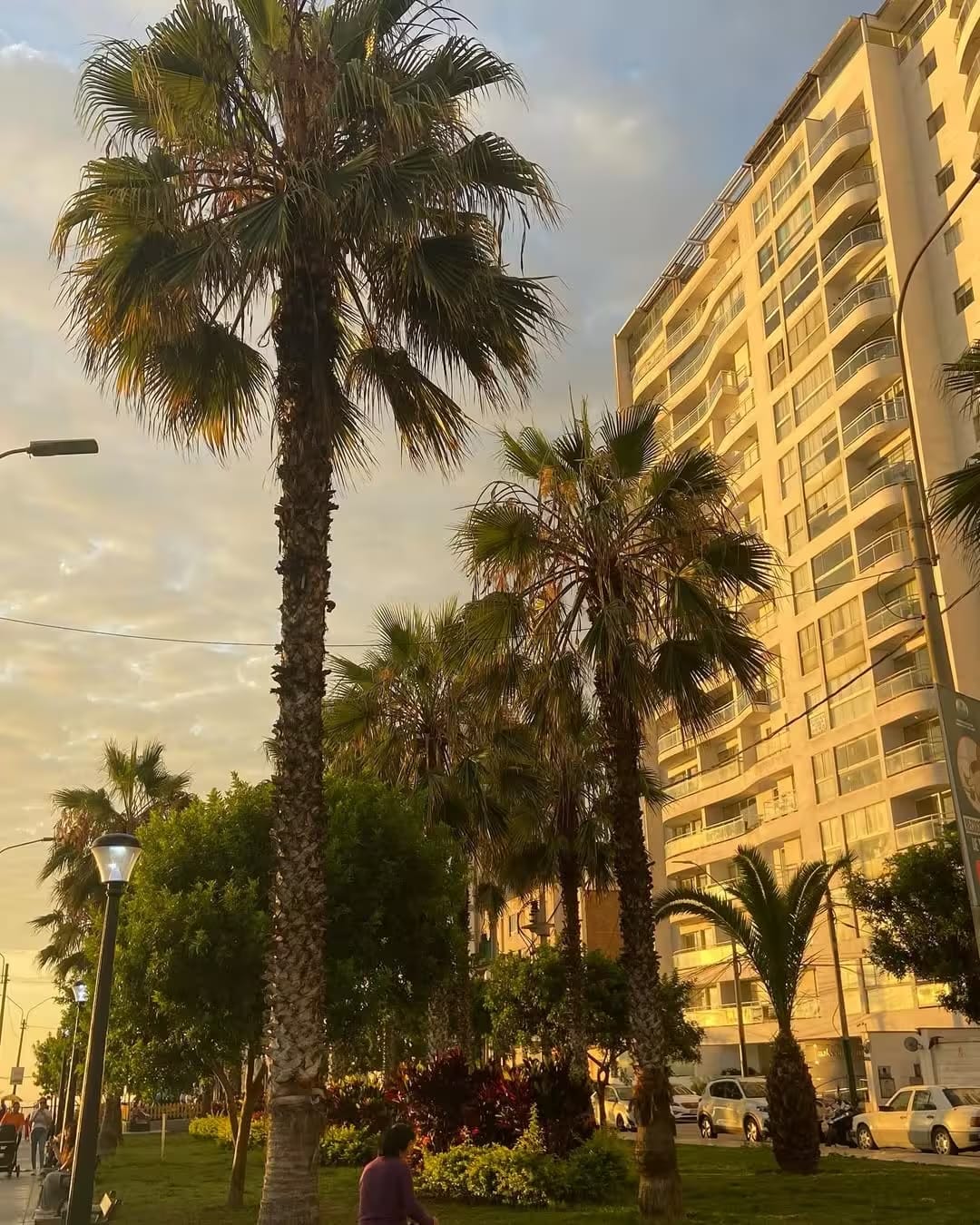
From two hundred metres, the five districts that line the Costa Verde resolve differently than they do from the street. San Miguel — the northernmost — is the flattest district on the cliff: the land is lower here, and the descent to sea level is gentler, the malecón closer to the water than in the southern districts. Magdalena del Mar is the residential district whose cliff gardens — narrow strips of irrigated green above the bare rock — look from above like a deliberate act of persistence, the city insisting on green at the edge of the desert. San Isidro's financial district towers are visible at the inland edge of the flight arc; from the cliff, the tower cluster reads as a single object against the desert plateau behind it rather than as a collection of individual buildings.
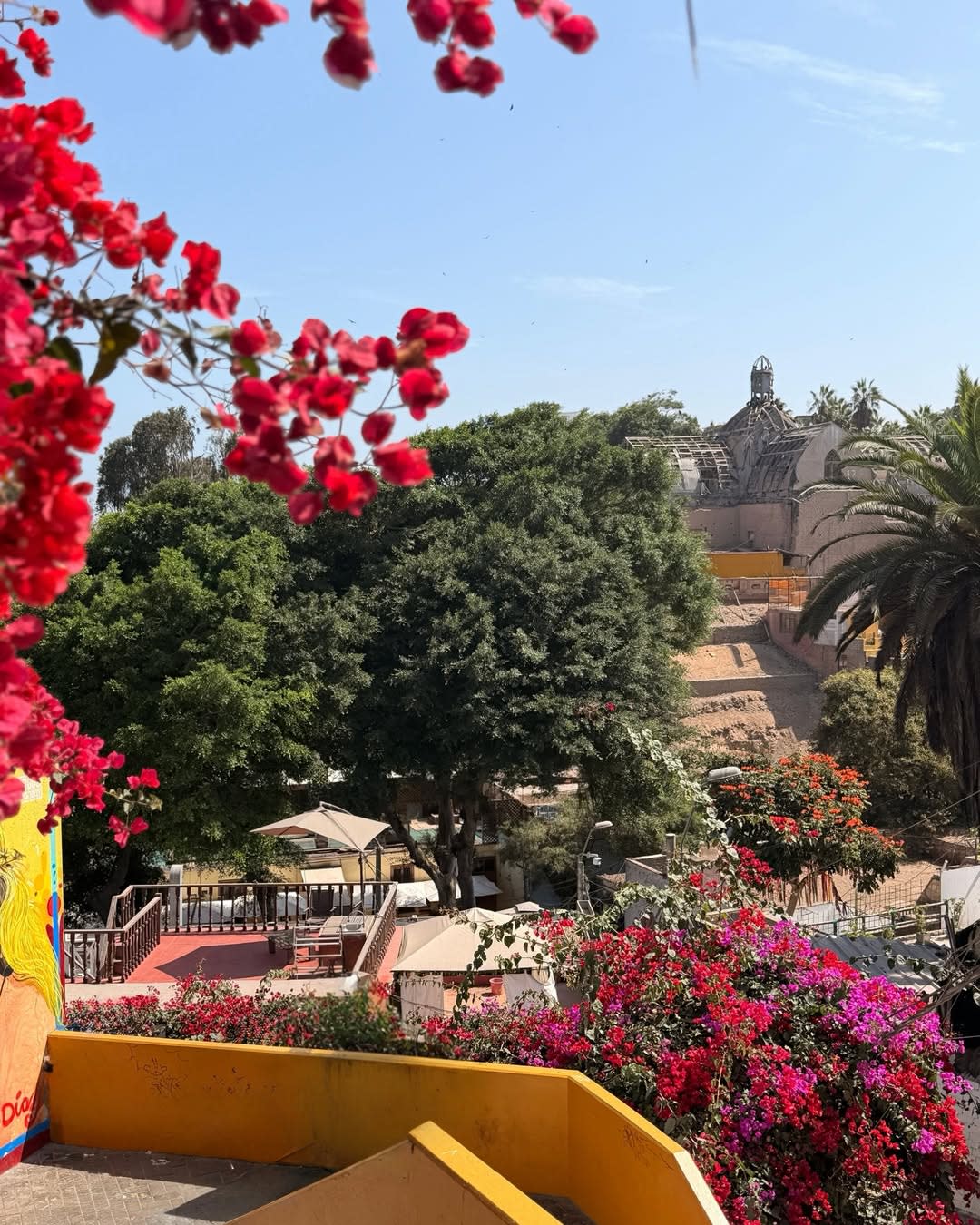
Miraflores — directly below the launch site — is the district most associated with the paragliding, and from above its internal logic is finally visible: the park system along the cliff edge (Parque del Amor, Kennedy Park, the Larcomar shopping centre cut into the cliff face), the residential grid behind it, the malecón that gives Miraflores its international identity as a walkable coastal neighbourhood. Barranco, at the southern end of the flight arc, is the smallest and most historically dense of the five districts: the cliff drops here more steeply, and the Bajada de los Baños — the staircase from the clifftop to the beach — is visible as a dark line against the pale cliff face.
The ocean itself, once you are looking down at it rather than across it, is not the blue of Caribbean or Mediterranean tourism photography. The Humboldt Current keeps it deep navy to dark teal, with a swell pattern that is consistent and uncrowded. There are surfers below at La Herradura and Punta Roquitas — visible from altitude as small figures on a wave — and the Lima fishing fleet at anchor north of Chorrillos. The city is entirely audible from the street. At two hundred metres, it is entirely silent.
What Kada Arranges
The flight we arrange is not the generic tandem offering available at Costa Verde's commercial booking points. The distinction is the pilot, the photographer, and the absence of a group queue.
The senior pilot we work with has more than fifteen years on the Miraflores cliff. His specific knowledge of the thermal patterns — which shift across the seasons, across the hours, and across the coastal weather systems that Lima's summer and winter produce — means the flight is structured around the conditions rather than around a fixed time slot. The departure is confirmed on the day, after the pilot has assessed the afternoon's thermal window. This is not a flexibility offered at commercial operations; it is the difference between a flight and an afternoon.
The aerial photographer — who flies a separate wing alongside — is a permanent collaborator rather than a contracted addition. His work is available to our guests after the flight: the images capture the city from the angle that ground-based photography cannot access, and for guests who want the document, the result is consistent with what they were looking at rather than with what a drone renders from fixed altitude.
For guests whose Lima itinerary includes several days, we position the paragliding flight at the end of the stay rather than the beginning — the city below is more legible once you have moved through it at street level, and the five districts are recognisable from above when you have already been in them.
Expert Insight
"I have done this flight probably forty times with guests, and the moment that does not change — ever — is the first thirty seconds after launch, when the cliff drops away and there is nothing below except the ocean. Every single guest goes quiet. Not from fear — from the sudden understanding that they have been looking at this city from the wrong direction the entire time. The flight does not add Lima. It corrects it."
— Daniel Ramos, Co-Founder & CEO, KADA Travel
A Practical Note
Paragliding in tandem requires no prior experience. The pilot controls the wing; our guests control nothing except their body position and the direction they look. The physical requirement is the ability to run a short distance at launch (typically fifteen to twenty metres, on a grass surface above the cliff) and to land standing or seated at the beach below. Guests with mobility limitations should discuss this with us in advance — launch and landing are the two moments where physical capacity matters.
The flight is weather-dependent and confirmed on the day. Lima's afternoon thermals are consistent from May through November; the January-March summer requires earlier confirmation as the marine layer clears later in the day. In the event that thermal conditions are not suitable on the scheduled day, we reschedule rather than accept suboptimal conditions.
Guests are weighed before the flight — tandem paragliding has a maximum combined weight for pilot and passenger. We communicate this at the booking stage rather than at the launch site.
Written by Kada Travel Editorial
Frequently Asked
No. The only physical requirement is the short running launch and the landing — both managed with the pilot's direction and both achievable by most guests without specific athletic preparation. The flight itself is passive for the passenger: the pilot handles all control inputs. The experience is sensory rather than physical.
The May-to-November window produces the most consistent afternoon thermal conditions and the clearest views — Lima's winter (June-August) has reliably clear skies above the marine layer by mid-afternoon. The January-March summer is warmer and has slightly longer thermal windows later in the day, but requires more flexibility on confirmation time. We arrange the flight in all months and adjust the departure accordingly.
Yes, with a secure strap or case. We provide guidance on camera security at the briefing. The aerial photographer we deploy alongside the flight documents the experience professionally; for guests who prefer not to manage a personal camera in flight, the professional images are the more reliable record.
The commercial operations at Miraflores function on a group queue: guests wait for their turn, the pilot completes the flight, and the next guest boards. The total time in queue can exceed the time in the air. The private arrangement we make eliminates the queue entirely — the pilot is engaged for the afternoon of our guests specifically, and the flight is timed to the optimal thermal window rather than to a schedule. The aerial photographer is a separate arrangement not offered in any standard commercial format.
Design Your Journey
Design your bespoke Peru journey
We talk. We listen. Then we design an itinerary that belongs only to you.
Start Planning