Unfolded· 7 min read·6 July 2026
What the Still Knows About the Grape
The Ica valley pisco route — a private curated circuit of two or three bodegas with a specialist sommelier, tasting puro, acholado, and mosto verde expressions across estates of different scales and production philosophies, in the valley where Peruvian pisco was legally defined and continues to be made in its most concentrated form.
By Kada Travel Editorial
The Ica valley contains most of what there is to understand about Peruvian pisco, and most visitors to the valley taste almost none of it. The commercial pisco available in Lima and internationally is a compressed version of a spirit that, in its best Ica valley expressions, is as geographically specific as the greatest distillates from any producing region on earth. The pisco route Kada designs is not a tour of three bodegas in sequence; it is a reading of the Ica valley as a pisco ecosystem, conducted by a sommelier who has spent years in this specific geography and knows the difference between what the official Denominación de Origen certification guarantees and what the best producers actually do inside it.
Pisco's Denominación de Origen (DOC) establishes the parameters: eight designated valleys in five departments of Peru, eight approved grape varietals, distillation in copper pot stills without rectification, no water added after distillation, no ageing requirement. What the DOC does not guarantee is quality within those parameters. The distance between a compliant pisco and an excellent pisco is the distance between a distiller who processes what the vineyard provides and a distiller who shapes the vineyard to produce a specific distillate at a specific moment. The Ica valley has producers at both ends of this range. The route Kada designs is from one end.
The Eight Grapes and What They Produce
Peruvian pisco is made exclusively from eight approved varietals, divided between non-aromatic and aromatic categories. The distinction is not incidental; it determines the flavour profile, the production method, and the definition of excellence for each expression.
The non-aromatic group — Quebranta, Negra Criolla, Mollar, Uvina — produces piscos whose character is defined by the terroir and the distillate rather than by the grape's own aromatic compounds. The Quebranta, dominant in the Ica valley, produces the puro de Quebranta: a restrained, mineral spirit with no added complexity from aromatic precursors in the must. The quality benchmark here is not intensity but exactness — the clarity of the distillate, the finish, the expression of the specific valley floor section in which those grapes grew. There is nowhere to hide.
The aromatic group — Italia, Moscatel, Albilla, Torontel — produces high-aromatic piscos whose flower and citrus notes come from the grape itself. The Italia varietal, planted widely in the Ica valley, produces the most internationally recognisable aromatic pisco style: the floral top note, the muscat family character, the intensity that transfers readily from the must through the still. The mosto verde, distilled from partially fermented must before the aromatic compounds have been broken down by yeast activity, preserves the aromatics in their most complex form — and demands significantly higher grape volume per litre of spirit, which is why it commands a premium.
The acholado — the blend of two or more varietals, aromatic and non-aromatic together — is the Ica valley's most site-specific expression: the blender's interpretation of the valley in a single glass, balancing the restraint of the Quebranta against the intensity of the Italia or Moscatel, in proportions that reflect the distiller's understanding of what this year's fruit at this address produces.
The Bodegas of the Route
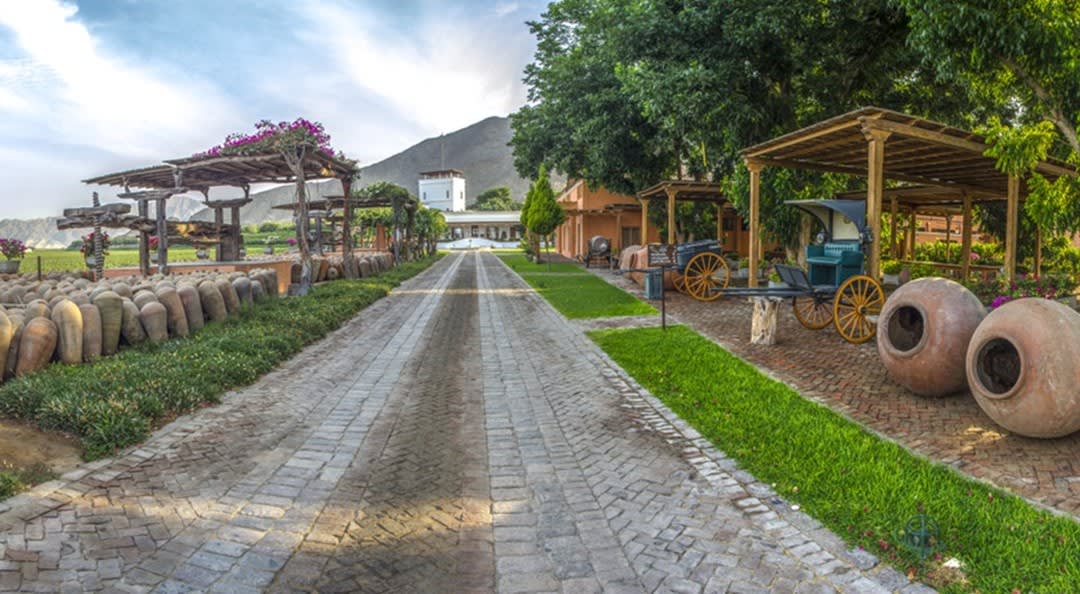
The Ica valley's pisco-producing estates range from the nineteenth-century industrial scale of Vista Alegre (founded 1857) to boutique family distilleries producing a few hundred cases annually for direct sale. Kada's route selects two to three bodegas per day, adjusted to the guest's interests and the season, with the sommelier's curation logic explaining why each was chosen for this particular tasting sequence.
The standard route opens with an estate of historical scale — the kind of operation that documents the Ica valley's commercial pisco production as an industry rather than a craft — and closes with the boutique producer where the distiller is also the winemaker and the viticulturist, where the decisions about what to plant and when to harvest and how to set the still are made by one person with thirty years of this valley's soil under their fingernails. The middle stop, if the programme includes three estates, is selected by the sommelier for a specific production argument: the estate that is doing something technically exceptional with the mosto verde, or the one whose acholado is currently the best argument for the blend in this valley's recent vintages.
The estates Kada accesses — Vista Alegre, La Caravedo, Tres Generaciones, and several boutique producers — are not all open to general visitors. Some conduct private tastings by appointment only; some open their historic facilities exclusively for referred clients. The sommelier's relationship with these estates, built over years of professional engagement, is part of what converts the route from a series of bodega visits into a curated argument.
The Distillation
Peruvian pisco must be distilled in a single pass in a copper pot still — no column rectification, no second distillation, no blending with neutral spirit after the fact. What comes out of the alambique on the first pass is what goes into the bottle, with the distiller making the cut between the cabeza (heads), the cuerpo (heart), and the cola (tails) by nose and instrument in real time. This is where the craft lives: the judgement call about when the heart starts and ends, made under the specific temperature and atmospheric conditions of the Ica desert on that day in that harvest.
The copper alambique is a traditional form — the pot and the swan neck and the condenser coil that the Spanish brought and the Ica valley adapted — and every serious Ica producer maintains at least one traditional still alongside any modern equipment. The sommelier's bodega visit includes the still room, where the distiller explains the specific cuts from the most recent harvest and what the decisions about head-tail separation produced in the final spirit. For guests who want to understand how pisco differs from other spirits made from grapes, this is where that understanding becomes concrete — not as an explanation from outside the still room, but as a demonstration from inside it, with the distiller describing his cuts from the most recent harvest, the specific decisions that shaped the cuerpo, and the problems the season created that no regulation required him to solve. That conversation is not available at the public tasting counter. It is available here because the sommelier's relationship with this estate made the question possible to ask.
What Kada Arranges
The route is shaped by a sommelier who has spent years working directly with Ica valley producers — not as a writer who visits the valley annually, but as a professional whose access to specific estates is the product of standing built over time in the valley itself. The producers Kada includes in the route — among them boutique operations that conduct tastings only for referred clients, and historic estates that open their facilities exclusively to visitors who arrive through an established relationship — receive the sommelier because he is known to them as a peer, not a customer. What changes in that context is the quality of what gets asked and answered: the cuts he made on last harvest's puro, the decision to blend rather than bottle the Italia as a single varietal, what the September humidity in the eastern valley section did to the fermentation. These are not the questions a tasting room visit answers for a general visitor. They are the questions the sommelier's relationship with the estate makes possible.
Private vehicle for the full route: the Ica valley's bodegas are spread across the valley floor, typically fifteen to forty minutes apart by road. The sommelier is in the vehicle throughout — the journey between estates is part of the session, used for the context-setting between one producer's approach and the next.
At each estate: thirty to sixty minutes, depending on the depth of the visit. The tasting at each bodega covers the estate's current range — the puro or puros, the acholado if they produce one, the mosto verde if available. The sommelier contextualises each expression against the previous estate's equivalent: the way the Quebranta reads differently in different clay-gravel ratios along the valley floor, the way the same varietal at the same latitude produces different distillates in the hands of a large commercial operation and a thirty-hectare family farm.
Lunch is typically at a valley restaurant between the second and third estate, or at a hacienda if the route coincides with the heritage dinner programme. The programme runs a full day; Kada designs the Ica pisco route as a complement to the Tacama hacienda visit, which is a natural first-day introduction to the valley's wine-and-pisco duality before the pisco route covers the broader landscape.
Expert Perspective
"The thing about pisco that most people don't know is how specific it is — not as a broad category, but grape by grape, valley by valley, harvest by harvest. I have been tasting through the Ica valley for years and I still find new things. The Quebranta from the western section of the valley, where the Humboldt Current fog comes in, is different from the Quebranta from the eastern section, where the Andean air is drier and the nights are colder. A well-made acholado tells you where it comes from and in what year. When I'm with guests on the route, the moment I find most useful is when we taste the same varietal — Italia, say — at two different estates and the same grape in the same valley tastes like two different arguments. That's when the geography becomes audible."
— Daniel Ramos, Co-Founder & CEO, KADA Travel
A Practical Note
Duration: the two-bodega route runs approximately four to five hours including transit and lunch; the three-bodega route is a full day of seven to eight hours. Kada recommends the two-bodega route for guests who are combining the pisco visit with other Ica activities on the same day, and the three-bodega route for guests dedicating a full day to the valley's pisco geography.
Season: the harvest and distillation season in the Ica valley runs from March through May. Visiting during this period provides access to the bodega in full production — the pressed must, the active fermentation, the stills running. Outside harvest, the bodegas are at rest; the tasting focuses on the previous harvest's bottled expressions. Both have their own quality of access; Kada communicates the seasonal difference at booking.
Pacing: pisco tasting at three estates across six hours is a volume that most guests manage comfortably with the route's built-in food and water intervals. Guests with lower alcohol tolerance who want to engage with the full session at each estate without restriction should discuss the pacing options with Kada in advance — the programme can be adjusted to a sipping-and-spitting format at each estate without diminishing the educational content.
Written by Kada Travel Editorial
Frequently Asked
This is a contested question with a long history. The Peruvian DOC establishes specific production rules: single-distillation pot still, no water added, no ageing requirement, from eight specific grape varietals. Chilean pisco production allows different methods. The historical origin of the name, the spirit, and the primary production geography are all subjects of ongoing diplomatic and commercial dispute between the two countries; the sommelier addresses this directly as part of the session. Kada takes no position on the diplomatic question; it sells Peruvian pisco in the Ica valley where it was made.
Yes, at most estates. Some boutique producers with limited production sell only to referred clients or visitors who have made prior appointments; the ability to purchase directly from the producer at the visit is one of the route's advantages over retail sourcing. The sommelier can advise on which estates to prioritise for specific expressions the guest has found compelling.
The route is designed as a tasting programme. Guests who are not spirits drinkers but are interested in the production and the agricultural geography can engage with the bodega visits — the vineyard, the still room, the production facility — without focusing on the consumption element. The sommelier calibrates the emphasis accordingly. The route is not a drinking circuit; it is a production-and-terroir argument that happens to include tasting.
The eight designated valleys produce pisco with distinct characteristics. The Ica valley Quebranta is the most widely recognised non-aromatic style; the Arequipa valleys produce a different expression influenced by the highland altitude and temperature range. The Lima valley producers are smaller in scale. The sommelier addresses the regional comparison as part of the session — the Ica valley route is the starting point, not the complete picture of Peruvian pisco geography.
Design Your Journey
Design your bespoke Peru journey
We talk. We listen. Then we design an itinerary that belongs only to you.
Start Planning