Unfolded· 7 min read·5 July 2026
The Vine That Arrived Before the Republic
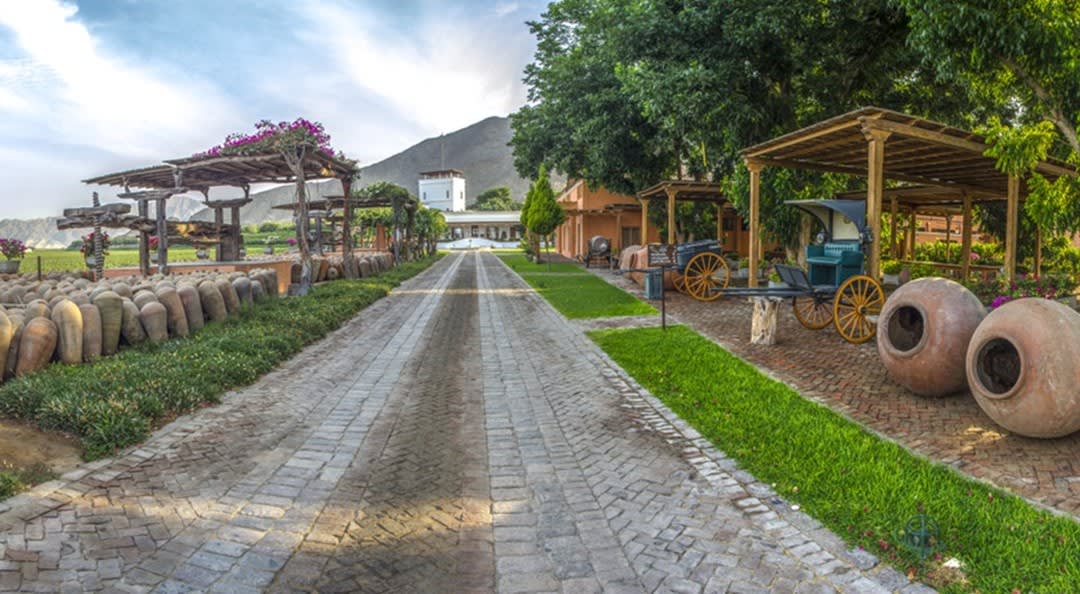
Hacienda Tacama, Ica valley — private tasting with the estate winemaker at the oldest continuously active vineyard in the Americas, where Quebranta vines first established in the sixteenth century continue to produce in soil that has been cultivated across five centuries of Andean, colonial, and republican Peruvian history.
By Kada Travel Editorial
Tacama has been producing wine in this valley since 1540, eight years after the first Spanish ships crossed the Andes and forty-seven years before Sir Walter Raleigh attempted Roanoke. What this means at the table is not nostalgia. It is that the soil — the gravelly, mineral-heavy alluvium of the Ica desert — has been read for almost five hundred harvests, and the vines in the ground today are the varietal descendants of cuttings carried across an ocean by men whose names appear in colonial inventories. The winemaker who walks the estate's rows now is building on an agronomic knowledge that was already old when Peru became a republic.
The estate that the Marqués de Calatayud established in the Ica valley in 1540 sits on land that was irrigated Andean agricultural territory before the Spanish arrived. The Nasca culture's underground aqueducts — the puquios — had managed the desert water table for centuries; the colonial hacienda appropriated this infrastructure and redirected it toward the vine. What Tacama grows now grows in soil that has been cultivated, without interruption, since before the concept of Peru existed as a nation. The Olaechea family, which has owned the estate since the nineteenth century, has navigated the transition from colonial hacienda to commercial wine and pisco producer — through independence, through wars, through the agricultural reforms of the 1960s that redistributed most of Peru's hacienda land. Tacama survived because it was already a functioning commercial estate by the time survival required it.
The Land Before the Vine
The Ica valley is an alluvial plain fed by the Ica River, which runs west from the Andes and typically terminates in the desert before reaching the Pacific. The underground aquifer the river feeds is what makes the valley green in one of the most arid environments on earth; the surface soil is gravelly, mineral-dense, and low in organic matter — conditions that commercial viticulture in more temperate climates would regard as challenging, but that specific wine geographies around the world have turned to advantage. The Ica valley's terroir is not a compromise with the desert; it is a product of it.
The extreme temperature variation between Ica days and nights — the desert heating to the mid-thirties during the day and cooling precipitously after sunset — functions in the vine the same way it functions in the Atacama and other desert wine regions: slow, even ripening, with the night cooling preserving the acidity that the day's heat would otherwise eliminate. The Humboldt Current's coastal influence, modifying the temperature in the valley's western reaches, adds a further variable that the estate's five centuries of observation have converted into varietal and site-specific decisions about where to plant what.
1540 and What Continuity Produces
The claim to the oldest continuously active vineyard in the Americas is supported by Tacama's founding documentation and production records. The qualification matters: the claim is not that the same individual vines have been in the ground since 1540 — vines do not live five hundred years — but that wine and pisco production on this land has not ceased since the first planting. The grafted varietal lineage of the Quebranta, the principal pisco grape of the Ica valley, has been maintained through the centuries; the specific genetic stock of Tacama's Quebranta may trace its varietal ancestry to those original Spanish cuttings, adapted over generations to the specific conditions of this valley.
What this produces is a wine — and a pisco — that has nowhere else to come from. Five hundred harvests of reading the same soil is an agronomic knowledge that cannot be imported or purchased. The winemaker at Tacama works in the same frames of reference that his predecessors worked in: the behaviour of the Quebranta vine in this specific clay-gravel mix in this specific microclimate, the point at which the harvest produces the must acidity that the distillate requires, the alambique adjustments that the desert heat of one year demands versus another. The question that comes back at the table is always the same: how does a country whose wine reputation is barely emerging produce something this exact?
The Quebranta
The Quebranta grape is the foundational varietal of Peruvian pisco. A thick-skinned, black grape with intense aromatic must, it produces the classic Ica valley pisco style — the puro de Quebranta — whose flavour profile is defined by the grape and the terroir rather than by aromatic compounds. Unlike the aromatic pisco varietals (Italia, Moscatel, Torontel), which produce the high-floral style common in commercial pisco, the Quebranta produces a restrained, mineral, fruit-forward spirit that requires quality control at both the vineyard and the alambique to distinguish excellent from average. There is no aromatic intensity to mask the distillation.
Tacama produces pisco in multiple expressions: the pure Quebranta, pure Italia, and the acholado — a blend of multiple varietals that is the most complex and site-specific expression of the Ica valley style. The mosto verde, distilled from partially fermented must at significant production cost, is the expression that most completely represents the grape's aromatics before fermentation has converted them. The winemaker presents all three in the tasting at the estate, explaining the varietal logic at each step — which converts a tasting of three glasses into a reading of how pisco typology is built.
The Two Bodegas
The Tacama estate operates two production facilities that correspond to two eras of its history. The old bodega — the traditional underground cellar adjacent to the colonial hacienda buildings, with stone floors and the annual temperature cycle of the desert — is where distillation and some wine ageing have occurred since methods evolved slowly from the colonial period. The new production facility, built in the twentieth century, applies contemporary winemaking technology to the same varietals in the same soil: stainless steel fermentation tanks, temperature-controlled storage, a working laboratory.
Both bodegas are included in the visit. The contrast is part of the argument: the copper alambiques, the barrel cellar, the traditional pressing equipment alongside the precision instruments of the modern facility. The estate uses both not as a heritage tourism gesture but because different products require different methods. The winemaker explains which is which and why. The logic of a five-hundred-year-old estate is not nostalgia versus modernity; it is continuity that incorporates what works and retains what has always worked.
What Kada Arranges
Private tasting with the Tacama estate winemaker, arranged outside the estate's standard visitor hours. The visit runs three to four hours: a guided tour of both bodegas, tasting of current wine and pisco expressions alongside the winemaker's commentary, and lunch in the hacienda's heritage comedor — prepared using local Ica valley produce, with the estate's current wine range on the table.
The hacienda is approximately fifteen minutes from the centre of Ica by private vehicle; the drive from Paracas takes approximately ninety minutes on the Pan-American Highway. Kada coordinates the transfer as part of the programme. The Tacama visit is most naturally combined with a half-day in Huacachina on the same day, or with the pisco route programme on the following day, as part of a full Ica valley itinerary.
Expert Perspective
"What I find myself thinking about at Tacama — and I have been there many times — is the specific kind of knowledge that only time makes possible. Not the wine, though the wine is excellent. The way the winemaker talks about this soil is the way you talk about something you have been watching your whole life, that your family watched before you. He knows which section of the vineyard the frost reaches first in an unusual year. He knows what the soil's moisture profile looks like in March versus September at a specific depth. This is not knowledge you can read in a book or bring from another wine region. It took five hundred harvests to produce. The Tacama visit is the only place in Peru where you can sit with that knowledge at a table and ask it questions."
— Katherine Cjuiro, Founder, KADA Travel
A Practical Note
Location: Hacienda Tacama is approximately 15 km from the centre of Ica, accessible by private vehicle. The drive from Paracas takes approximately 90 minutes on the Pan-American Highway. Kada coordinates the transfer as part of the programme.
Harvest season: the Ica valley harvest (vendimia) occurs in March and April. A visit during harvest provides a different quality of access — the bodega in full production, the harvest crew in the vineyard, the must in the fermentation vessels. The tasting programme is available year-round; Kada communicates harvest timing for guests who want to plan around it.
Mobility: the estate grounds involve walking on unpaved surfaces between the old bodega, the production facility, and the hacienda buildings. The route is generally flat; guests with mobility considerations should flag this at booking.
Written by Kada Travel Editorial
Frequently Asked
Tacama holds documentation for continuous wine production on this land since 1540, supporting the claim. The qualification "continuously active" is important: other colonial wine estates in the Americas that have ceased production at some point do not qualify under the same criterion. The Olaechea family archives substantiate the founding date and the unbroken production lineage.
Tacama produces both as separate products from the same estate's grapes. Wine is fermented grape juice that is not distilled; pisco is produced by distillation of fresh grape must before complete fermentation. The same Quebranta grapes supply both products; the winemaker and production team determine the allocation by varietal and quality criteria. The tasting includes both product lines alongside the winemaker's explanation of how each is made.
Yes. The hacienda and Huacachina oasis are both in the Ica valley, approximately twenty minutes apart by vehicle. Kada designs the Ica full-day programme to include both: morning at the hacienda for the winery visit and lunch, afternoon at Huacachina for the sunset dunes circuit. The combination gives the Ica valley in its two distinct registers — the agricultural heritage and the desert landscape — in a single full day.
The winemaker presents each expression as a product of specific decisions about harvest, fermentation, and distillation, rather than as a sales catalogue. Guests are welcome to purchase estate products; no obligation is created. The visit is a private programme; there is no retail component that the standard visitor experience involves.
Design Your Journey
Design your bespoke Peru journey
We talk. We listen. Then we design an itinerary that belongs only to you.
Start Planning