Unfolded· 7 min read·26 July 2026
The Bull on the Roof
A morning at a Pucará master potter's workshop — the small ceramic bulls placed on Andean rooftops for protection and fertility, made in the same town using the same clay tradition that began more than two thousand years ago. The torito de Pucará is the most widely recognised symbol of the Andean house, and most people who recognise it have no idea where it comes from.
By Kada Travel Editorial
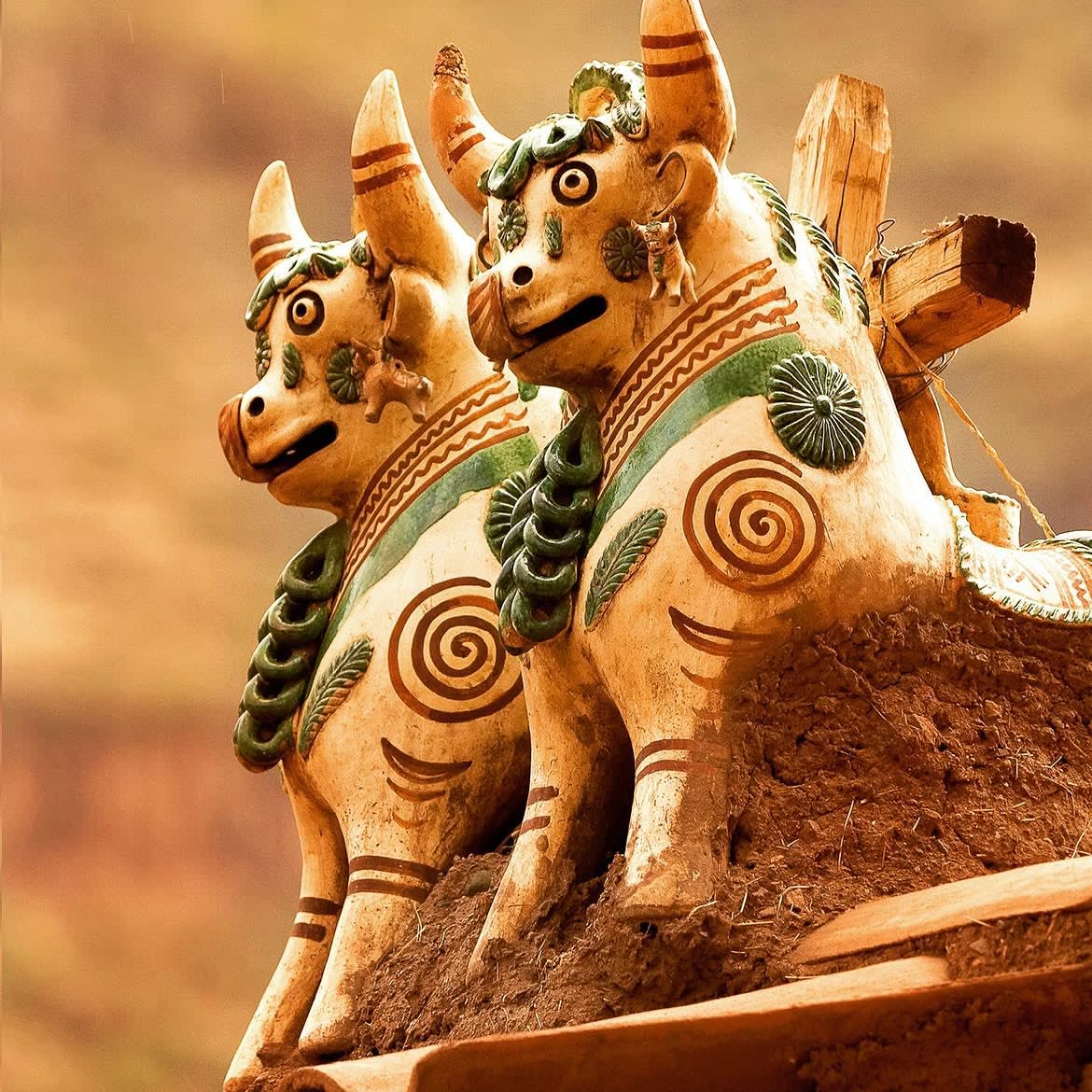
On the rooftops of Andean houses — from Puno to Cusco, from the altiplano to the Sacred Valley — you see small ceramic bulls. They stand on the ridgeline of thatched or tile roofs, often in pairs, facing outward over the edge. If you ask the families inside about them, you hear consistent answers across communities that have never been in contact with each other: the bulls protect the house, bring fertility and abundance, and mark the house as inhabited by people who maintain their obligations to the land. The bulls are called toritos de Pucará. And they come from one place.
Pucará is a small town in the altiplano north of Puno, on the road that runs between Puno and Cusco. It sits at approximately 3,900 metres, in the high plain between the lake and the southern Peruvian highlands. The town is unremarkable by altiplano standards — a market square, a church, a scattering of houses — except that it has been making ceramics continuously for more than two thousand years.
Most people who have a torito de Pucará at home acquired it in a market in Puno or Cusco — a piece cast in a mould, fired in a gas kiln, made at speed for tourist-market volume. The form is correct; the bull looks like a bull. What a market torito does not carry is the clay this specific town sits on, the wood kiln this specific family has fired for generations, or the hand-modelling sequence that produces the weight and slight variation that distinguish a workshop piece from a reproduced one. The visit Kada arranges goes to the source.
The Pucará Culture
The Pucará archaeological culture (approximately 200 BCE to 300 CE) is one of the predecessors of Tiwanaku — the major ceremonial and political centre on the Bolivian side of the lake that reached its peak between 500 and 1000 CE. Pucará was a significant ceremonial site in its own right: the excavated temple complex, studied by Peruvian and international archaeologists since the mid-twentieth century, shows evidence of large-scale ceremony, specialised craft production, and long-distance trade connections throughout the southern Andes.
The ceramics of the Pucará culture — excavated from the site and from burial contexts throughout the region — are sophisticated: polychrome painted vessels with geometric and zoomorphic motifs, technical execution that required controlled firing at significant temperatures, and a formal vocabulary that influenced subsequent traditions including Tiwanaku. The relationship between the pre-Hispanic Pucará ceramic tradition and the contemporary torito de Pucará made in the town today is not simple inheritance — the colonial period interrupted the continuity, and the bull figure itself is a European import (cattle did not exist in the pre-Hispanic Andes). But the making of ceramics in this specific place, from this specific clay, has continued across the rupture.
The Torito
The torito de Pucará — the small ceramic bull — is simultaneously the most recognisable symbol of the Andean house and one of the least understood by the people who display it. The bull figure was adapted by Andean communities in the colonial period from the Spanish cattle introduced after 1532, and invested with pre-existing beliefs about fertility, abundance, and the protection of the domestic space. The specific form of the Pucará bull — modelled in local clay, fired with local fuel, painted in the specific palette of red, white, and green that characterises the tradition — carries the accumulated associations of the communities that have used it for five centuries.
The bull's placement on the rooftop ridgeline is not decorative. It marks the house as protected — by the bull's own force, by the land on which the house stands, and by the household's continued maintenance of the relationship between the domestic space and the world outside. When families move from rural to urban settings, the torito moves with them. When the ceramic weathers and breaks, it is replaced. The practice is not declining; it is present in new construction as in old.
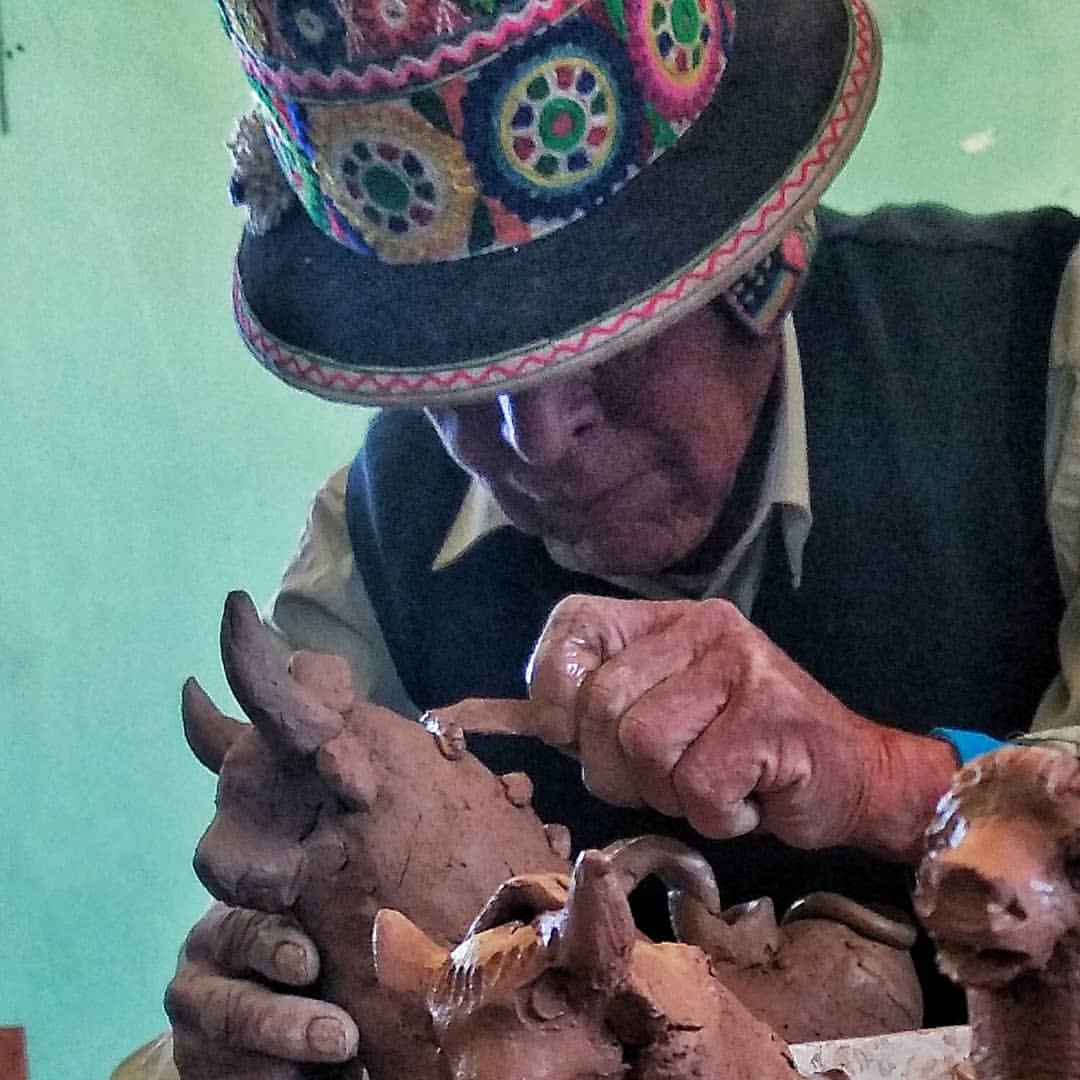
The master potter who makes these bulls — in a workshop attached to his family house in Pucará, using clay extracted from a specific deposit outside town, fired in a kiln his family has maintained for generations — has supplied toritos to communities throughout the altiplano. He has also supplied them to collections and to visitors passing through on the Puno-Cusco route, which is how most non-Andean people encounter the form.
The Workshop Visit
The visit to the Pucará workshop is a morning: arriving at the workshop around 9:00 AM, spending two to three hours with the master potter, and returning to the road by midday. Pucará is approximately eighty kilometres north of Puno on the direct road to Cusco — a ninety-minute drive on paved road, making it a natural stop on the overland route between Puno and Cusco for guests continuing northward.
What the workshop morning looks like: the master potter works at his normal pace, on whatever stage of production he is currently at. The production cycle of the torito involves several stages — clay preparation, modelling, drying, surface treatment, painting, firing — and the guest typically encounters one or two stages in progress. The potter explains each stage: where the clay comes from and why, the specific proportion of local clay to temper that produces a body strong enough to survive firing without cracking, the modelling sequence that produces the bull's form, the painting process that applies the distinctive palette.
Guests who want to model clay can. The master potter is patient with beginners and direct about technique. The piece a guest produces will not be a finished torito — the clay needs to dry for days before it can be fired, and firing takes additional time — but working the clay with the potter's guidance produces a physical understanding of what the technique requires that observation alone does not.
For guests who want to take home a torito: the master potter has finished pieces available for direct purchase, and the quality is not the same as what is sold in tourist markets in Puno or Cusco. Commissions for specific pieces — size, colour combination, paired figures — are possible, and the master potter can arrange shipping.
What the morning adds to the object a guest takes home — if they choose to take one — is not sentimental. A finished torito purchased from the master potter carries something a market torito cannot: the specific clay of a deposit several kilometres outside town, the surface character that wood firing produces and gas firing does not, the slight variation in proportion that distinguishes a modelled piece from a moulded one. These are not romantic additions. They are the conditions that produce a piece that communities throughout the altiplano have chosen to place on their rooftops as working objects — not as souvenirs of a tradition, but as participants in one.
The Road and the Landscape
Pucará is a stop on a journey, not a destination in itself. For guests travelling the altiplano route between Puno and Cusco by road — which Kada recommends over the direct flight for guests with sufficient time, because the landscape is the journey — the workshop is a natural pause at the three-hour mark. The drive from Puno to Pucará crosses the flat high plain of the altiplano at altitudes between 3,800 and 4,100 metres, passing through market towns whose characters change with the day of the week.
The archaeological site of Pucará itself — the excavated temple complex above the town — is accessible on foot from the town square and provides context for the contemporary ceramic tradition. The site museum contains excavated ceramics from the Pucará culture; seeing the pre-Hispanic originals before visiting the contemporary workshop makes the continuity — partial, interrupted, real — visible.
What Kada Arranges
The master potter Kada works with has produced toritos in this workshop since he was learning the technique beside his father — who learned it beside his. He works with clay extracted from a specific deposit several kilometres outside town, a deposit the family has worked for generations because the mineral composition fires to a density that clay from market-town suppliers does not. The kiln is wood-fired, the same structure his father used, producing the surface character that gas firing cannot replicate. He supplies communities throughout the altiplano — households that place his toritos on their rooftops as working objects, not as decorative purchases — and collectors who know the difference between a hand-modelled piece and a mould-cast one. The Kada partnership means the morning visit is a scheduled part of a day he has prepared for, not an interruption to his work.
The Pucará visit is incorporated into the Puno-Cusco overland transfer for guests who choose the road route. Kada coordinates departure from Puno to reach Pucará by mid-morning, with the workshop visit followed by lunch in town and arrival in Cusco in the late afternoon. The master potter relationship is an established Kada partnership; the morning is not a walk-in visit.
For guests based in Puno who want to visit Pucará without continuing to Cusco, the return to Puno by afternoon is straightforward — the round trip is approximately three hours of driving plus the workshop morning.
Expert Perspective
"What strikes me most at the Pucará workshop is the confidence of the form. The master potter makes the same bull he has made for thirty years, that his father made before him, that the tradition has made since the colonial period. He is not uncertain about the form — he does not need to think about it. When he models the bull's head, the ears, the horns, the proportion of body to leg, he is executing something that is already in his hands before the clay is. That confidence is the product of repetition across generations, and it is what the tourist-market versions lack — they are made quickly by people who have learned the form from the outside. The potter's version is made from the inside."
— Isabela Santos, Senior Travel Designer, KADA Travel
A Practical Note
Location: Pucará is approximately 80 kilometres north of Puno on the direct road to Cusco (approximately 90 minutes by private vehicle). It works best as part of an overland transfer or as a dedicated full-day excursion with private vehicle.
Market days: Pucará's market operates on specific days of the week, Sundays being the most active. Combining the workshop visit with a market day adds an additional layer — the market includes food stalls, agricultural produce, and ceramic vendors alongside the standard altiplano market goods. Kada will confirm the market schedule when planning.
Altitude: Pucará is at approximately 3,900 metres — slightly higher than Puno. Guests acclimatised to Puno altitude will have no additional issue. Guests arriving before acclimatisation should be aware of the elevation.
Purchase and shipping: The master potter can prepare pieces for international shipping. Toritos are earthenware, fired to withstand outdoor conditions — durable, not fragile porcelain. The potter's family handles packing and shipping; the cost can be included in the commission price.
Written by Kada Travel Editorial
Frequently Asked
The Pucará culture flourished in the altiplano north of Lake Titicaca from approximately 200 BCE to 300 CE. It was one of the most significant ceremonial cultures of the southern Andes during that period, with a major temple complex, specialised craft production, and trade connections throughout the region. Tiwanaku, the dominant culture of the Titicaca basin from approximately 500 to 1000 CE, developed on the Bolivian side of the lake and incorporated many elements of the Pucará tradition. Some archaeologists describe Pucará as a predecessor state to Tiwanaku; others treat them as related but parallel traditions. The ceramic vocabulary of Pucará — the polychrome geometric and zoomorphic styles — is visible in the later Tiwanaku tradition, suggesting cultural transmission.
The rooftop placement is specific to the ridge of the roof — the highest point of the structure, and the boundary between the interior domestic world and the exterior world. The torito on the ridge guards this boundary — facing outward, the pair of bulls creates a protective presence at the most exposed point of the house. Some ethnographic accounts describe the initial placement of the torito as a ceremony in itself: the day a new house is complete, the bulls are installed with a small offering that marks the relationship between the household and the land.
Market toritos — the painted bulls sold in tourist markets in Puno and Cusco — are typically produced by slip-casting in moulds, which produces a uniform form without the slight variation that hand-modelling produces. The clay body is often different from the traditional Pucará clay, and the firing may use a gas kiln rather than the wood kiln the Pucará workshop uses. The result is visually similar to the traditional piece but lacks the density and surface texture of a handmade piece. Workshop pieces by the master potter are significantly more expensive and worth it.
Yes. The master potter accepts commissions for specific sizes, specific colour combinations within the traditional palette, and paired figures. The production time depends on the clay drying and firing cycle — typically two to three weeks. International shipping can be arranged by the potter's family. Kada can facilitate the commission communication and payment.
Design Your Journey
Design your bespoke Peru journey
We talk. We listen. Then we design an itinerary that belongs only to you.
Start PlanningRelated Stories