Unfolded· 8 min read·22 July 2026
The Towers the Inca Did Not Build
A private afternoon and sunset at Sillustani with an archaeologist — the Colla and Lupaqa funerary towers above laguna Umayo, arrived at when the standard groups have gone and the altiplano light turns the stone to amber. Architecture that pre-dates the Inca and, in certain technical respects, rivals it.
By Kada Travel Editorial
The standard visit to Sillustani lasts ninety minutes. It includes a guide with a group of twelve to twenty people, a scripted route between the four most photographed chullpas, and a departure timed to return to Puno before dark. For most of the people who make this visit, Sillustani registers as a scenic addition to the Puno itinerary — towers on a peninsula, pre-Inca, photogenic at sunset, interesting.
What the ninety-minute visit does not permit is what Sillustani actually is: one of the most technically sophisticated pre-Hispanic funerary complexes in the southern Andes, built by a culture that the Inca conquered and partially absorbed but never fully replaced, using a stoneworking technique that some archaeologists consider comparable to Inca masonry in precision and in certain structural respects superior to it. The chullpas of Sillustani are not a footnote in the story of Andean civilisation. They are a chapter of it that most visitors skip.
The Colla and the Lupaqa
Sillustani is a Colla and Lupaqa site. These are distinct pre-Inca cultures — the two dominant peoples of the Titicaca basin before Inca expansion in the late fourteenth and early fifteenth centuries. The Colla controlled the northern shore of the lake and the altiplano above it; the Lupaqa controlled the southwestern shore, including the area around modern Puno. Their political relationship was competitive and sometimes violent. Their funerary traditions converged at Sillustani, a peninsula projected into the laguna Umayo — a smaller lake connected to Titicaca by a narrow channel — which appears to have functioned as a shared sacred site.
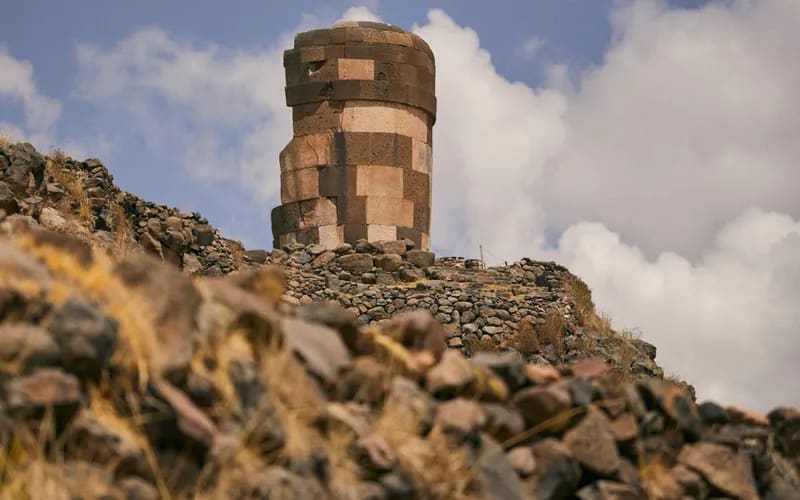
The chullpa — the Quechua word for funerary tower — is not exclusively a Colla or Lupaqa invention. Funerary towers exist throughout the southern Andes and into what is now Bolivia. What distinguishes the Sillustani chullpas is their scale and their technical ambition. The largest towers reach twelve metres in height. Several of them taper inward as they rise, then flare outward at the top — an inverted taper that defies the structural logic of simple stacking and required its builders to work with a level of precision in stone-cutting that contemporary engineers find notable. The doorways — small rectangular openings facing east, toward the rising sun — were sealed after the burial of the mummy and its grave goods. Some burial chambers have been excavated; others remain intact.
The dating places the main construction period between approximately 1100 and 1450 CE — before Inca expansion reached the Titicaca basin. The Inca arrived in the region around 1450, incorporated the Colla and Lupaqa into the empire, and in some cases added their own construction to existing Colla sites. At Sillustani, the Inca presence is visible but secondary. The overwhelming visual logic of the site is Colla and Lupaqa.
The Stonework
The archaeological debate about the Sillustani stonework is not a minor point. The blocks used in the largest chullpas — particularly the Chullpa del Lagarto, which at twelve metres is the tallest on the site — are fitted without mortar, with no visible gap between courses. The blocks were cut from local volcanic stone, a reddish-brown andesite, and shaped in ways that interlock at angles, producing walls with structural integrity that has survived six hundred years at altitude in a climate of extreme diurnal temperature variation.
The comparison to Inca masonry is instructive. The Inca were extraordinary builders — the polygonal stonework of Sacsayhuamán and the coursed ashlar of Ollantaytambo represent the highest expression of Andean stonemasonry. What the archaeologist who accompanies Kada visits points out is a specific technical detail: the Colla builders at Sillustani worked their larger blocks from the exterior face inward, producing what appears to be a flat surface but is actually a slight convexity — a technique that accounts for the compression of the wall under its own weight and resists the gradual outward lean that flat-faced masonry develops over centuries. Whether this is deliberate engineering or emergent from the Colla building practice is a subject of ongoing research. What it produces is walls that have remained structurally sound longer than some comparably sized constructions of later periods.
The Light and the Site
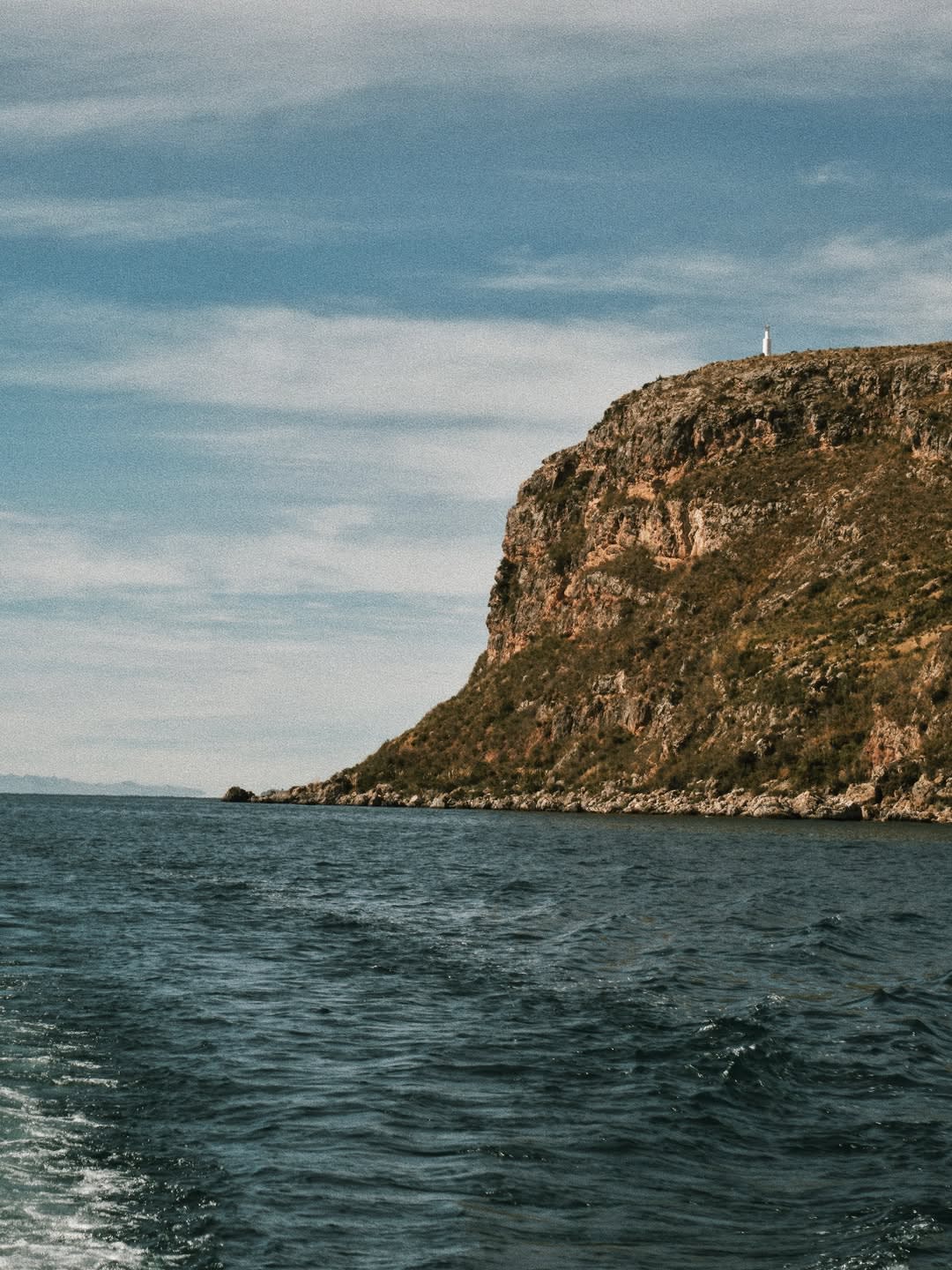
Sillustani faces west over the laguna Umayo. The peninsula on which the chullpas stand is elevated above the lake — the towers are visible from considerable distances across the water, which may have been deliberate: a landscape feature as much as a burial site, marking the presence of the dead on the topography of the lake.
At sunset, the towers catch the altiplano light from the west. The andesite, which appears grey-brown at midday, turns amber and then deepening orange as the sun drops toward the horizon. The laguna Umayo below reflects the same light. The visual effect — documented in photographs that have circulated widely enough to make Sillustani one of the iconic images of highland Peru — is real, and it is best experienced from the site itself rather than from a photograph.
The standard tour groups arrive in the late afternoon and leave by sunset. Kada's coordination with site authorities allows access after the standard closing time, which means guests arrive as the last tour groups depart and have the site in private for the duration of the sunset. Two to three hours at the site — unhurried, with the archaeologist available for questions — is a different experience than ninety minutes with a group.
The Archaeologist
The archaeologist who accompanies Kada visits to Sillustani has conducted fieldwork on Colla funerary practices and contributed to research on the relationship between Sillustani and the broader Titicaca basin archaeological record. This is not a guide who has memorised information about the site. It is a researcher who has spent years with the specific questions the site raises: who ordered the construction of which chullpas, how the Colla elite buried their dead and what that reveals about social structure, how the Lupaqa tradition interacted with the Colla at this shared sacred space, and what the Inca incorporation of the site changed and did not change.
The visit follows no fixed script. The archaeologist reads the site for what the guests are curious about. For guests whose primary interest is the architecture, the visit concentrates on the stonework — the individual towers, the building sequence, the engineering logic. For guests whose interest is the social history, the visit concentrates on what the chullpas contain and what that reveals about the people buried in them. For guests whose interest is the landscape, the visit includes the relationship of the peninsula to the laguna Umayo, the sight lines from the site, and the geography of the Colla territory that extended from Sillustani across the altiplano.
What Kada Arranges
The Sillustani visit departs Puno in the early afternoon — timed to reach the site mid-afternoon, when the standard tour groups are present but beginning to thin, and to remain through and past the standard closing time. The drive from Puno is approximately forty-five minutes on paved road, with views across the altiplano and, in the final approach, the laguna Umayo below the site.
The archaeologist meets the group at the site entrance. The visit lasts approximately two and a half to three hours, ending after sunset. The return to Puno arrives in the early evening; dinner reservations in Puno can be arranged to follow.
For guests continuing to the Titicaca community visits (Articles 3 and 4), Sillustani pairs naturally as the archaeological context for the human communities that still inhabit the basin — the pre-Inca heritage that precedes and frames the Quechua and Aymara cultures present on the lake today.
Expert Perspective
"What I try to explain at Sillustani is that the Colla built something the Inca chose not to replace. In most of the southern Andes, Inca construction superseded what came before — the Inca reorganised sites, built over existing temples, imposed their own architectural logic on the landscape. At Sillustani, they added to the site but did not demolish what was there. The Colla chullpas remained standing alongside whatever the Inca built. That's unusual. Either the Inca found the Colla funerary tradition compatible enough with their own to preserve it, or they found it powerful enough to leave alone. The distinction matters, and it's the kind of question that the towers themselves pose if you stand with them long enough."
— Jaime Ttito, Head of Guides & Cultural Interpreter, KADA Travel
A Practical Note
Altitude: Sillustani stands at approximately 3,850 metres above sea level — slightly above Puno (3,827m). Guests who have not yet acclimatised to the altiplano should plan this visit for the second or third day of their Puno programme. The walk around the site involves uneven ground and some gentle ascent between towers; physically manageable at altitude but requiring a slow pace.
Temperature: The altiplano at sunset loses heat rapidly. The afternoon may be warm; by the time the light reaches the main towers, the temperature will have dropped significantly. Layered clothing — including a wind layer — is necessary regardless of the season. The site is exposed and there is no shelter.
Photography: The sunset light at Sillustani is extraordinary and the temptation to photograph continuously is understandable. The archaeologist's commentary and photography are not in competition — the visit is long enough for both. The most interesting photographs are typically taken at the moment the sun touches the horizon, which arrives approximately ninety minutes after the standard tour groups have left.
Access: Kada's coordination with the site authority allows post-closing access. This arrangement depends on advance notice and is not available for walk-in visits.
Written by Kada Travel Editorial
Frequently Asked
The Colla and Lupaqa were the two dominant cultures of the Titicaca basin before Inca expansion. The Colla controlled the northern lake shore and the high altiplano; the Lupaqa controlled the southwestern shore, including the area around modern Puno. They were distinct peoples with related but separate political structures, and their relationship was competitive. Both built chullpas at Sillustani and at other sites in the region. After Inca incorporation in the mid-fifteenth century, both cultures were absorbed into the Tawantinsuyu, but their communities survived as recognisable entities into the colonial period. The distinction matters at Sillustani because some towers are associated with Colla elite burials and others with Lupaqa — the site is a shared funerary landscape, not a homogeneous one.
The comparison is instructive precisely because Sillustani is not Inca. The Inca incorporated the Colla and Lupaqa into their empire and added construction to Sillustani, but the dominant logic of the site is pre-Inca. The scale of the largest chullpas rivals Inca construction; the stoneworking technique is comparable in precision. What Sillustani offers that purely Inca sites do not is evidence that the Inca were the inheritors of a sophisticated Andean building tradition, not its inventors. The chullpas make that argument in stone.
Some chullpas have been partially excavated; others remain sealed. The mummies and grave goods from excavated chambers are in the regional museum in Puno and in national collections. The unexcavated chambers retain their contents — the Colla practice was to inter mummies in a seated position, facing east, with ceramics, textiles, and other grave goods. The archaeologist can describe the contents of excavated chambers in detail; access to the interiors of the towers is not permitted.
The laguna Umayo is a shallow lake connected to Titicaca by a narrow channel. Archaeological evidence suggests it was a sacred body of water in the Colla world — the peninsula of Sillustani, jutting into it, was chosen as a funerary site not only for its elevated position but for its relationship to the water. In the Andean cosmological framework shared by both Quechua and Aymara traditions, bodies of water — particularly lakes — are associated with the passage between the world of the living and the world of the dead. The placement of a funerary complex on a peninsula extending into a sacred lake was not incidental.
Design Your Journey
Design your bespoke Peru journey
We talk. We listen. Then we design an itinerary that belongs only to you.
Start Planning