Unfolded· 8 min read·13 July 2026
The Highest Water, the Quietest Night
Two choices for sleeping on the lake itself — Suasi, the only private island on Titicaca, a solar-powered lodge with forty-three hectares of highland grassland and views that reach the Bolivian cordillera; and Anapia, the community island near the border where families host guests in their homes. The choice between them is a choice between two kinds of solitude, both at 3,812 metres.
By Kada Travel Editorial
The Kada Peru catalogue runs from Lima at sea level to Titicaca at 3,812 metres. In between, it passes through Paracas (coastal desert, Pacific fog), the Amazonas basin (cloud forest canopy, river tributaries), Arequipa (volcanic stone, canyon depth), and Cusco (high Andean agriculture, Inca stonework). The range is the point: Peru is not one landscape or one climate or one culture, and the catalogue does not pretend otherwise.
The Titicaca articles close the catalogue — not as a conclusion, because Peru does not conclude and neither does the lake, but as an end-point that is also the furthest point from Lima in altitude, in culture, in the character of the silence. The lake at night, at 3,812 metres, without city noise or vehicle noise or connectivity, is as quiet as any place in Peru at this latitude. The stars are close. The water is still. What there is to do is be there.
The Lake
Titicaca covers 8,372 square kilometres — the largest lake in South America by volume, and the world's highest navigable lake. Its deepest point reaches 281 metres below the surface. The water is blue-green in direct light and shifts to a reflective silver at dawn and dusk. At 3,812 metres, the air over the lake is thinner than at most inhabited places on earth; the sky is correspondingly darker at night, and the stars visible from an island without artificial light are those of the full highland sky.
The lake is navigable — boats travel it, fishing is conducted on it, and communities have lived on its shores and islands since before the Inca. The totora reeds that grow in the shallow bays around the shore have been harvested for boats, houses, and food since the pre-Inca period. The fauna of the lake includes the Titicaca water frog (Telmatobius culeus), the world's largest fully aquatic frog, and a variety of waterbirds including the Andean grebe, several species of coot, and the flightless Titicaca grebe. The bird population around the island lodges is visible from the shore in the early morning.
Suasi
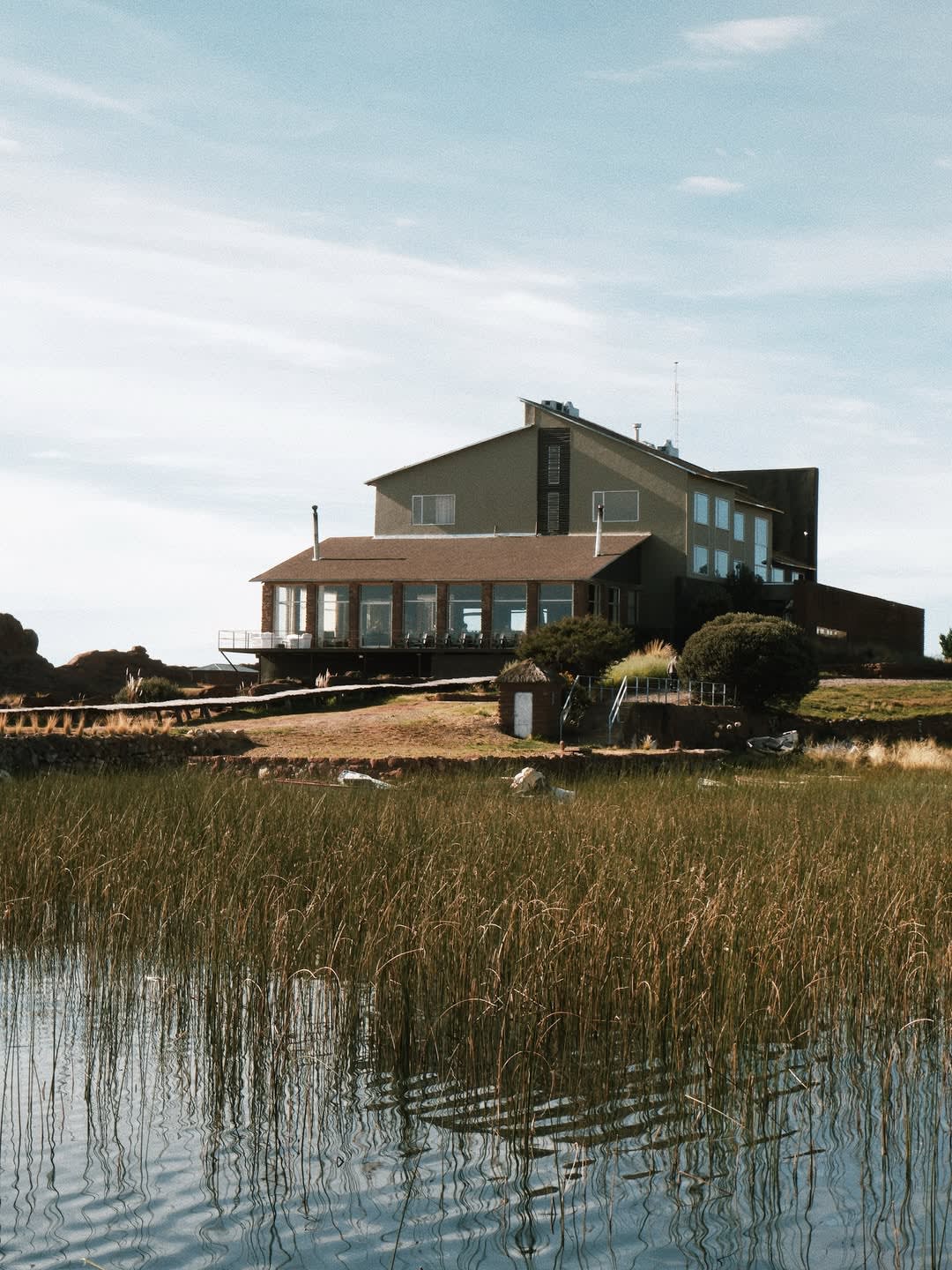
Suasi is the only private island on Lake Titicaca on the Peruvian side. Approximately forty-three hectares — a low, rounded island in the northwestern section of the lake, visible from the Capachica peninsula — it is operated as a lodge by Casa Andina, the Peruvian hotel group. The lodge runs entirely on solar power. There is no grid connection to the mainland; electricity is generated on the island, and water comes from a spring within the property. The rooms are stone and adobe construction — individual casitas designed to sit within the island landscape rather than impose upon it.
The scale is deliberately limited: the lodge accepts a small number of guests at a time, which is what makes the island feel private. There are no other guests in sight; there is no restaurant noise from another table; there is no lobby traffic.
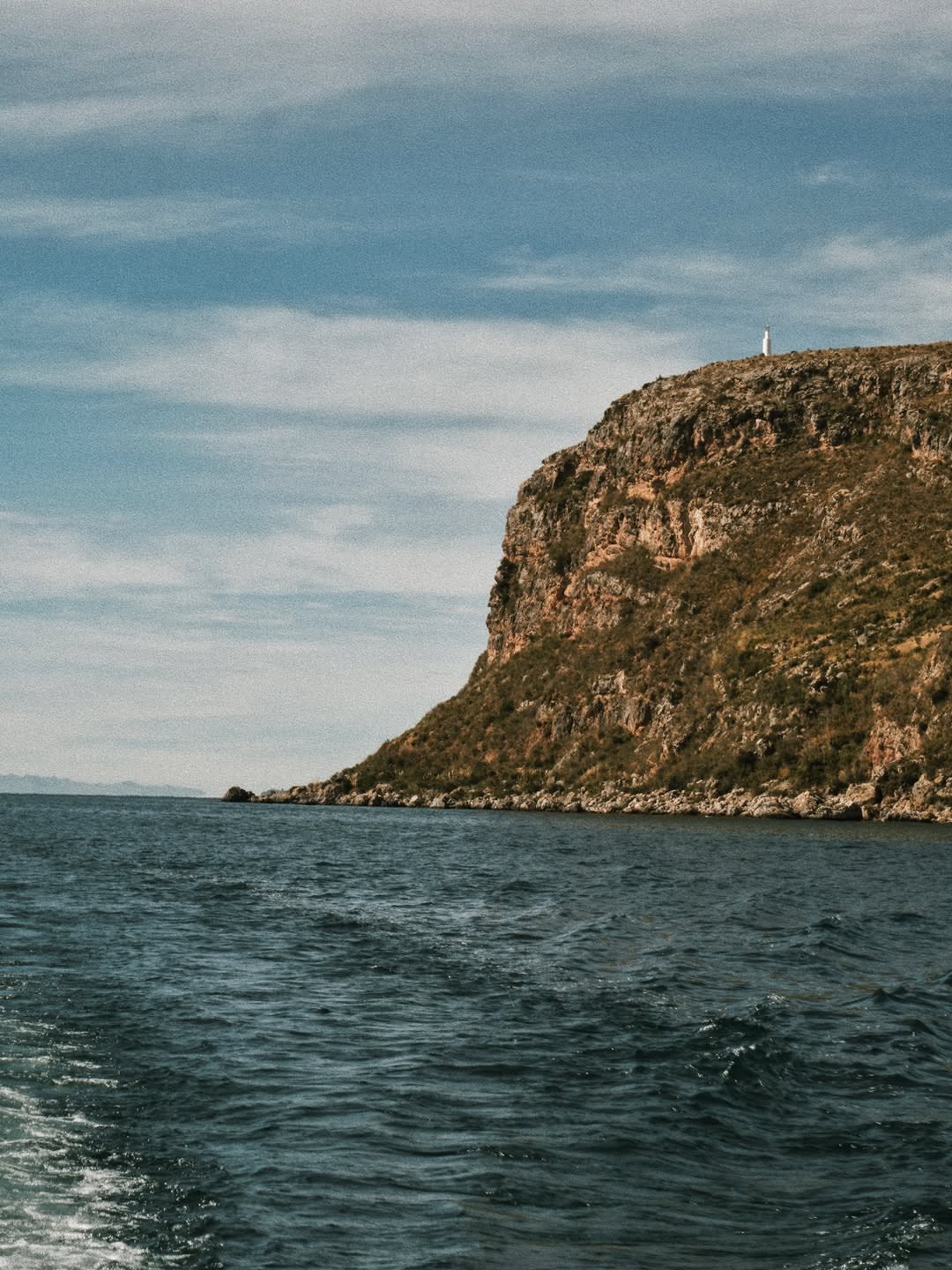
What Suasi offers: the island itself, which can be walked in two to three hours including the elevated northwest point with its view over the lake to the Bolivian cordillera; birdwatching from the shore in the early morning hours when the Andean grebes and coots are most active; kayaking on the lake (the water is cold — 12 to 14°C — and the kayaking is calm-water paddling, not sport); trout fishing in the lake around the island; and dinner at the lodge prepared from local produce with lake trout as the centrepiece. The altitude and the absence of connectivity are not problems to solve — they are the experience.
Kada's approach to Suasi is not the standard lodge package. The private lancha from Puno — approximately two to two-and-a-half hours on the open lake, including sections where the mainland is no longer visible — is part of the experience that a standard transfer does not offer. The programme on the island — which activities, in what sequence, at what pace — is designed in advance with the guest, not assigned by the lodge schedule.
Anapia
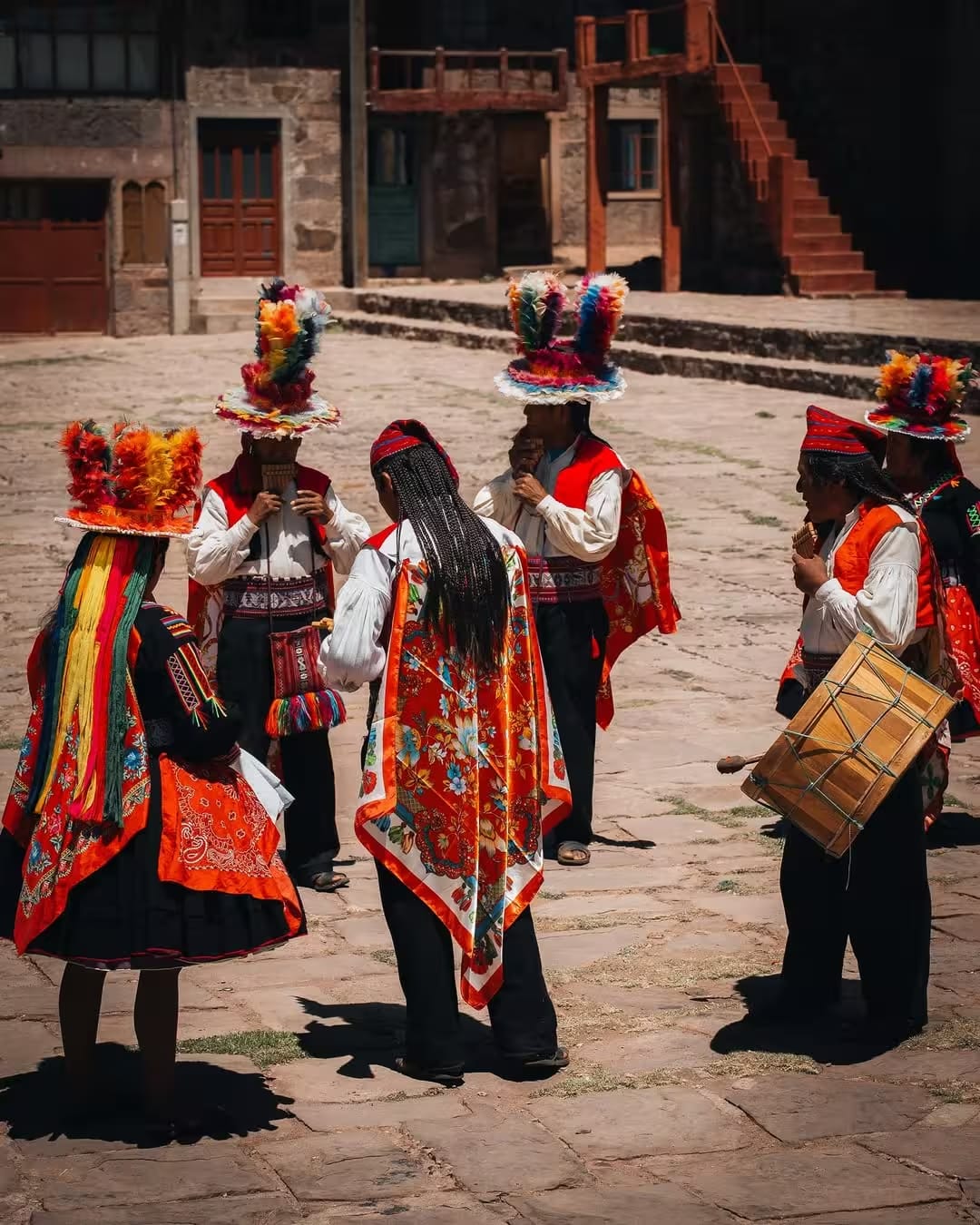
Anapia is a different kind of island. It is part of the Wiñaymarca archipiélago, in the southern section of the Titicaca near the Bolivian border. The island is inhabited by a farming and fishing community of approximately 600 people who have organised a homestay tourism programme — guests sleep in family homes, eat what the family eats, and participate in or observe the island's agricultural and fishing daily life.
The comparison to Suasi is instructive. Suasi is privacy as an amenity — the island is your space, the lodge serves you, the experience is organised around what you want. Anapia is community as the experience — the island is the community's space, the family hosts you, the experience is organised around what the community is doing. Both are on the lake at 3,812 metres. Both are genuinely isolated from mainland noise and connectivity. What you do in that isolation is different.
For guests who have spent several days in luxury properties in Cusco or Lima and want one experience that is the opposite of service — where the value is in being received by a family on their own terms rather than in being attended to — Anapia is the experience. The food is what the family produces: lake trout, chuño (freeze-dried potato, a technique invented on the altiplano centuries ago), quinua soup, herbal tea. The room is a family room. The morning is the family's morning, and the guest is in it.
The Choice
The choice between Suasi and Anapia is character-dependent rather than quality-dependent.
Suasi for: couples on a significant journey who want solitude together and the sensation of having the lake to themselves. Guests for whom comfort and privacy are important and who will use the island as a place to be still rather than to gather experiences. The final night of a long Peru journey, where the exhaustion of travel is real and the reward should be unambiguous.
Anapia for: guests who have done several luxury properties and want one experience that ruptures the register — where the value is in the encounter, not the comfort. Guests who travel to Peru specifically for community contact and for whom the homestay is not a compromise but the point. Guests who have read the rest of this catalogue and want to understand the lake through its people rather than through its view.
Some guests do both: one night on Suasi, one night on Anapia, in either order. The contrast is sharp and intentional. The lake seen from a solar-powered lodge in private, then the lake seen from a family kitchen with the community's morning beginning outside the window.
What Kada Arranges
For Suasi: private lancha from Puno, coordinated arrival with the lodge, programme design for the island stay — activities, meals, bird guide if wanted. The lancha takes approximately two to two-and-a-half hours across the lake; the crossing itself, through the open water as it widens northward, is part of the programme. Kada does not book Suasi as a standard transfer; the approach and departure are treated as part of the island experience.
For Anapia: advance coordination with the community tourism cooperative, allocation to a specific family — Kada provides information about the guest's interests and any practical requirements, so the allocation suits them. Transport to the port and private lancha across the Wiñaymarca section. The community controls the allocation; Kada does not select the specific family but provides context so the match is appropriate.
For both: altitude management. At 3,812 metres, a night on the lake follows the same principles as any other altiplano night — adequate hydration, moderate activity the first evening, genuine rest. Guests who have spent several days in Cusco (3,400m) before reaching Titicaca will have partially acclimatised; Titicaca at 3,812m still requires attention.
Expert Perspective
"I have placed guests on Suasi and on Anapia, and the guests who remember the experience most specifically are not necessarily the ones who went to Suasi. The Suasi experience is beautiful and I recommend it without reservation — it is genuinely special to sleep on a private island at that altitude, at that level of calm, with that view. But the guests who come back from Anapia with something in their face that I recognise — that look of having been received somewhere, not served somewhere — those guests experienced something that is harder to organise and harder to replicate. The Peru catalogue closes here, at the highest navigable lake in the world, on a family island near the Bolivian border. That is a complete journey."
— Daniel Ramos, Co-Founder & CEO, KADA Travel
A Practical Note
Suasi — getting there: Private lancha from Puno, approximately 2 to 2.5 hours on the open lake. Morning departures are recommended; afternoon winds can produce rough conditions on the crossing.
Suasi — what to bring: Warm layers (temperatures approach 0°C at night at altitude, even in summer), sunscreen (UV at 3,812m on a reflective water surface is extreme), any medication for altitude. No WiFi, no mobile signal on the island.
Suasi — booking: Casa Andina Suasi has limited capacity. Kada coordinates availability and the private programme in advance; last-minute booking is not possible.
Anapia — getting there: Road from Puno to Juli (approximately 90 minutes), then private boat across the Wiñaymarca section to Anapia (approximately 45 minutes).
Anapia — accommodation: Family house, shared facilities. Simple but clean; warm blankets are provided. The nights are cold at altitude. Bring the same layers and sunscreen as for Suasi, plus: no expectations about service or schedule.
Altitude and health: Guests with cardiovascular conditions or a history of altitude illness should consult a physician before this part of the programme. The crossing from Puno to either island does not reduce altitude — both islands are at 3,812 metres. In the event of serious altitude sickness, evacuation by boat to Puno takes two to two-and-a-half hours from Suasi, less from Anapia given its southern position.
Written by Kada Travel Editorial
Frequently Asked
Casa Andina Suasi is a small luxury lodge on the private island of Suasi. The rooms are individual adobe and stone casitas — small buildings with their own terrace, views over the lake, and fireplaces for the cold nights. The main building has a dining room and lounge that serves as the gathering space. The cooking uses local ingredients with an emphasis on lake trout, altiplano grains, and seasonal produce. The solar power system means electricity is available but not unlimited — the lodge operates at a level of energy conservation appropriate to an island without grid connection.
Kayaking, yes — the lodge provides kayaks and life vests, and the lake around the island is calm-water paddling rather than open-water navigation. Swimming is different: the lake water is 12 to 14°C year-round, and the combination of cold water and altitude makes extended immersion inadvisable for most guests. Some guests do swim briefly. Most find kayaking more comfortable.
Both Suasi and Anapia have emergency contact protocols with the Puno mainland. The treatment for serious altitude sickness is descent — evacuation by boat to Puno, approximately two to two-and-a-half hours from Suasi and somewhat less from Anapia. Kada pre-screens guests' altitude experience and recommends acclimatisation in Cusco before Titicaca.
The island can be walked in two to three hours including the northwest high point. Birdwatching occupies the morning hours when the Andean grebes and coots are most active from the shore. Fishing is possible with equipment from the lodge. The afternoon, for most guests, is reading, sitting in the sun on the casita terrace, and watching the lake light change. This is enough. The point of Suasi is not to fill the day; it is to allow the day to unfold at the pace the altitude imposes.
Design Your Journey
Design your bespoke Peru journey
We talk. We listen. Then we design an itinerary that belongs only to you.
Start PlanningRelated Stories