Destinations· 8 min read·14 November 2024
Private Overflight of the Nazca Lines: What to Expect
Thirty minutes above Peru's most enigmatic desert — from the airfield, the cabin, the turbulence and the silence that follows.
By Kada Travel Editorial
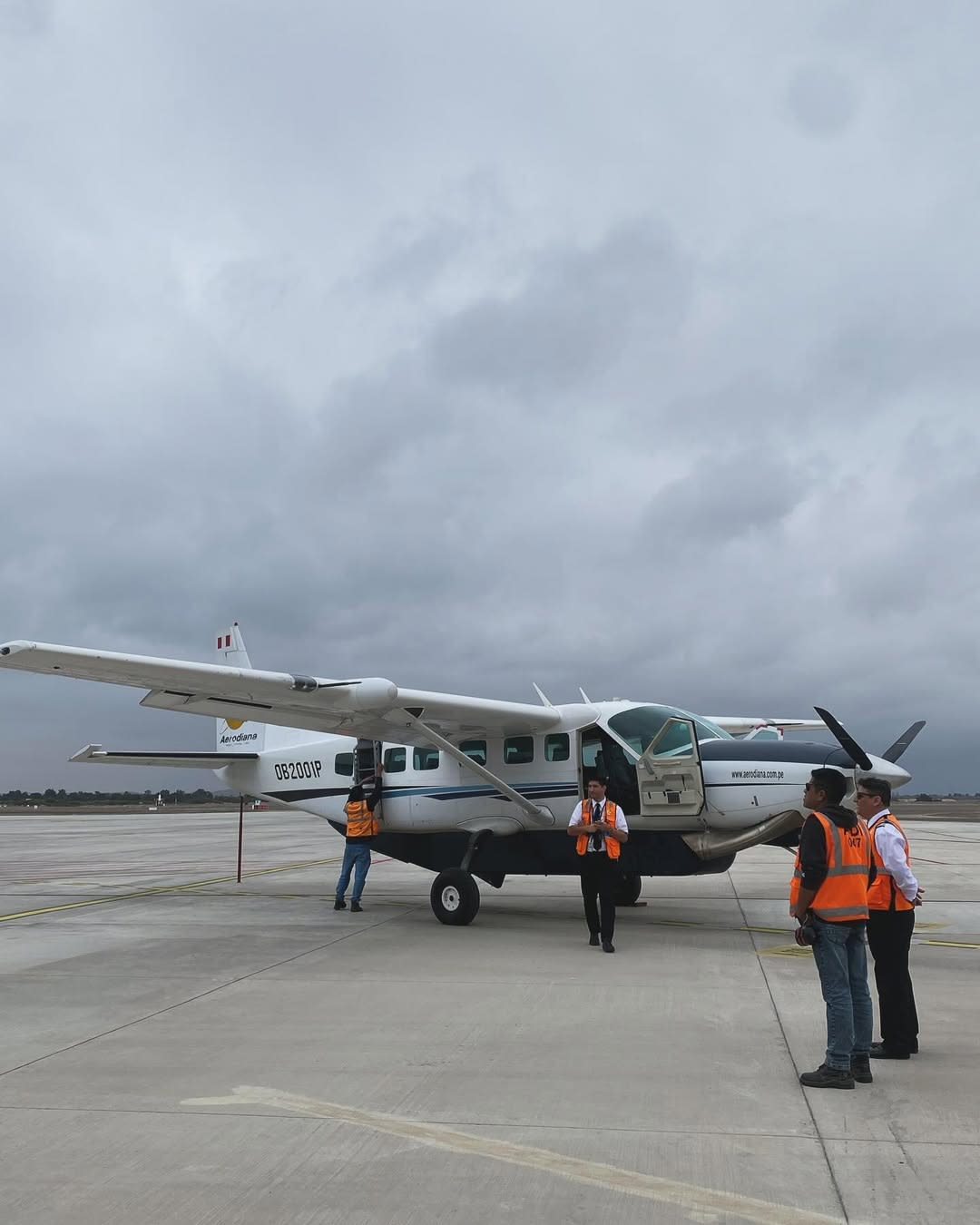
The Pisco airfield opens at seven twenty in the morning, not because there are commercial flights —there aren't any— but because the Pacific wind has not yet risen and civil aeronautics considers that range the only safe window for flying over desert. By seven thirty, when the guest reaches the hangar, there is already a Cessna 207 with cold engine, a pilot in white uniform, and a safety form to sign without discussion. This is the first contact with the reality of the overflight: it is not a tourist experience, it is a small commercial flight. And it is worth preparing for.
The Nazca Lines —geoglyphs up to 270 metres etched into the Jumana desert two thousand years ago by the Nazca culture— can only be seen from the air. Hiram Bingham crossed them in 1911 without seeing them; commercial pilots began reporting figures in the 1920s; María Reiche, a German mathematician, dedicated fifty years to measuring and defending them until her death in 1998. They are now World Heritage, and the only meaningful way to visit them is by overflight.
Three airfields, three different timings
There are three possible departure points: Lima, Pisco and Nazca itself. The difference is geographical and temporal.
From Lima, the flight lasts five hours: one hour out to Nazca, thirty minutes over the lines, one hour back. It is the lower-logistics option for a traveller with a single Lima night, but has two drawbacks: the total duration exhausts even seasoned passengers, and prices are high (USD 600-750 per person). We do not recommend it except in very specific circumstances.
From Pisco —three and a half hours from Lima— the flight is more reasonable: ninety minutes total, thirty over the figures, sixty round trip. This is what we recommend for travellers combining Paracas with a Nazca day. Departure at eight in the morning, return at nine thirty, the rest of the day free for the Paracas National Reserve or the drive back to Lima.
From Nazca —five and a half hours by car from Lima, two hours from Pisco— the flight lasts only forty-five minutes: half an hour over the figures, fifteen of circuit. It is the option for travellers spending a night in Nazca town who also want to visit the Cahuachi archaeological site and the Chauchilla cemetery in the afternoon. Suggested hotel: Hotel Majoro, a late-nineteenth-century Republican hacienda fifteen minutes from the airfield.
The aeronautics that matter
Two airlines concentrate private traffic: Aerodiana and AeroNasca. Both operate Cessna 207 (six passengers plus pilot and co-pilot) or Cessna Caravan (twelve passengers) on demand. For luxury travellers, we always recommend the Cessna 207: its size requires the pilot to bank harder over each figure for both sides of the plane to see, and the experience feels more intimate.
The Cessna 207 has six individual windows; each passenger sits next to one. Distribution matters: the guest on the left side sees the figures on the first pass, the one on the right on the second (the pilot reverses orientation on return). To let both sides see everything, the overflight traces a figure-eight pattern over each glyph.

The figures you see (and the ones you don't)
The overflight covers fourteen main figures in thirty minutes. In typical order of appearance:
The Trapezoid and the Spiral are the first geoglyphs in view, the oldest and hardest to photograph for their abstract form. Then comes the Whale —a 65-metre figure, contrary to Nazca's desert logic, suggesting the culture knew marine fauna. Next, the Astronaut, the figure popularised by Erich von Däniken's alien theory; archaeologists read it as a shaman or priest.
The Monkey —135 metres, spiralling tail— is the most photographable figure, alongside the Hummingbird (96 metres, wings extended) and the Condor (135 metres, in open flight). The Dog, the Parrot, the Pelican, the Hands (better called "the pair", for their symmetric composition) and the Tree complete the circuit.
What you do not see from the air: the Chauchilla cemetery, the Cahuachi pyramids and the Cantalloc subterranean aqueducts. These are Nazca-culture archaeological sites that require ground visits. If the trip allows a night in Nazca, we recommend the combination: morning flight, lunch at Hotel Majoro, sites in the afternoon.
What the theories say and don't
Four academic theories circulate on the origin of the lines. The most established —by María Reiche and Paul Kosok— read them as an astronomical calendar, aligned with solstices and constellation rises. Johan Reinhard's interprets them as religious rituals to invoke water, in a region so arid that priests would have walked the lines as offering. Anthony Aveni's sees them as maps of underground water sources. And the marginal but persistent one —Erich von Däniken— proposes them as alien landing strips, a hypothesis serious anthropology rejects.
The pilot, during the overflight, usually explains the theories in chronological order. We recommend not asking about the alien theory in earnest —pilots are polite about it but there is a degree of fatigue. What is worth asking: why the lines have survived (the dryness and lack of wind in the desert), how they were made (by removing the upper layer of oxidised pebble to expose the lighter sand below), and how they were discovered (Toribio Mejía Xesspe, a Peruvian archaeologist, first reported them in 1927).
The lines have survived because the Jumana desert is one of the driest places on Earth. The Nazca culture chose the only possible surface to write something that would last two thousand years.
Kada Travel
What the body experiences
The flight is not for everyone. Thirty minutes of tight turns at five hundred metres above desert with rising thermals produce constant turbulence. The pilot banks the aircraft to forty-five degrees over each figure to allow vertical sight. The stomach feels it.
Recommendations, in order of importance: do not eat a heavy breakfast (a coffee and biscuits), take the anti-nausea pill thirty minutes before (Dimenhydrinate 50mg, sold over-the-counter at any Peruvian pharmacy), bring sunglasses (desert light is intense) and choose the eight o'clock flight —not later, since after ten the air movement worsens.
Twenty per cent of passengers get airsick. The airline provides bags. It is not embarrassment —it is physics— and the pilot adjusts speed if someone feels unwell. The only thing not to do is request to cancel mid-circuit: the cost is paid and returning to the airfield mid-flight is not an option for this kind of operation.
Afterwards
Returning from the overflight leaves the passenger with a mix of adrenaline, mild nausea and a mental image that does not fit in photographs. The lines are too large and the contrast with the ground too subtle for phones to capture them well. What stays is the scale —the monkey drawn from an altitude impossible two thousand years ago— and the unanswered question that organises half of Andean archaeology: who were they made for.
The overflight, done with time and the right logistics, is not a tourist whim. It is the only possible visit to a site the Nazca culture designed to be seen from a point they could not reach. That paradox —which is the question of the lines themselves— is solved only in the air.
Written by Kada Travel Editorial
Frequently Asked
The two authorised private airlines (Aerodiana and AeroNasca) operate under Peruvian civil aviation and international maintenance standards. The industry had accidents in the 1990s and 2000s that prompted stricter regulation; the last fifteen years' record is good. We recommend operations from Pisco, where the control tower is stricter.
Honestly, no. The flight has constant turns in a small cabin with little ventilation. For passengers severely prone to motion sickness, the Chauchilla cemetery on the ground and the Nazca museum in Lima offer a reasonable alternative.
From Pisco: USD 200-280 per person on a shared Cessna 207, USD 950-1,200 with a private Cessna (up to 6 passengers). From Lima: USD 600-750 per person. From Nazca: USD 110-150 per person.
Cessna 207 in our view. Smaller size, tighter banking, every passenger by a window, greater sense of proximity. The Caravan is for larger groups; the turns are gentler but the experience is diluted.
Yes, in wind season (October-December) and on coastal fog days. The airfield rule is: above 18 knots of wind, no flying. We always recommend leaving a buffer day in the itinerary for rescheduling.
For high season (May-September), three to four weeks. For low season, one week. The eight-o'clock departures —the most stable— are the first to fill up.
Design Your Journey
Design your bespoke Peru journey
We talk. We listen. Then we design an itinerary that belongs only to you.
Start Planning