Unfolded· 7 min read·11 July 2026
The Fibre from the Puna
A curated visit to Lima's alpaca and vicuña collections, a master weaver's demonstration, and the full story of the rarest natural fibre on earth.
By Kada Travel Editorial
The vicuña cannot be farmed. This is not a matter of regulatory restriction; it is a biological fact. The Vicugna vicugna — the small wild camelid of the high Andean plateau, cousin to the alpaca, the llama, and the guanaco — cannot be domesticated. It does not adapt to enclosure. It does not reproduce in captivity at a rate that sustains a breeding population. It lives at four thousand to five thousand metres above sea level on the puna, the high grasslands where the air is thin enough to slow every process, including the one that grows its fibre, which it does at an extraordinary fineness across the two-year shearing cycle that the animal requires to be left alone.
This constraint is the central fact about vicuña, and it is what explains everything else: why the fibre measures twelve microns in diameter (finer than cashmere at fourteen to nineteen, finer than the finest merino at fifteen); why the Inca reserved it for royal and ceremonial use under penalty of death; why the Spanish colonial hunters had brought the animal to near-extinction by the mid-twentieth century; and why Peru's government regulated, protected, and eventually revived the vicuña population through legislation that treats the animal as a national resource in the way a diamond deposit might be treated — not to be extracted, only to be periodically accessed.
The textile visit we arrange is not a shopping guide. It is a conversation about what one country's most unusual natural material actually is, and what it takes to turn it into a garment.
The Puna and the Chakku
The vicuña lives on the puna at altitudes that exclude most human activity — the grasslands above the treeline, above the agricultural terraces, in the thin air where the Andean wind shapes the tola shrubs into permanent lean. Before the Spanish arrived, the Inca conducted the chakku: a large-scale communal roundup in which thousands of workers would form a human circle several kilometres in circumference, gradually tightening inward until the vicuñas at the centre could be shorn and released. The chakku was conducted every four years — the interval the animals required to regrow a usable fleece — and it was a state undertaking of considerable logistical complexity, organised through the same mit'a labour system that built the roads and the temples.
The Spanish broke the system. Colonial hunting — for both the fibre and the meat — reduced the vicuña from a population that may have numbered in the millions to fewer than ten thousand animals by the late 1960s. Peru's response, through the Ley de Vicuña of 1969 and subsequent revisions, was to ban all killing, establish protected reserves, and organise modern chakkus in partnership with Andean communities who receive the proceeds from the fibre they collect. The population has recovered to an estimated two hundred thousand animals in Peru. The fibre remains the rarest natural textile material produced by any animal on earth.
The chakku today involves the same principle as the Inca version: a community forms a circle, the vicuñas are shorn with electric clippers in under a minute per animal, and the animals are released unharmed. Each animal yields approximately one hundred and fifty grams of fibre per shearing — enough for approximately one scarf, or a fraction of a coat. A vicuña coat requires the shearing of thirty to forty animals across multiple chakkus.
Alpaca: The Accessible Relation
The alpaca — domesticated, herded, bred across the Andes in populations that now exceed three million animals in Peru alone — is the fibre most people encounter when they encounter Andean textiles. Alpaca Huacaya, the common variety, has a crimped, fluffy staple and measures between eighteen and thirty microns depending on the animal's age and genetics; Suri alpaca, rarer and valued higher, has a silky, straight staple and a lustre that approaches raw silk. Both are warm, lighter than wool, and hypoallergenic in a way that merino, with its finer scales, is not.
The difference between alpaca and vicuña is not primarily warmth — both are exceptional insulators, and an alpaca baby (a tui) at its finest approaches vicuña in thermal performance. The difference is in the fibre's diameter and surface structure. Vicuña fibres are so fine that they cannot be processed on the industrial machinery that handles alpaca; they require hand-processing at every stage from raw fleece to finished yarn. This is why vicuña garments are produced in small quantities by specialist manufacturers, why the retail price of a vicuña coat in Lima starts at several thousand dollars, and why most people who encounter vicuña fabric in a flagship store are touching something they have never felt before — a fibre that has no commercial equivalent in any other species.
The Visit
The curated visit we arrange has two parts: the flagship and the weaver's studio.
The flagship — Lima's most significant collection of alpaca and vicuña textiles in Miraflores — is where the full commercial range of the tradition is visible: from baby alpaca (the finest shearing of young alpaca, approximately fifteen to seventeen microns, close to the softer cashmere in hand feel) through progressively finer grades to the vicuña pieces, which are displayed separately and handled differently, because the fibres are fragile enough that vigorous folding damages them. Our visit is arranged as a private session — the shop floor before opening, or a reserved space with a specialist from the brand — so our guests can handle pieces and ask technical questions without the ambient commercial pressure of a retail environment.
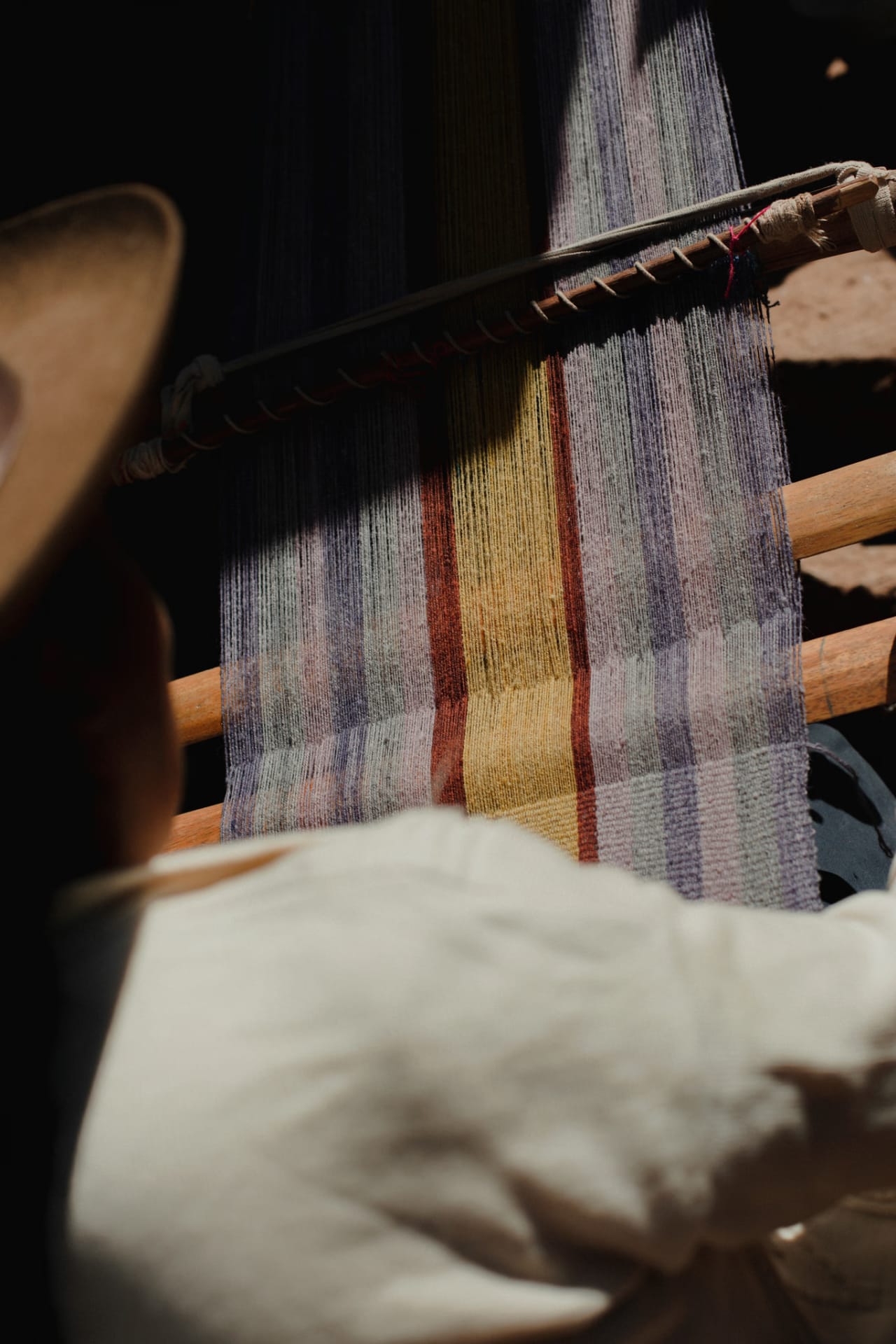
The weaver's studio is a different register entirely: a working space where a maestro tejedor — a master weaver trained in the Andean back-strap loom tradition — demonstrates the process from cleaned fleece to finished textile. The back-strap loom has not changed in essential design since the pre-Columbian period; the body tension of the weaver is the loom's adjustment mechanism, and the quality of the result is inseparable from the physical knowledge of the person working it. Our guests watch the process, handle the raw vicuña and alpaca fibres before and after processing, and can ask questions at the level of craft — how the warp count determines the textile's drape, what the natural colour range of alpaca actually includes (twenty-two recognised natural shades, from white through fawn to charcoal and black, without dyeing).
Where our guests' interests extend to contemporary Peruvian textile design — the designers who are taking the Andean material heritage and working with it in contemporary silhouettes — we can arrange a private appointment with an independent Lima-based designer whose work we know directly. These appointments are subject to the designer's schedule and are arranged separately from the flagship and weaver visits.
What Kada Arranges
The textile visit is curated as a half-day — typically a morning, running approximately three and a half hours across the flagship session and the weaver's studio. We brief our guests the evening before with context reading: the Inca textile traditions, the vicuña regulation, and a brief note on the contemporary Peruvian designers whose work sits at the intersection of the Andean heritage and international fashion. The briefing is preparation, not a substitute for the experience; the point is that the morning's conversation can begin at a level of specificity that makes the technical details interesting.
For guests travelling onward from Lima to Cusco or the Sacred Valley, we position the Lima textile visit as an orientation — the materials and processes visible in Lima's finest flagships are the same ones that the communities of the highlands have been producing for generations, and the conversation begun in Miraflores continues naturally in the markets of Pisac or the weavers' cooperatives of Chinchero.
Expert Insight
"What I want our guests to understand before they touch a vicuña piece is the ecological constraint behind it. This is not a luxury that exists because someone decided to charge more. It exists because the animal that produces it cannot live anywhere except at four thousand metres, cannot be farmed, and gives you a hundred and fifty grams every two years. When you understand that, the price stops being about status and becomes about scarcity — which is an entirely different thing. And then the textile itself feels different in your hands."
— Katherine Cjuiro, Founder & Travel Director, KADA Travel
A Practical Note
The flagship session and the weaver's studio are in different parts of Miraflores and require twenty minutes of transit between them. We handle the logistics — transportation, timing, and the introductions at each stop — so the morning moves without the gaps that independent arrangements produce.
Vicuña pieces in the flagship range from scarves (the most accessible point of entry, typically from five hundred dollars for a small piece) to full coats (from three thousand dollars for the simplest cuts, significantly more for tailored garments). We do not organise the visit around purchasing and do not suggest specific pieces — our role is to provide the context in which our guests can make their own decisions. Guests who have no intention of purchasing anything find the morning equally complete; the tactile and conceptual education does not require a transaction.
Written by Kada Travel Editorial
Frequently Asked
Alpaca is the fibre from a domesticated Andean camelid; it ranges from approximately eighteen to thirty microns in diameter depending on the animal's age and genetics. Baby alpaca refers to the first shearing of a young alpaca, which produces fibres in the fifteen to seventeen micron range — softer and finer than adult alpaca, though the "baby" designation in commercial labelling is sometimes applied loosely. Vicuña is the fibre from the wild, undomesticated *Vicugna vicugna*, measuring approximately twelve microns — the finest natural fibre produced by any animal on earth. The three are not substitutable; their hand, warmth, drape, and price reflect genuinely different physical properties.
For pieces in the flagship's standard range, alterations and custom sizing are handled directly with the brand. For fully custom garments — unusual cuts, specific natural colour combinations, pieces that incorporate both vicuña and alpaca in a single textile — we can connect our guests with an independent Lima designer who does bespoke work at a lead time of four to eight weeks. The conversation about commissions happens at the briefing stage, before the visit, so that any custom discussion during the morning can be specific rather than exploratory.
Yes. The Sacred Valley — particularly the weaver cooperatives of Chinchero and Pisac — offers a closer view of the community-based production that feeds the Lima market. We position Lima's flagship and weaver visit as an orientation to the material itself; the Sacred Valley visits are where the social and ecological context of production becomes visible in the landscape. For guests interested in both, the sequence Lima → Sacred Valley is more coherent than the reverse.
Yes. The vicuña story is primarily a story about ecology, Inca statecraft, colonial destruction, and state-led recovery — any one of which is compelling to a non-specialist. The textile is the vehicle; the history of the animal and the fibre is the destination. Guests who arrive with no particular interest in fashion consistently find the morning more interesting than they expected.
Design Your Journey
Design your bespoke Peru journey
We talk. We listen. Then we design an itinerary that belongs only to you.
Start Planning