Unfolded· 7 min read·28 July 2026
The Forest Before It Goes Quiet
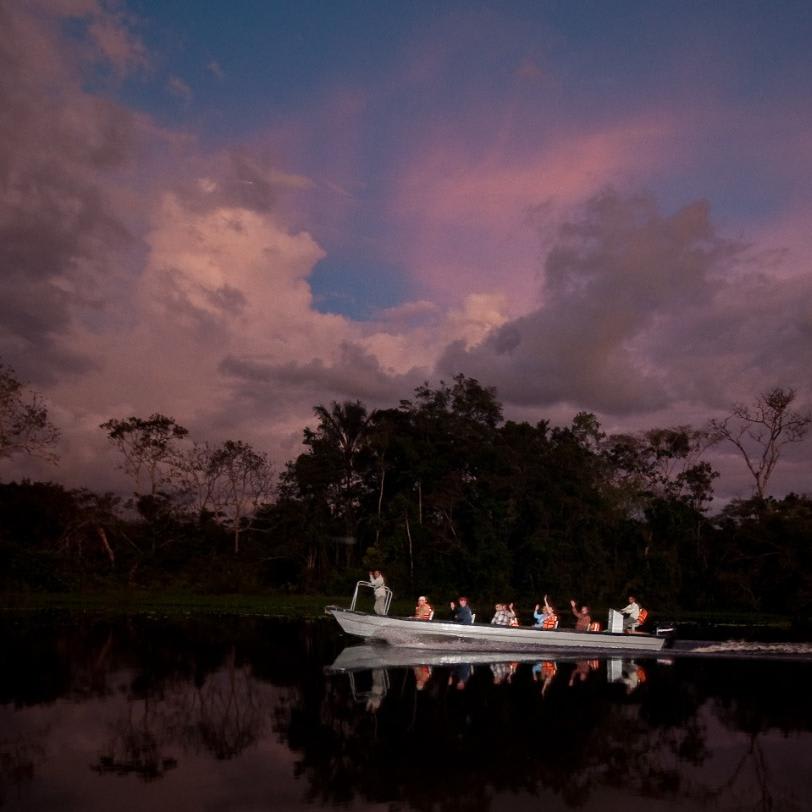
The Amazon at dusk — the hour when the diurnal community finishes and the nocturnal one begins, and both are briefly audible together. A seated listening session in the primary forest with a bio-acoustician who maps this transition as a measure of ecosystem health. Not a walk. One hour of deliberate attention to what the forest sounds like when no one is moving through it.
By Kada Travel Editorial
The Amazon produces approximately eleven thousand distinct acoustic signals between 5:00 PM and 7:00 PM. This is not a metaphor. It is a measurement: bio-acoustic surveys in primary terra firme forest in the Madre de Dios region have documented, across longitudinal recording sessions, the number of distinct sound events — bird calls, frog choruses, insect stridulation, mammal vocalisations — that occur in the sixty-minute window centred on dusk. The number varies by season, by microhabitat, and by the health of the specific forest. In primary forest with documented full species communities, it is high. In secondary forest recovering from disturbance, it is measurably lower, and the species composition of what remains is different. The soundscape is a diagnostic.
The bio-acoustician who leads Kada's dusk listening session came to the Amazon by way of acoustic ecology — the field that studies the relationship between living things and the sound environments they generate and inhabit — and developed her specific research focus on Amazonian forest soundscapes after five seasons of comparative recording in Tambopata, Manu, and the northern Amazon around Iquitos. She monitors the same forest sites across years, documenting the acoustic signature of the ecosystem at specific seasonal moments, using the soundscape data as a long-term health indicator. The session she leads for Kada's guests is not a side project from her research. It is conducted at the same locations she uses for her monitoring work, with the same positioning logic — upwind from the lodge, in primary forest with minimal background noise from human activity, at sites where the sound exposure from the surrounding canopy is maximal.
The session lasts one hour. Guests are seated. No one moves. That is the programme.
Why Dusk
The acoustic transition at dusk is the most compressed and dramatic soundscape event in the Amazonian daily cycle. The explanation is ecological: the diurnal community — the birds, the insects, the primates that operate in daylight — responds to the falling light by increasing vocalisation. For many species, the last hour of visible light is the final window for territorial calls, social contact calls, and alarm calls before the lowered visibility makes those behaviours less effective. The chorus that results from this simultaneous last-light activity peaks in the fifteen to twenty minutes immediately before the sun disappears below the canopy horizon.
At the same time, the nocturnal community begins. Frogs, which have been largely silent through the hottest midday hours, activate in the cooling humidity of dusk. The earliest nocturnal insects begin their stridulation. The kinkajou — a nocturnal procyonid of the canopy — produces its contact call before full darkness as it begins its nightly foraging cycle. In primary forest with intact populations of both diurnal and nocturnal species, there is a window of approximately thirty minutes in which both communities are vocally active simultaneously — the diurnal community winding down and the nocturnal community beginning, their acoustic signatures overlapping in a density that the bio-acoustician can parse by ear but that overwhelms an untrained listener initially as a single undifferentiated roar of sound.
What the session teaches is that the apparent chaos is structured. Each call has a frequency range, a temporal pattern, a spatial origin within the forest volume. After twenty minutes of seated attention with the bio-acoustician identifying individual signals — pulling specific frog species, specific bird species, specific insect groups out of the acoustic mass and naming them — the listener begins to hear the structure. The session is not about silence. It is about learning to hear what was always there.
The Acoustic Signals
The bio-acoustician begins each session with an orientation to the soundscape that will be encountered — what species are currently active in the specific site, which calls to listen for first, what the seasonal conditions are doing to the composition. The following are consistent presences across Tambopata dusk sessions.
The red howler monkey (Alouatta seniculus) typically calls in the late afternoon, not at dusk — the deep, resonant vocalisation that carries three kilometres through primary forest is a late-afternoon territorial call, not a dusk vocalisation. But in sessions that begin at 5:00 PM, the tail of the afternoon howler sequence is often the acoustic opening of the session — the deep, sustained vocalisation fading as the light begins to fall, giving way to the sharper, more varied calls of the birds.
The spectacled owl (Pulsatrix perspicillata) begins calling at dusk in primary forest. Its call — a deep, rhythmic series of notes, lower in frequency than most of the surrounding bird chorus — is one of the earliest nocturnal signals in the session. The bio-acoustician uses it as a marker for the point at which the nocturnal community is beginning to dominate: when the spectacled owl is clearly audible above the fading diurnal chorus, the transition is past its midpoint.
The tungara frog (Engystomops petersi) and the other small frog species of the forest floor begin their chorus as humidity rises and light falls. In the wet season, the frog acoustic layer is dense enough to cover most of the bird calls at mid-session. In the dry season, the frog chorus is thinner, and the bird-to-frog acoustic ratio shifts to produce a different session. Neither is better; they are different soundscapes from the same forest at different seasonal moments, both of which the bio-acoustician can read as health indicators.
The insects — primarily crickets (Gryllidae), katydids (Tettigoniidae), and cicadas (Cicadidae) — build their stridulation through the session. In primary forest, the insect acoustic layer operates across frequency ranges higher than most of the vertebrate calls, creating a consistent high-frequency background that the bio-acoustician asks guests to notice explicitly: the insects are always present, the brain suppresses them as background, and the act of consciously attending to them produces a different perception of the total soundscape.
The Recording
The bio-acoustician records each session on a calibrated acoustic monitor — a device identical to those used in her monitoring work, positioned in the same configuration as the research sessions. At the end of the one-hour programme, she plays back a selection of the session's recording through a small speaker, inviting guests to hear the sounds they have just lived with from the outside — as an observer rather than an inhabitant of the acoustic environment. The quality of the recording is the quality of a research instrument, not a consumer device. The playback is not edited or enhanced. What was in the forest is what is in the recording.
Guests may request a copy of their session recording as an audio file. The bio-acoustician provides it with a key identifying the species she documented in that specific session — a document that is, in a practical sense, a snapshot of the forest's acoustic health on that date, in that site, at that hour.
What Kada Arranges
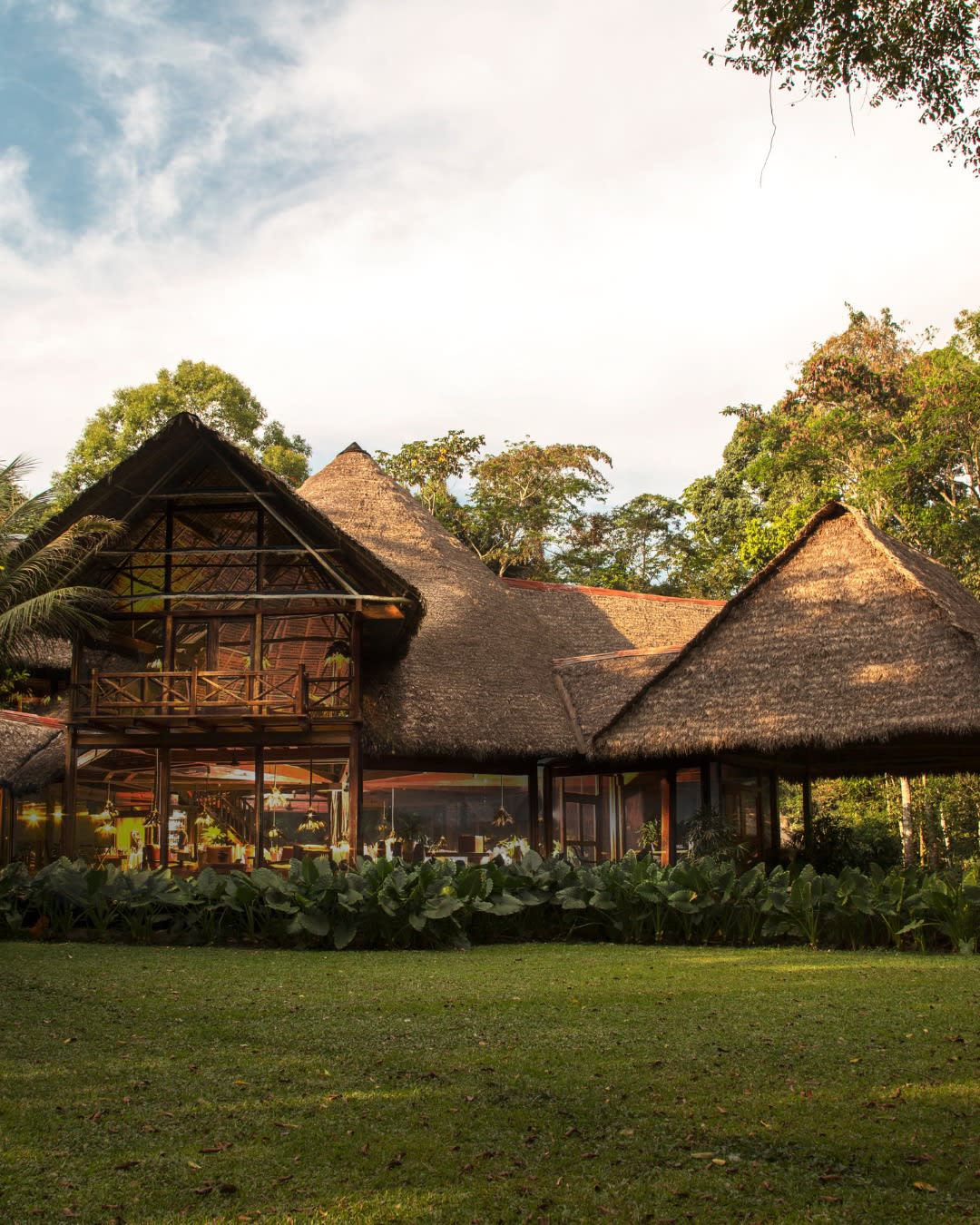
The session is a standalone afternoon programme, scheduled for 5:00 PM departure from the lodge. It is available in the Tambopata reserve zone, from accommodation at Inkaterra Reserva Amazónica, Refugio Amazonas, or Posada Amazonas, where the forest access is immediate and the primary canopy begins within walking distance of the lodge structures.
Departure on foot from the lodge at 5:00 PM, arriving at the session site by 5:15 PM. One hour seated. Return to the lodge by 6:30 PM — before full dark, on the same trail used for the night walk programme if the guest is combining both in a multi-night stay. The session is complete in daylight; no torch is required and no night-navigation capability is needed.
What guests bring: insect repellent applied before departure (not during the session — aerosol application creates acoustic interference), a lightweight long-sleeved layer (temperatures drop noticeably in the twenty minutes after the sun passes below the canopy), and the willingness to remain still. The bio-acoustician emphasises this directly before the session begins: the acoustic environment changes measurably when humans move through it. The session's value — to the guests and to her monitoring data — depends on stillness.
Expert Perspective
"I started recording the dusk transition in Tambopata because I wanted a measure of ecosystem health that didn't require visual observation — something I could collect in rain, in bad light, in any condition the forest produced. What I found over three seasons of comparative data is that the number of distinct signals in a dusk session tells you more about the forest's condition than almost any other single measurement. A primary forest with intact predator and prey populations, intact canopy structure, and low human disturbance has a specific acoustic signature at dusk. A disturbed forest has a different one. It is quieter, but more than that — it's simpler. The complexity collapses. What I'm asking guests to hear, in the session, is complexity. Not just sound, but structured, layered, species-specific complexity. If they can hear that — even partly, even for a moment — they understand something about what they would lose before they lose it."
— Isabela Santos, Acoustic Ecologist, Resident Researcher, Tambopata Reserve Zone
A Practical Note
Stillness: The session requires participants to remain seated and still for one hour. This is the non-negotiable element of the programme — the bio-acoustician is not being precious about it. Animal vocalisation behaviour at dusk is measurably affected by human movement and sound; a group that remains still produces a materially richer acoustic session than one that shifts and whispers. Guests with physical conditions that make prolonged sitting uncomfortable should discuss this with Kada before booking; the session site can be configured with back-supported seating for guests who need it.
Children: The session is appropriate for older children and teenagers with an interest in natural history who can understand and maintain the stillness requirement. Young children who find extended quiet sitting difficult should not be booked for this specific programme — the sessions that involve movement (night walk, canopy tower, dawn collpa visit) are better matches for younger ages.
Mosquitoes: The dusk session is the peak hour for mosquito activity in the primary forest. Full-coverage insect protection — lightweight long trousers, long sleeves, repellent applied before departure — is essential. Guests who are reactive to DEET should discuss alternatives with Kada before the Amazon itinerary; the picaridin-based alternatives are effective and acceptable in this setting.
Night walk combination: The dusk listening session (5:00–6:30 PM) and the night walk (8:30 PM departure, Art. 2) are offered as a complementary pair on multi-night stays. They access the same forest at different hours with different sensory orientations — the listening session is seated and acoustic; the night walk is moving and visual. The transition hour between them — dinner at the lodge — gives guests time to process the acoustic experience before entering the same forest again in darkness.

Written by Kada Travel Editorial
Frequently Asked
Bio-acoustics is the study of sound production and reception in living systems — the physics of how animals produce and perceive sound, and the ecology of how sound functions in animal communication and behaviour. It is not species-specific: a bio-acoustician works across taxonomic groups (birds, frogs, insects, mammals) rather than within a single one. The specific application in the Tambopata monitoring work is soundscape ecology — using the acoustic complexity of an environment as an integrated measure of its biodiversity and health. The species identifications the bio-acoustician makes during the session draw on ornithological and herpetological knowledge, but the framework for interpreting what the totality of those signals means is acoustic ecology rather than taxonomy.
Longitudinal soundscape data — repeated recordings at the same sites over years — allows researchers to track changes in species composition and acoustic complexity over time, without the logistical requirements of continuous visual wildlife surveys. Changes in the soundscape can indicate habitat disturbance, species loss, invasive species arrival, or the recovery of populations after protection. In the Tambopata zone, the bio-acoustician's monitoring programme has documented changes associated with the reserve's protection status across the years since its establishment. The data contributes to SERNANP's monitoring reports and to comparative studies with non-protected secondary forest in the buffer zone.
Yes. Rain affects the session but does not cancel it. Light rain on the canopy produces a consistent background sound layer that the bio-acoustician accounts for in her monitoring protocol — she notes weather conditions for every session. Frog chorus density is significantly higher in the wet season, and the overall acoustic complexity of the session increases. Heavy rain or lightning cause the session to be abbreviated or postponed for safety reasons; the bio-acoustician makes this call based on conditions on the day.
They are not interchangeable. The listening session is a sensorial and scientific programme oriented toward the acoustic dimension of the forest at dusk — the species composition of the vocalising community, the ecological meaning of the transition, the soundscape as a research instrument. The night walk (Art. 2) is a visual programme oriented toward the herpetological and invertebrate community active in the dark, moving through the forest with torches, at a different hour and with a different species focus. Guests who want the fullest engagement with the forest's night ecology include both in their multi-night itinerary.
Design Your Journey
Design your bespoke Peru journey
We talk. We listen. Then we design an itinerary that belongs only to you.
Start Planning