Unfolded· 8 min read·18 July 2026
The Wall That Calls Three Hundred Birds
The Collpa Chuncho at dawn — a clay cliff on the Tambopata River where scarlet macaws, blue-and-yellow macaws, red-and-green macaws, and two dozen parrot species descend between 5:30 and 6:30 AM to eat minerals from the riverine face. Private blind. Licensed biologist with active research in the reserve. The largest concentration of macaws on a single clay lick recorded in South America.
By Kada Travel Editorial
The Collpa Chuncho is a clay bank on the Tambopata River, inside the Tambopata National Reserve in the department of Madre de Dios. The wall stands approximately twenty metres high and fifty metres wide — a buff-coloured vertical face cut into the riverbank by the river's erosive action, exposing the mineral-rich clay beneath the forest floor. What covers it, between 5:30 and 6:30 AM on most mornings from April through November, is the largest concentration of macaws and parrots on a clay lick recorded anywhere in South America — up to three hundred and fifty individual birds from seven or eight species descending simultaneously on the exposed face to eat minerals from the clay.
The phenomenon has a known mechanism. The Peruvian Amazon produces fruits and seeds with high alkaloid content — evolved to discourage herbivores — and the clay of riverine collpas contains sodium, calcium, and magnesium ions that neutralise those toxins in the digestive system. The birds that eat the clay are not eating it for nutrition. They are eating it to manage the chemical consequences of the forest's own defences. The Collpa Chuncho happens to be one of the most mineral-rich and most consistently active clay licks in the Amazon basin, which is why the concentration here exceeds anything comparable in the region.
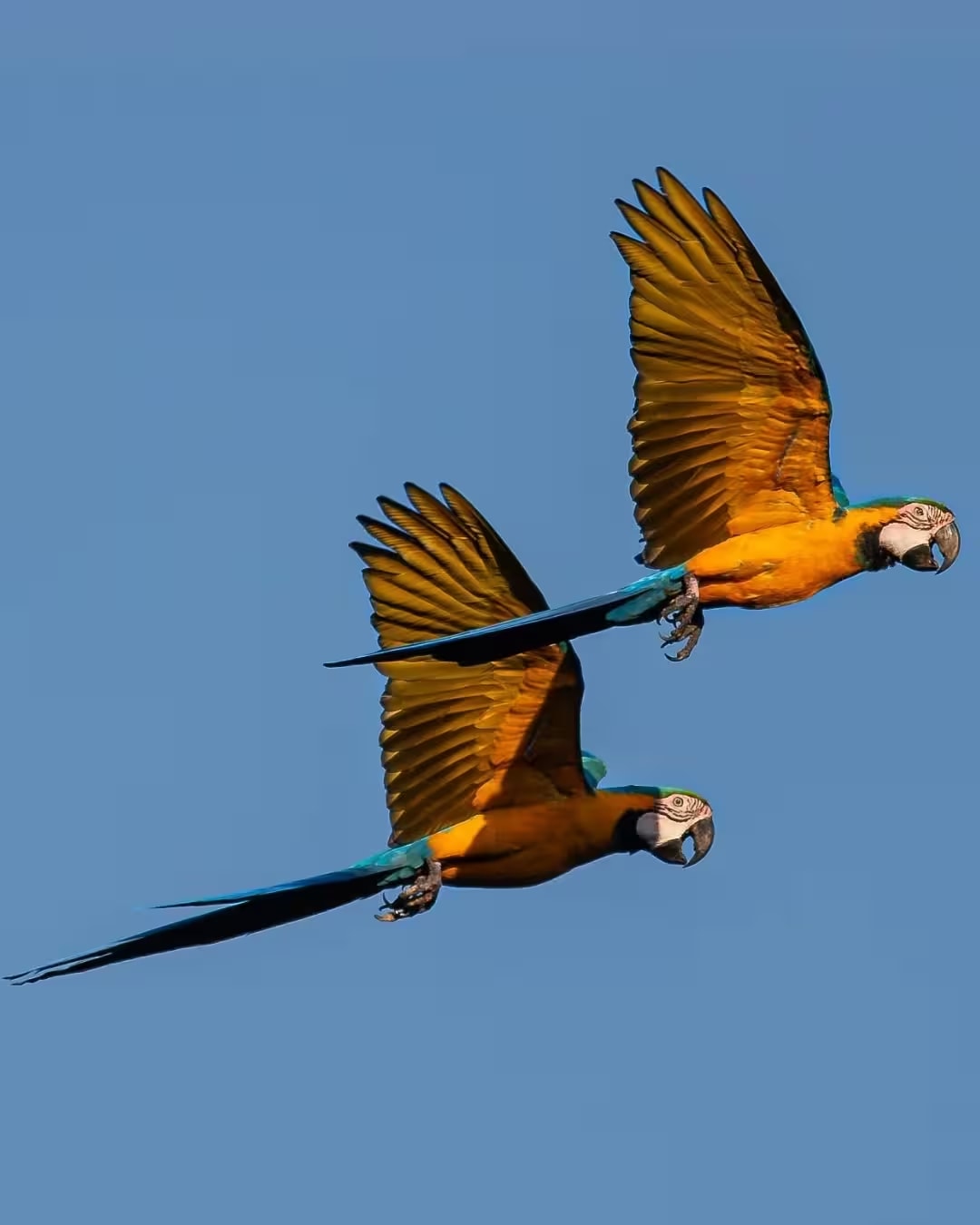
What happens in the hour between first light and full morning heat is not subtle. The scarlet macaws (Ara macao) arrive in the largest numbers — forty, sixty, sometimes a hundred birds in a single descent, their primary feathers spread against the clay in a feeding posture that has no equivalent in any other context. The blue-and-yellow macaws (Ara ararauna) form the second major colony. The red-and-green macaws (Ara chloropterus) arrive last and work the lower sections of the face. Below all of them, the parrots — mealy amazons, blue-headed parrots, orange-cheeked parrots — fill the fissures between the larger birds. The sound the colony produces at full attendance carries three hundred metres across the river. It is the sound of Tambopata.
Why the Clay Lick Requires a Biologist
The collpa dynamic is not static. The macaws arrive in waves, retreat at the first alarm call when a raptor passes overhead, return when the threat clears, and shift their feeding positions in response to the social hierarchy operating within each colony. The biology of that hour — the pair bonding visible at the feeding face, the alpha pairs that control the highest-mineral sections of the wall, the juveniles arriving for the first time and learning the site — is only legible with a naturalist who has spent years observing the same individuals return to the same wall.
The biologist Kada works with at the Collpa Chuncho has conducted survey and monitoring work in the Tambopata National Reserve for more than a decade. He tracks specific macaw pairs across seasons, documents arrival timing correlated with weather and fruiting cycles, and has mapped the mineral gradient in the clay face that corresponds to different species preferences. The visit is not a guided tour of a scenic event. It is a field session with a researcher who is actively studying the site. The difference in what guests take away — what they understand about the birds, the forest, the chemical logic of the ecosystem — is the difference between watching and comprehending.
The Blind
Access to the Collpa Chuncho requires a SERNANP permit coordinated with the reserve authority. The blind Kada uses — a screened observation position built into the riverbank vegetation on the opposite bank — does not appear on any commercial tour map and is not listed in the published itineraries of the lodges that take groups to the collpa in open boats. The distinction matters operationally: a group of six in an open motor canoe on the river creates a visual profile and noise level that the macaw colony reads as a threat. The approach distance is limited to whatever the navigation channel permits.
Kada's position is fixed before the birds arrive. Guests are on site by 5:15 AM, in silence, with optical equipment deployed and eyes adapted to the pre-dawn light. The macaws begin their descent around 5:30. The biologist uses a low headset to communicate observations without raising his voice above a murmur. When the full colony is simultaneously on the face — the thirty or forty seconds when all seven species are present at once before the first raptor alarm — it is the kind of spectacle that wildlife photographers spend entire expeditions trying to position themselves for. The blind places guests at that position without announcement.
What Kada Arranges
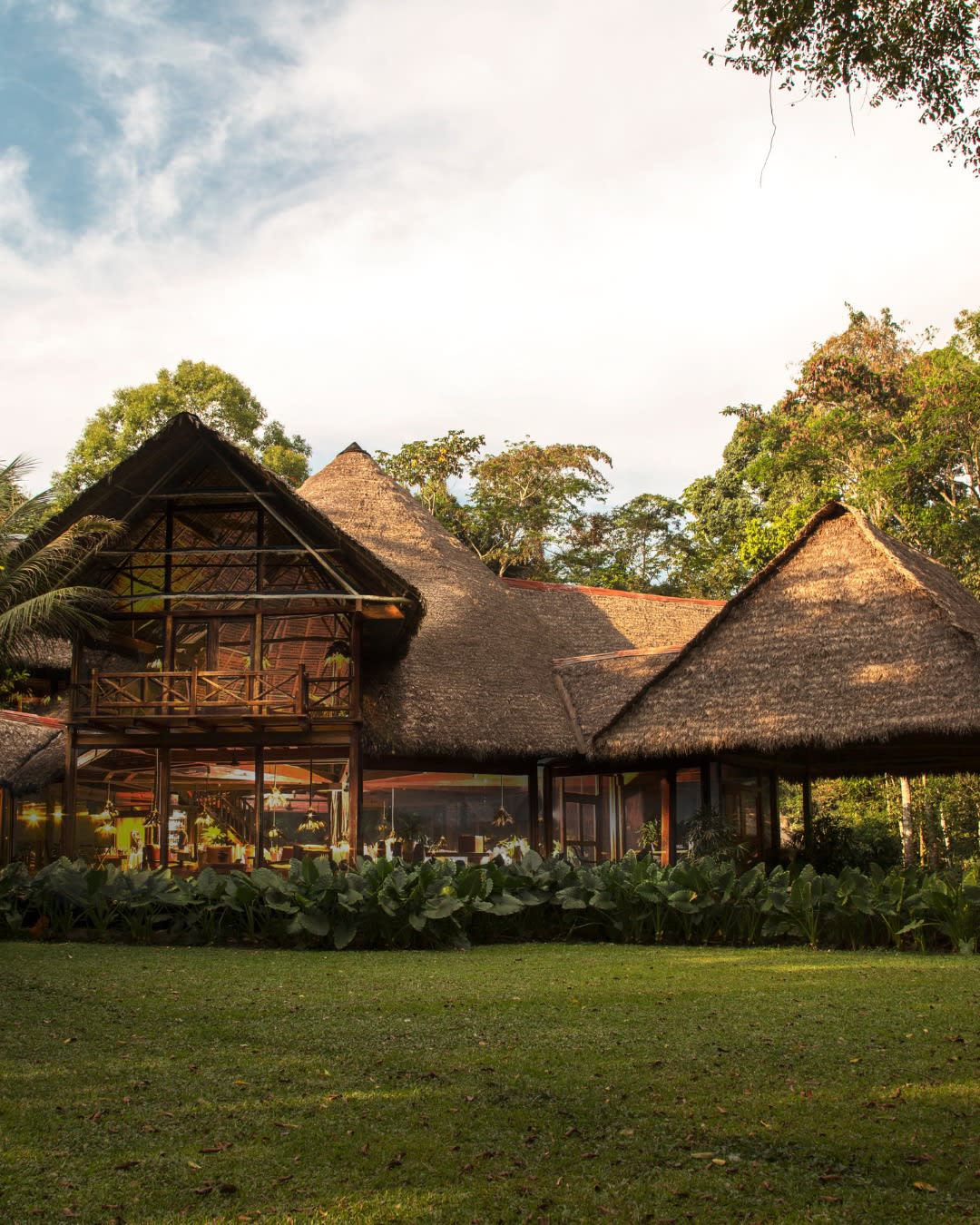
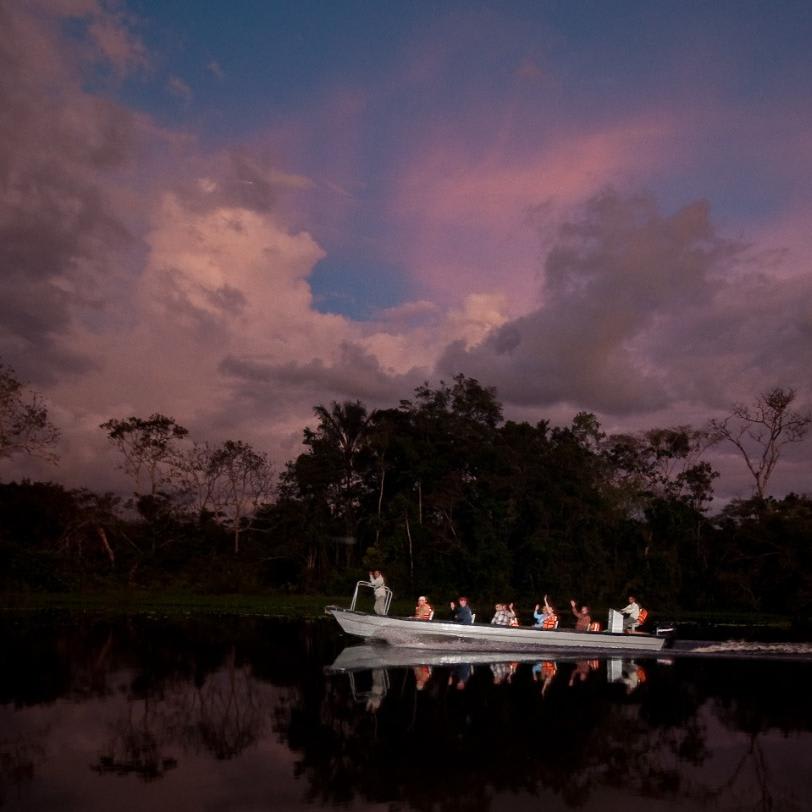
River transfer from the accommodation — Inkaterra Reserva Amazónica or Refugio Amazonas, depending on which property Kada has placed the guest in — departs at 4:45 AM by private motorised canoe. The journey to the Collpa Chuncho takes approximately forty-five minutes downstream. The biologist is already at the blind on arrival, having reached the site earlier to confirm conditions and set up the optical equipment.
Equipment provided for each guest: 10×42 binoculars, spotting scope mounted on the blind wall, red-filtered headlamp for the approach, waterproof seat cushion. The biologist carries a field notebook and a species checklist annotated with the morning's specific sightings; guests who want a copy of the annotated record receive one at the end of the session.
The session closes between 6:30 and 7:00 AM, when the macaw colony disperses into the canopy to begin the day's foraging. The return journey to the lodge is timed for breakfast at 8:00 AM, leaving the remainder of the morning available for secondary programming — canopy observation, river otters, or forest trail work.
One session per morning is the maximum Kada books for the Collpa Chuncho blind. The position accommodates up to six guests without compromising the silence and sight-line quality that the experience requires.
Expert Perspective
"I have been to the Collpa Chuncho more times than I can accurately count. Somewhere past thirty, I stopped keeping the number and started just going whenever I could get there before the light changed. Every time, there is a moment — usually around the fifteen-minute mark after the first major descent — when the wall is covered and the sound is at full volume and the person next to me in the blind stops moving completely. Not because I told them to. Because the event is loud enough and large enough and close enough that the body just responds on its own. I cannot manufacture that moment. I can only put people in the position where it is possible. That is what the Collpa Chuncho visit is: a position, a biologist, and whatever the birds decide to do that morning."
— Daniel Ramos, Co-Founder & CEO, KADA Travel
A Practical Note
Season: The Collpa Chuncho is active year-round but peak attendance occurs April through November (Amazonian dry season), when fruit availability in the forest drops and mineral demand increases. The clay lick visit is included in Tambopata itineraries from April through November; December through March remains possible but colony attendance numbers are variable and the pre-dawn river journey is more exposed in wet-season conditions.
Timing: The 5:15 AM arrival at the blind is not flexible. The macaw colony begins descending at 5:30 to 5:45 AM on most mornings; arriving after the colony has established means the approach across the river is visible to the birds and will scatter the lower sections. SERNANP regulations require permit confirmation 48 hours in advance.
Equipment: Binoculars are provided. Guests who wish to bring long-lens camera equipment should inform Kada in advance — the blind has mounting positions for lenses up to 500mm. Tripods are recommended for anything above 300mm. Flash photography is not permitted under any circumstances.
Physical requirements: The river journey is by motorised canoe with covered seating. The approach to the blind requires approximately five minutes of walking on uneven ground in pre-dawn darkness. Standard waterproof boots are sufficient. Guests with moderate mobility can access the blind.
Children: The programme requires absolute silence during the observation period. Children under ten are not appropriate for this specific session — the duration of sustained quiet observation exceeds what is realistic for younger guests. For families with children aged twelve and above, the experience is appropriate with prior preparation.
Written by Kada Travel Editorial
Frequently Asked
The macaw colony feeds at the collpa at dawn for two linked reasons. The minerals in the clay are most efficiently metabolised on an empty stomach before the day's foraging, and the morning window before 7:30 AM falls below the thermal activity that powers the raptors that prey on macaws. Hawks and eagles soar on rising thermals; the macaws arrive, eat, and leave before the morning thermals fully develop. By 7:00 AM, the colony is already dispersing into the canopy. Afternoon visits to the collpa produce dramatically fewer birds.
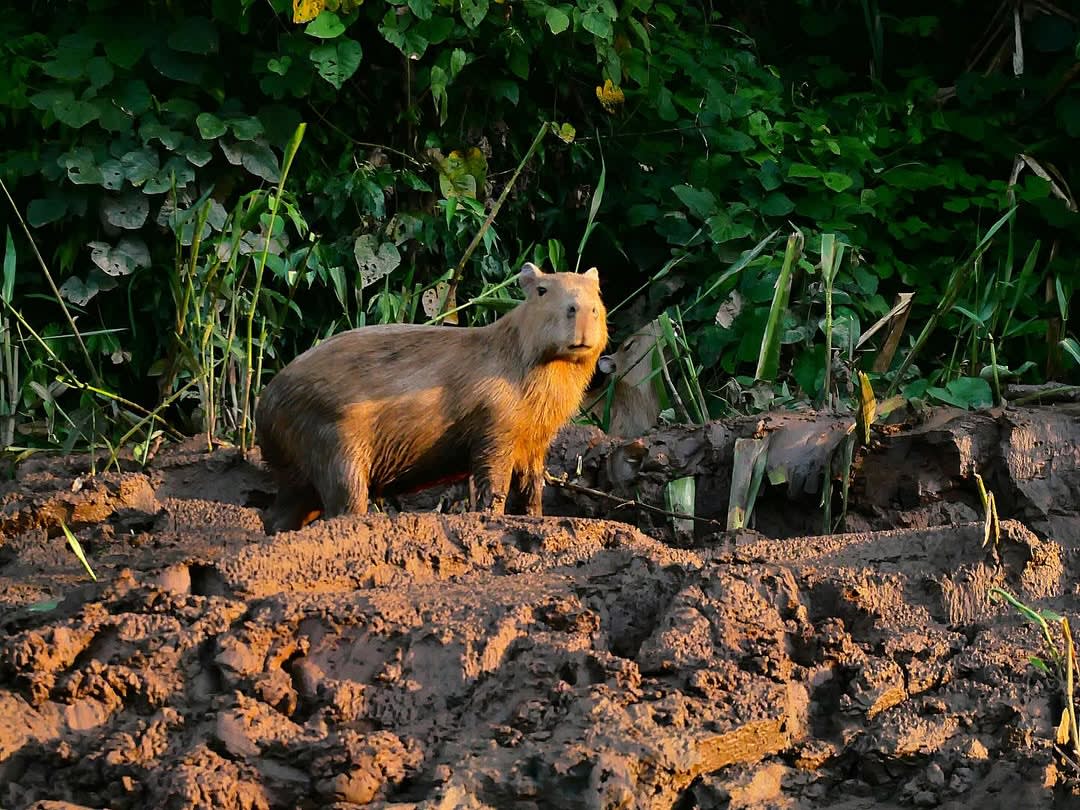
The jaguar is present in the Tambopata National Reserve and occasionally uses the river edge near the collpa — paw tracks are sometimes found in the riverine mud during the morning session. However, the Collpa Chuncho programme is a macaw experience, not a jaguar itinerary. Any mammal sighting is additional and unpredictable. Kada does not represent the collpa as a jaguar-watching site, and guests whose primary objective is jaguar should discuss that separately.
Light rain does not affect the macaw colony — the birds attend the collpa on overcast and lightly rainy mornings. Heavy rain or electrical storms cause the colony to not appear. The biologist monitors conditions from the lodge the previous evening; if weather makes the session unlikely to be productive, Kada reschedules to the following morning where the itinerary permits. No-show mornings due to weather are rare in the dry season and somewhat more common in November through March.
The collpa session occupies the 4:45 AM to 8:00 AM window. It pairs naturally with an afternoon programme on the same day — canopy observation, river otter monitoring, or the reserve trail walk. The night walk is typically scheduled for a different day to allow guests adequate rest after the pre-dawn departure. The Tambopata Research Center's canopy tower session, which begins at a more reasonable hour, is the natural complement scheduled for a different morning.
Design Your Journey
Design your bespoke Peru journey
We talk. We listen. Then we design an itinerary that belongs only to you.
Start Planning