Unfolded· 7 min read·29 July 2026
The Sky the Forest Opens To
The equatorial night sky from the Peruvian Amazon — near zero latitude, no artificial light for fifty kilometres in any direction, and the Milky Way oriented directly overhead rather than at the horizon angle the northern hemisphere knows. An honest account of what this sky offers, what the Amazon's cloud cover limits, and what a clear night in primary forest produces that nowhere else on Earth replicates.
By Kada Travel Editorial
The southern hemisphere's night sky is not the northern hemisphere's night sky with a rotation. It is a different sky. The Magellanic Clouds — the Large and Small — are two satellite galaxies of the Milky Way visible to the naked eye from the southern hemisphere, absent entirely from skies north of approximately twenty degrees latitude. The Southern Cross is visible in the south, a compact constellation that navigators of the southern hemisphere have used for centuries as the north uses the North Star. The centre of the Milky Way — the galactic bulge, the densest and most luminous region of the galaxy — is visible from the southern hemisphere at higher angles than from the north, and from near-equatorial latitudes it passes directly overhead. If you lie flat on your back in a clearing in the Peruvian Amazon on a clear night, the centre of the galaxy is above you, not at the horizon.
This is what zero latitude provides: a sky that is simultaneously the southern sky and the equatorial sky. No other inhabited region of the Peruvian Andes or coast offers this in combination with the complete absence of artificial light that primary Amazonian forest provides. Paracas has the darkest coastal sky in western South America — Bortle Class 2, reliably clear, almost no humidity. The Amazon has something different: the sky at zero latitude, above a canopy that has no human light source within fifty kilometres, available on the nights when the clouds are absent. It is not better than Paracas. It is irreplaceable in a different way.
What Zero Latitude Does
The equatorial position has specific consequences for the observable sky that a guest from the northern hemisphere may not have encountered before.
Overhead Milky Way: The galactic plane, which in northern latitudes appears as a band at an angle across the sky, passes directly overhead at equatorial latitudes. The visual effect is of the Milky Way as a ceiling rather than a wall — a structure above rather than beside, the density of the galactic core directly at zenith on the nights when the band is at its highest. For guests accustomed to the Milky Way as a diagonal feature of the summer sky, the equatorial orientation is immediately and physically disorienting in the way that genuine novelty is.
Magellanic Clouds: The Large and Small Magellanic Clouds are satellites of the Milky Way — irregular dwarf galaxies gravitationally bound to the Milky Way system, visible to the naked eye at angular sizes larger than some constellations, appearing as detached sections of the Milky Way when seen for the first time. They are permanent features of the southern sky, circumpolar from southern latitudes, visible from the equatorial Amazon on any clear night regardless of season. Guests from Europe and North America have never seen these objects with the naked eye; no amount of description prepares them for the first sighting.
Southern Cross: The crux constellation is compact — the four primary stars form a cross smaller than a hand held at arm's length — but unmistakable once identified. From the Peruvian Amazon (approximately twelve to sixteen degrees south), the Southern Cross is circumpolar, never setting below the horizon. The dark nebula adjacent to it — the Coalsack, a molecular cloud in the galactic plane that appears as an absence of stars against the Milky Way — is one of the features the astrophysicist identifies in the first minutes of the session, because it is one of the most striking objects in the equatorial sky that northern observers have never encountered.
An Honest Account of the Clouds
The Amazon is a humid tropical environment. It produces clouds — the convective cycle that drives the Amazon's daily weather generates afternoon cloud build-up that persists into the night on a regular basis through much of the year. The Paracas desert at Bortle 2 has reliably clear skies because it is a desert. The Amazon does not have reliably clear skies, because it is the Amazon.
What this means practically: the equatorial night sky programme is available on clear nights. In the dry season (May through October in the southern Amazon), clear nights occur more frequently than in the wet season. The estimate — honest rather than promotional — is three to four clear-sky observation hours per week in dry season, fewer in the wet season. Kada does not describe this programme as reliably available on any specific night of a guest's itinerary.
What Kada does instead: the astrophysicist who leads the programme monitors sky conditions at the observation sites used in the reserve zone and the lodge platforms. When conditions are favourable, the session is scheduled. When conditions are not favourable, the session is postponed to the following night if the guest's stay allows, or it does not happen. The session is presented as an opportunity contingent on the Amazon's weather, not as a guaranteed delivery within the itinerary.
Guests who require certainty about astronomical observation should be directed to the Paracas programme (where stargazing is woven into the Atacama-adjacent desert sky). Guests who understand the Amazon's atmospheric conditions and are willing to accept that a clear night is a gift rather than a promise will find, on the nights it occurs, an experience of the sky that the desert programme does not offer.
The Clearing and the Platform
Observation requires an unobstructed view of the sky. The primary forest canopy is continuous and dense; a clearing is required. The two types of observation sites the astrophysicist uses in the Tambopata zone are natural clearings — river bends where the canopy opens above the water surface, and oxbow lake edges where the open water provides a clear sky view — and lodge platforms where the accommodation structures have elevated observation decks above or at canopy level.
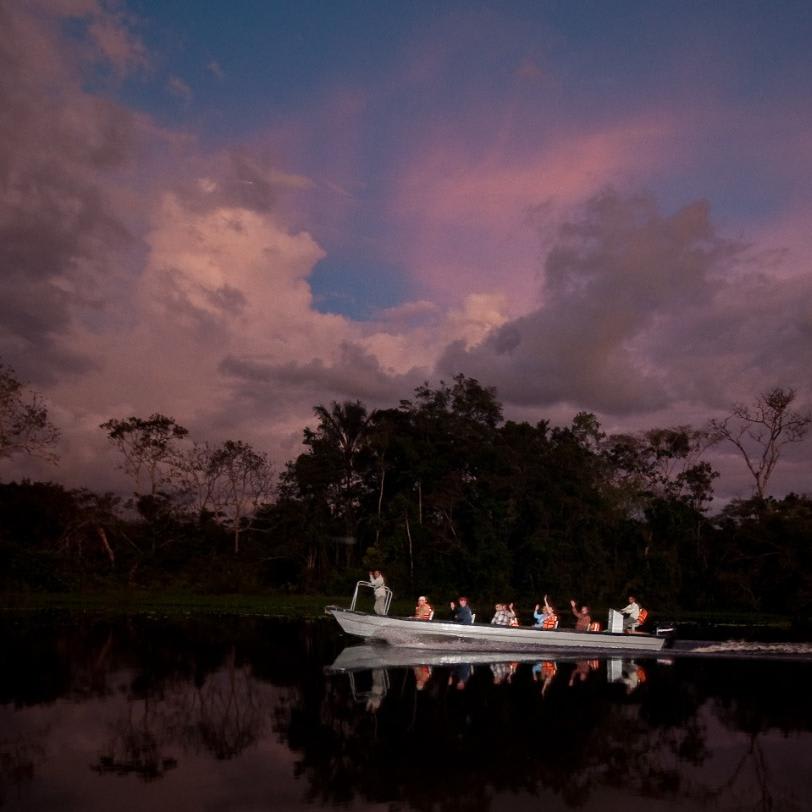
Inkaterra Reserva Amazónica, Refugio Amazonas, and the Tambopata Research Center all have observation decks or elevated structures that provide partial sky views on clear nights. The riverside clearings — accessed by short river transit after dark — provide more complete horizon-to-horizon sky coverage, at the cost of a twenty-minute boat departure in the dark. The astrophysicist selects the site based on current sky conditions and the guest's preferences; the riverside clearing is his preferred observation site for the best conditions, and the lodge platforms are the fallback when river conditions after dark make the transit impractical.
What Kada Arranges
Session begins at 9:00 PM — two hours after full dark, when the sky has reached its maximum darkness for the night and the eyes have adapted to the absence of artificial light. The astrophysicist conducts a thirty-minute naked-eye orientation — identifying the major features of the current night's sky, explaining the equatorial geometry of what the guests are seeing, and placing the Milky Way, the Magellanic Clouds, and the Southern Cross in their cosmological and historical context. The subsequent thirty to forty minutes are telescope time: the astrophysicist uses a portable refractor (aperture 100mm, configured for the wide-field views most appropriate to first-time southern hemisphere observers) to show Saturn's rings, Jupiter's moons (the Galilean satellites are visible as pinpoints flanking the planet's disc), the Omega Centauri globular cluster (the largest in the Milky Way, containing ten million stars), and the features of the Milky Way's core. The telescope is not the main event; the naked eye in the dark clearing is the main event. The telescope is for moments when the sky's specific features deserve close attention.
Total programme: ninety minutes to two hours. Return to the lodge by 11:00 PM.
Expert Perspective
"I have watched the Milky Way from clearings in the Atacama, from the Andes above 4,000 metres, and from three sites in the Peruvian Amazon. They are not the same sky. The Amazon sky — when it is clear, and it is not always clear — has something the desert skies don't: the sound of the forest below it. The frog chorus. The insects. The occasional howler monkey. You are lying in a clearing at nine degrees south, looking at the galactic centre directly above you, and the Amazon is making its full nocturnal sound around you. I have never been able to explain that combination to someone who hasn't experienced it. The sky is enormous and the forest is alive and they are simultaneously present. On the nights it happens, it is the single most complete sensory experience I have had in twenty years of guiding in Peru. That is the honest answer to the question of why we offer it despite the clouds."
— Katherine Cjuiro, Founder, KADA Travel
A Practical Note
Contingency: This programme is conditional on clear sky. Kada builds a minimum two-night stay in any lodge where the stars programme is included, specifically to allow the astrophysicist to select the better of the two nights. Guests on single-night stays should understand that the programme may not be available and that the itinerary should be valued independently of the astronomical session.
Eye adaptation: Dark adaptation — the eye's adjustment from artificial light to true darkness — takes approximately twenty to thirty minutes. Guests should avoid screen use and artificial light from dinner onward if the session is scheduled for that night. The astrophysicist provides red-light torches for navigation; red light does not disrupt dark adaptation. White phone screens do. This is the single most impactful practical instruction: put the phone away before leaving the lodge.
Equipment: The telescope and the sky orientation materials are provided. Guests should bring a lightweight jacket — temperatures in the Amazon clearing at 9:00 PM are lower than midday temperatures, typically 22–25°C, with a humidity that produces a wind-chill effect on exposed skin after extended stillness. A light blanket or ground mat for lying flat during the naked-eye portion is provided by the astrophysicist; guests who prefer their own mat may bring one.
Insects: Mosquito protection should be applied before departure and maintained through the session. Some guests are concerned about repellent affecting the lens of the telescope; the astrophysicist manages the equipment and this is not the guest's concern. DEET on skin does not damage the optics from normal observatory distances.
Written by Kada Travel Editorial
Frequently Asked
Paracas and the Atacama offer superior sky conditions in terms of frequency and reliability — the coastal desert climate produces clear nights on approximately three hundred days per year, with Bortle Class 2 or better darkness and minimal humidity. The astronomical opportunity in those locations is more reliably accessible within a fixed itinerary. The equatorial Amazon sky, on clear nights, offers what neither the Atacama nor Paracas can: the zero-latitude orientation of the Milky Way directly overhead, combined with the complete biological experience of the Amazon forest at night — the frog chorus, the insect stridulation, the nocturnal forest alive beneath the stars. Guests who want reliable astronomical observation book Paracas. Guests who want the Amazon sky specifically — knowing it is conditional on the forest's weather — book this programme with their eyes open to what "conditional" means.
At northern latitudes (Europe, North America), the Milky Way band is visible in summer as a diagonal arc across the sky — the galactic plane at an angle relative to the observer's horizon, rising in the northeast and setting in the southwest. The angle of the band relative to the horizon depends on latitude; the higher the latitude, the lower the band's maximum elevation. At the equator, the galactic plane passes through the zenith — directly overhead — at certain times of year, meaning the full band of the Milky Way, including the galactic centre, is at or near ninety degrees elevation. The visual experience is fundamentally different: the galaxy is a structure above rather than beside, and the sense of depth — looking toward the galactic core — is maximal when the gaze is directly upward rather than tilted.
The Large Magellanic Cloud (LMC) and Small Magellanic Cloud (SMC) are irregular dwarf galaxies orbiting the Milky Way at distances of approximately 160,000 and 200,000 light years respectively. They are visible to the naked eye as detached luminous patches — the LMC covers an area of sky roughly twenty times larger than the full moon — and have been observed by southern hemisphere peoples for millennia. They are not visible from latitudes north of approximately eighteen degrees. From the Peruvian Amazon (nine to sixteen degrees south, depending on location), both Clouds are above the horizon for most of the night and well-positioned for naked-eye observation on clear nights.
Yes, but with significantly different cloud probability by season. The dry season (May through October) produces the most frequent clear nights and is the optimal period for the programme. The wet season (November through April) brings more frequent cloud cover and the programme is available but less reliably accessed. Kada advises guests planning specifically around the astronomical session to time their Amazonas visit to the dry season; guests for whom the stars are one of several programme elements accept the seasonal variability as part of the broader Amazonian experience.
Design Your Journey
Design your bespoke Peru journey
We talk. We listen. Then we design an itinerary that belongs only to you.
Start Planning