Unfolded· 7 min read·12 July 2026
Four Species, One Valley
Awana Kancha — between Cusco and Pisac, where the four South American camelid species are kept together and the full chain from fleece to finished cloth is presented as a working demonstration, not a heritage reconstruction.
By Kada Travel Editorial
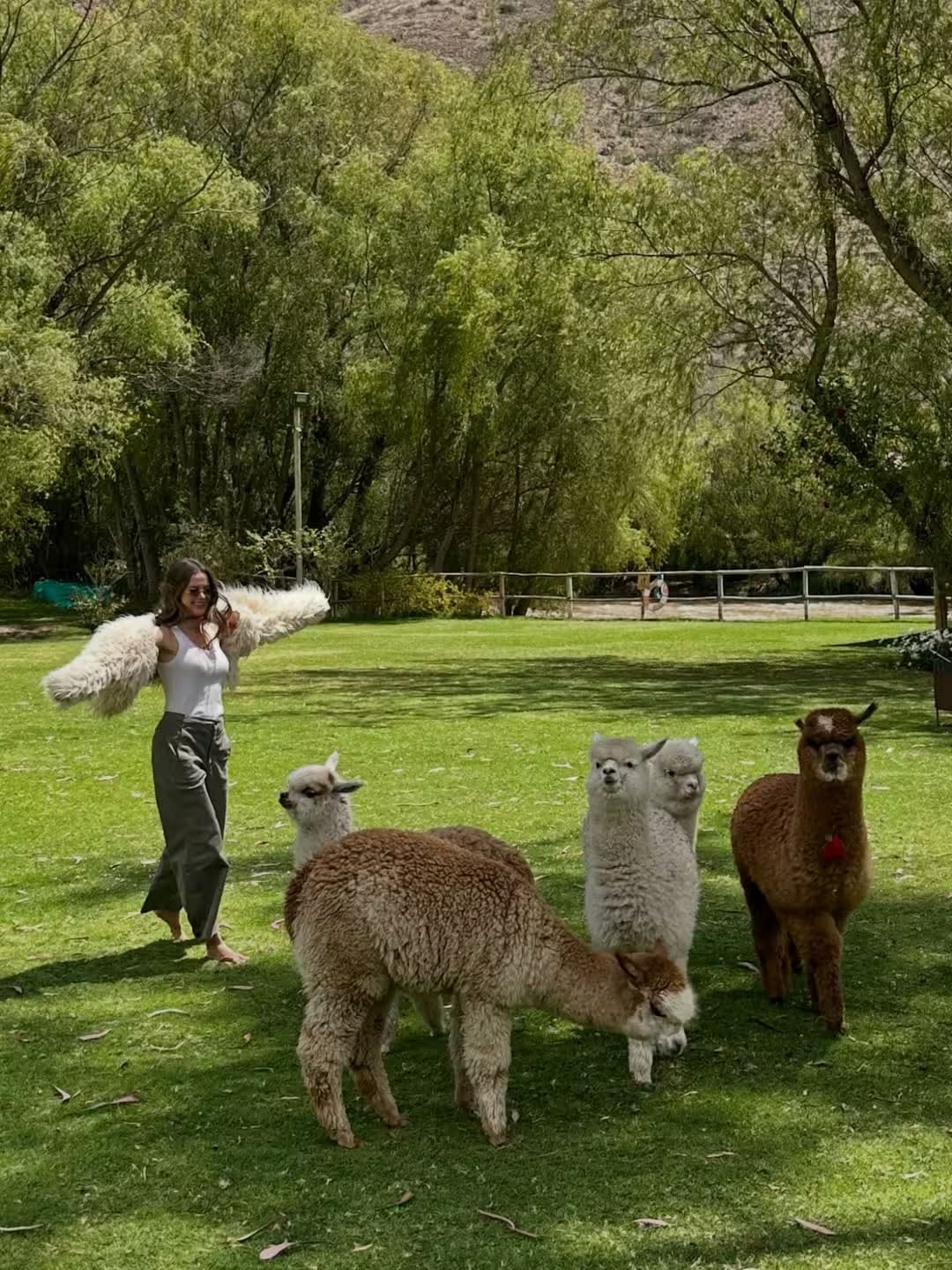
There are four camelid species native to South America, and Awana Kancha keeps all of them. This is less obvious than it sounds. In the Andes today, alpacas and llamas are domesticated livestock — common across the Sacred Valley, present at every highland market, available at every roadside tourist stop between Cusco and Aguas Calientes. The vicuña and guanaco are different: the vicuña is wild, herded briefly for shearing under state permit and then released, and produces the finest natural animal fibre on earth; the guanaco is the wild ancestor of the llama, present in remote areas of southern Peru, and almost never encountered in a setting where it can be observed at close range. At Awana Kancha, which maintains all four species with careful attention to their welfare and natural behaviour, the comparison between them — in scale, in temperament, in the texture of their fleece — is possible in a single morning.
The textile programme at Awana Kancha operates at a different register from the rural cooperative visits we arrange at Chinchero. This is not a family workshop where the transmission of technique happens in Quechua at kitchen-table pace. It is a professional textile centre with a team of accomplished weavers, a natural dye laboratory, and a standard of documentation and presentation that reflects sustained institutional investment. For guests whose primary interest in the tradition is its relationship to contemporary design, to material quality, to the commercial and cultural context of high-end Peruvian textiles — Awana Kancha provides the most comprehensive single-site encounter the Sacred Valley offers.
The two visits are complementary rather than competing. We often arrange both within the same Cusco itinerary, on separate mornings, precisely because they show the same tradition from different vantage points.
The Four Animals
Alpacas are the primary textile animal of the Andes, and Awana Kancha keeps both breeds. The Huacaya — the familiar crimped fleece that most visitors associate with the Andean highlands — produces a soft, springy fibre widely used in commercial production. The Suri is rarer, perhaps ten percent of the alpaca population; its long silky locks fall in loose spirals rather than crimping, and the cloth it produces has a drape and lustre distinct from anything the Huacaya makes. Most guests who have purchased "alpaca" garments have never encountered Suri textile; the difference is immediately apparent when both are present.
The llama, the domesticated relation, was bred for carrying capacity rather than fibre quality. A llama can sustain thirty to forty kilograms across the altitude range of the Inca road network — performance no horse or mule manages at the same sustained pace and altitude — and the Inca state depended on llama transport for the logistical functioning of Tawantinsuyu. The fleece is coarser and was used mainly for rope, sacks, and utilitarian cloth. At Awana Kancha, the llamas are typically the most approachable animals; the temperament difference from the more cautious alpacas is immediately legible.
The vicuña is the species whose fleece the Inca state monopolised for cumbi cloth — the highest-grade textile in the imperial system, reserved for the emperor and his closest allies. The animal produces roughly two hundred grams of usable fibre per year, the finest natural animal fibre by micron count, and can be shorn only once every two years under current Peruvian conservation regulation. The resulting cloth commands prices that reflect genuine scarcity. At Awana Kancha, the vicuñas are kept in a section with restricted visitor access; approach is at a controlled distance, because vicuña domestication has not progressed to the point where close human contact is predictable.
The guanaco is the largest of the four, the least familiar to most visitors, and the wildest in captivity. It is the animal from which the llama was domesticated approximately seven thousand years before present, and the genetic distance between them is sufficient that the two look distinctly different: the guanaco has longer legs, a more pronounced neck, and a wilder register of attention that is obvious even across the enclosure fence. It is the animal at Awana Kancha that is most likely to be standing at an angle that suggests it is calculating whether the fence is a genuine constraint.
The Textile Programme
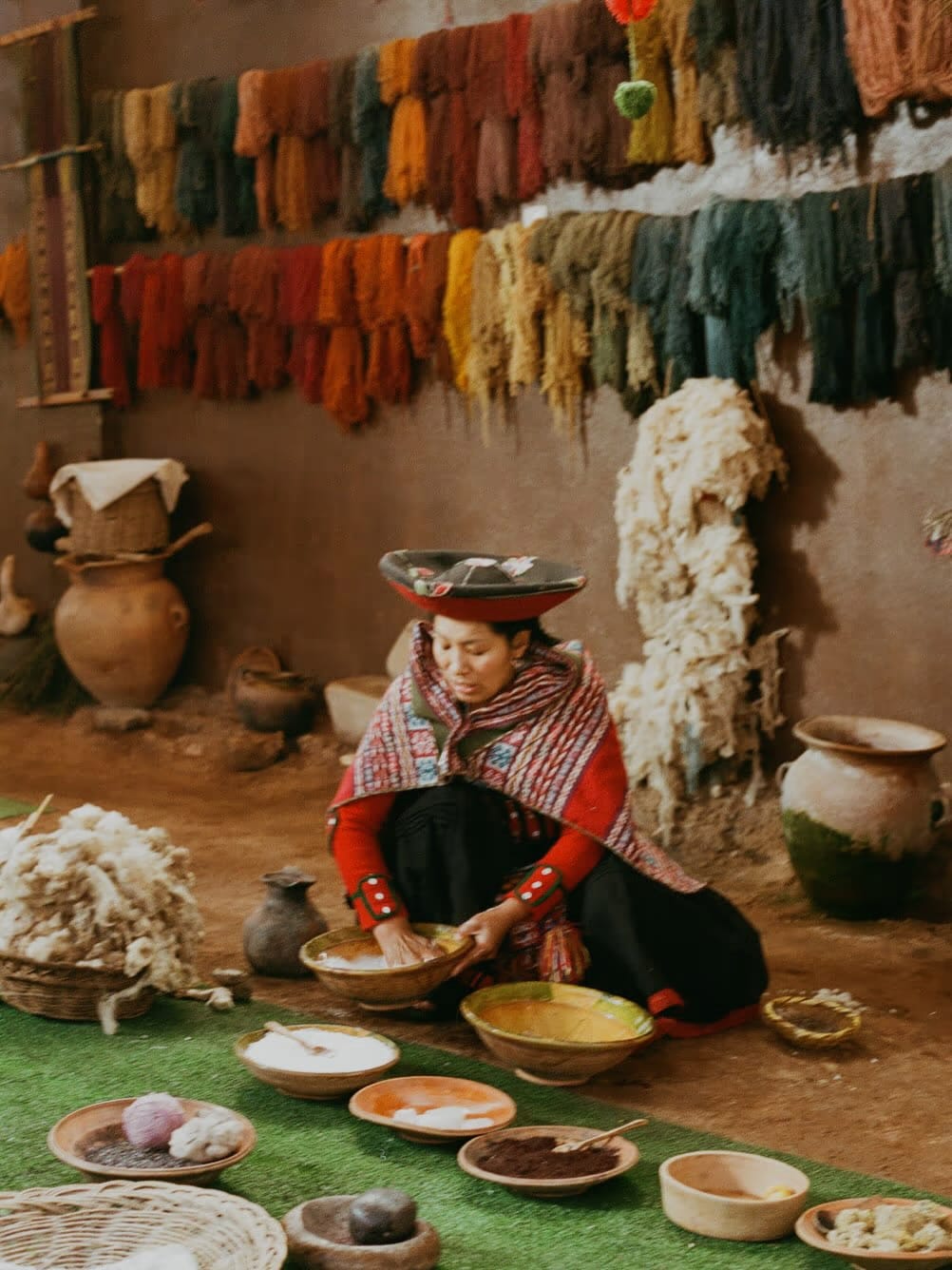
The natural dye laboratory is one of Awana Kancha's strongest assets, and it is where the visit makes its most distinctive contribution. The range of colours achievable from cochinilla, qolle bark, ñucchu flowers, and indigo is presented with their chemistry explained — the mordant reactions, the reason that an alum mordant brightens a cochinilla bath while an iron mordant darkens it toward grey, the reason the same plant dye produces different colours at different pH levels. What this explanation does is convert the natural dye tradition from folk practice into a sophisticated colour technology: a system that Andean weavers developed empirically over millennia and that produces results comparable to synthetic dyes in range and intensity, at a greater investment of labour and knowledge.
The weaving demonstration covers the backstrap loom — the telar de cintura — in the hands of practitioners at full professional standard. The technical programme at Awana Kancha is more structured than the family workshop context at Chinchero: the demonstrations are designed for comprehensibility and depth rather than calibrated to a strict time slot, and the weavers are accustomed to explaining their work in both Spanish and English as well as Quechua. For guests who want to understand the tradition's relationship to contemporary textile design — the way Peruvian designers working in this material navigate between traditional technique and current market aesthetics — the Awana Kancha weavers can speak to that conversation in a way that a rural cooperative visit does not typically support.
The collection produced at Awana Kancha and available for purchase spans the full material range from standard alpaca to vicuña. The pricing reflects genuine production costs, which in the case of vicuña reflect both the scarcity of the fibre and the labour intensity of working at this quality level. For guests considering a significant textile acquisition, the visit provides the context — fibre quality, dye provenance, weave structure — to make an informed decision.
What Kada Arranges
A private visit to Awana Kancha runs two to two and a half hours. We arrive at the centre's opening — or slightly before, where arrangements permit — to complete the full programme before the main Sacred Valley day-trip groups arrive from 10:00 AM onward. The private visit format gives the group direct access to the centre's senior weavers and dye specialists rather than the standard visitor pathway.
The sequence: camelid enclosures first — the four species in order, with attention to the Suri alpaca and the vicuña sections — then the dye laboratory, then the weaving demonstration, then the collection. This order is deliberate: the physical encounter with the animals establishes the fibre quality differential before the dye and weaving demonstrations show what is done with it. By the time a guest arrives at the collection, they have a material reference for what they are looking at.
For guests who are considering a custom textile commission — a specific fibre, pattern, and colour combination — the visit is the right moment to develop that brief directly with the weaving team. Awana Kancha ships internationally; the logistics of a commission are straightforward when the specification is clear, and a minimum of six weeks' lead time covers most standard requests. Pieces involving vicuña fibre require eight to twelve weeks depending on available fleece.
Maximum group size for the private visit format is six to eight.
Expert Perspective
"What I find most useful about Awana Kancha for guests who are seriously interested in the textile tradition is the opportunity to understand quality differentials side by side — the Huacaya and Suri alpaca fleece against each other, the alpaca against vicuña, the natural dye palette against synthetic alternatives — in a single visit, at a level of explanation that is genuinely technical rather than commercially motivated. For guests who are considering a textile purchase — whether here, at Chinchero, or at a Lima gallery — having the material reference changes the decision significantly. You understand what you are looking at and why the price is what it is. That shift, from 'this is expensive' to 'this reflects a specific sequence of decisions about fibre source, dye method, and weave structure,' is what distinguishes an informed acquisition from a purchase made on general impression."
— Isabela Santos, Senior Travel Designer, KADA Travel
A Practical Note
Awana Kancha is at approximately 3,500 metres on the road between Cusco and Pisac — positioned as the valley descends from the Cusco plateau, which means the altitude is slightly lower than Cusco city rather than higher. The acclimatisation concern is less acute than for visits to the Chinchero plateau (3,762m), but standard altitude caution applies for guests in their first two days at elevation.
The camelid enclosures are outdoors. Morning temperatures in the dry season are typically 8–12°C; the covered weaving and dye areas are warmer. Layers remain useful until mid-morning.
Photography of the animals and the textile process is standard. The vicuña enclosure has restricted photography protocols consistent with the welfare requirements for that species; the weavers at the demonstration are accustomed to being photographed during their work. Asking before close-up photography of individuals is the courtesy we reinforce.
Written by Kada Travel Editorial
Frequently Asked
The vicuña at the centre are maintained under Peru's legal framework for vicuña conservation, which permits shearing of managed animals every two years under permit. The fibre from the centre's herd contributes to their production; for pieces under consideration for purchase, the team can speak to provenance — whether a specific piece uses fibre from their own herd or from a licensed *chaku* (the traditional communal shearing event) conducted elsewhere in the highland communities. Provenance information is available on request for any vicuña piece.
The two visits show the same tradition from different vantage points. Awana Kancha is a professional textile centre: structured, documented, and designed for guests who want to understand the tradition as design practice and material culture, including the four camelid species, the natural dye chemistry, and the commercial context of high-quality Peruvian textiles. The Chinchero cooperative is a working rural studio in which Jaime's translation of the Quechua craft vocabulary and the family lunch at the end place the same tradition in its community and linguistic context. Guests with sufficient time benefit from both; the choice for guests who can do only one depends on whether their primary interest is in the tradition as institutional knowledge or as living community practice.
Six weeks for a standard custom piece in alpaca. Pieces involving *Suri* alpaca, or any content in vicuña fibre, require eight to twelve weeks depending on available fleece. Custom commissions are arranged through Kada at the planning stage; we brief the Awana Kancha team on the guest's requirements before the visit and use the visit to develop the final brief directly with the weavers.
Yes — the visit is designed to be informative without requiring specialist knowledge as a prerequisite. The four-camelid encounter is engaging independently of any interest in textiles; the dye laboratory explanation works at whatever level of chemical detail the guest wants; and the weaving demonstration is calibrated to make the skill visible and comprehensible to anyone who is paying attention. Guests who arrive with no prior knowledge of the Andean textile tradition consistently leave with a more substantive understanding than they could have acquired from reading about it.
Design Your Journey
Design your bespoke Peru journey
We talk. We listen. Then we design an itinerary that belongs only to you.
Start Planning