Unfolded· 7 min read·11 July 2026
What the Thread Holds
Chinchero — the master weavers of the Sacred Valley plateau, where pre-Inca weaving techniques are transmitted in Quechua from grandmother to granddaughter, and where the cooperative that keeps this work alive is not the one on the tourist circuit.
By Kada Travel Editorial
Most of the weaving demonstrations along the Sacred Valley road follow the same format: a twenty-minute tour through dye pots, a brief seated demonstration at the loom, a shop at the end. The content is accurate. The technique shown is real. What those demonstrations cannot provide — what no demonstration calibrated to tour bus timing can provide — is the conversation that the craft actually runs on. That conversation happens in Quechua, between women who have been doing this since childhood, in a vocabulary that was built alongside the tradition and has no precise equivalent in Spanish or English. I translate at Chinchero because without the translation, the most important part of what the master weavers know remains inaccessible.
Chinchero sits at 3,762 metres on the plateau above the Sacred Valley, thirty minutes from Cusco by road. It has a colonial church built on Inca foundations — the standard Cusco pattern — and a Sunday market that draws visitors from across the valley. What makes Chinchero significant in any serious account of world textile art is not the church or the market. It is the concentration, in a small number of specific cooperatives, of women who hold the full technical knowledge of the Andean weaving tradition as a working practice. The tradition here is not reconstructed. It did not require revival. It continued.
The cooperative we work with is not the one on the main road. The distinction matters in practice: the women of this cooperative weave as their primary livelihood, not as an income supplement, and the technical depth of what they know and are willing to explain — given the time and the translation — is different from what a thirty-minute demonstration slot makes possible.
The Tradition
Andean textile production is one of the oldest continuous craft traditions in the world. Archaeological evidence places backstrap weaving in the Andes at more than five thousand years before present; the Inca state, which organised skilled labour into systematic tribute and redistribution, made textile production one of the two primary goods in its economy — alongside agricultural output. The cumbi cloth, woven from vicuña fibre in specific dye combinations and reserved for the emperor and his closest allies, represented the highest technical and social value the Inca system produced. The women who wove it were not artisans in the sense a European guild would recognise; they were a specialised workforce within the state's own administrative structure, working in acllahuasi — the houses of chosen women — under conditions of total institutional commitment.
What the Spanish conquest interrupted, at the level of the state textile programme, was not the technique. The women who had woven cumbi cloth continued weaving; they adapted the iconographic programme of the textiles to incorporate colonial Catholic imagery into the existing geometric vocabulary, and the tradition continued. The cooperatives in Chinchero are the direct inheritors of this continuity — not in a symbolic sense, but in the literal sense that the women who run them learned the full technical process from women who learned it from women who have been doing this, without interruption, since before the Inca organised it.
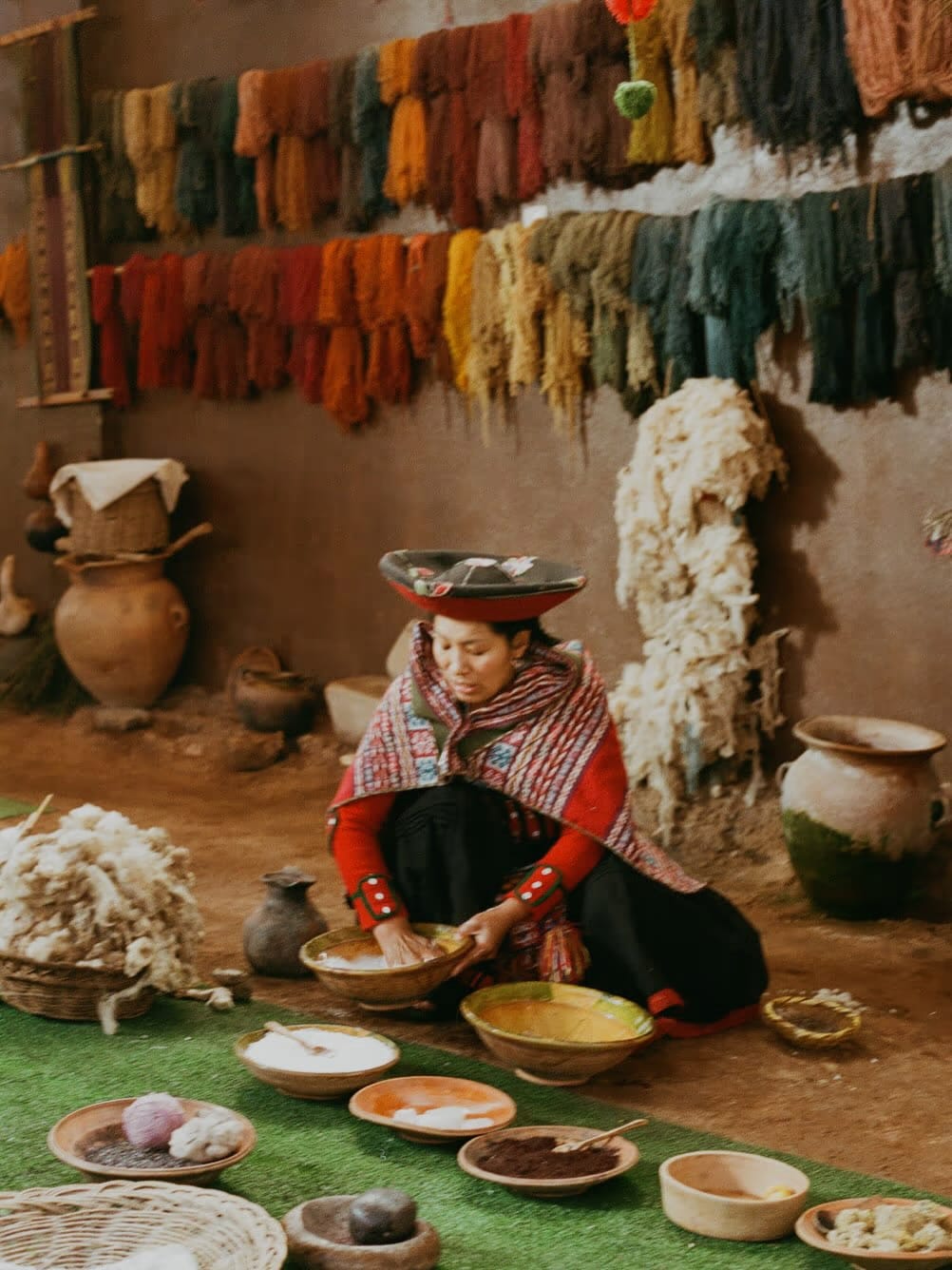
The dye tradition is equally old. Andean textile colour derives from a combination of mineral, plant, and animal sources. The most important animal source is cochinilla — the dried and ground body of the cochineal insect (Dactylopius coccus) that lives on the nopal cactus — which produces, depending on the mordant applied, a full range from pale coral to deep crimson. Plant-based dyes supplement the range: qolle bark yields the gold and tan tones; ñucchu flowers — the red Andean salvia — contribute warm pinks; indigo brought up the trade routes from lower altitudes produces the blues. Synthetic dyes are available and cheaper. The cooperative we work with does not use them. The difference in the finished cloth is visible to the naked eye: a depth and variability of tone that synthetic dyes replicate only at a surface level.
The Process
The visit runs through the complete textile process from raw material to finished cloth, in sequence. This is not a selective demonstration of the photogenic stages; it is the full chain, because understanding the full chain is the only way to understand what a finished piece of traditional Andean weaving represents in terms of accumulated knowledge and labour.
Raw alpaca fleece is cleaned and then spun using a drop spindle — the pushka — into thread. Spinning is itself a skill that takes years to develop; the consistency and twist of the yarn determines the quality of the finished weave, and an experienced spinner produces thread of an evenness that a novice cannot replicate in an afternoon. The movement of the spindle — a practiced flick of the wrist that keeps the whorl turning at a consistent speed — becomes invisible through repetition; what looks effortless in the master weaver's hands produces an uneven thread in the guest's.
The dye process follows. The cooperative demonstrates dyeing with natural materials: the cochinilla bath in different mordant combinations, the plant dye extractions from qolle bark and ñucchu, the mineral fixatives. Different mordants applied to the same cochinilla bath produce different colours; the women know the combinations without measurement, by result. The yarn is dyed in hanks, dried in the courtyard sun, and wound onto spools for the loom.
The loom itself — the telar de cintura, or backstrap loom, in which the weaver's body provides the tension for the warp by leaning back against a strap tied to her waist — is the mechanism in which the technical knowledge fully concentrates. The pattern emerges from the manipulation of warp threads with a series of flat sticks and the weaver's fingers; different patterns require different sequences of thread manipulation, and the sequences are held in the weaver's memory and hands, not in any written instruction. A complex traditional pattern, in the hands of a master, requires the kind of sustained bodily knowledge that long practice builds and short observation cannot decode. What the full sequence — raw fleece to finished cloth, in a single morning — makes legible is not a series of impressive skills but the architecture of a knowledge system: how each stage is inseparable from the next, and why the tradition survived by being transmitted as a complete practice rather than as individual techniques.
What the Patterns Hold
The geometric patterns of traditional Chinchero weaving are not decorative in the sense that implies ornamental without meaning. They are a visual language with a specific vocabulary: forms that denote community identity, family lineage, ceremonial occasion, the specific agricultural and ecological context of the plateau. A weaver who grew up in the tradition can read another woman's cloth in the way a fluent reader reads text — not interpreting symbols but receiving meaning directly.
The transmission of this vocabulary happens in Quechua. The names of each weave structure, each pattern element, each stage of the dye and spinning process exist in the Quechua craft vocabulary and do not have precise equivalents in Spanish. When a master weaver says that a pattern "remembers" a mountain — the specific phrase she uses — she is not being poetic. She is using the technical term for the relationship between a visual structure and the landscape form it represents, in a vocabulary that her grandmother used to teach her the same pattern. I translate this because without translation it sounds like a metaphor. With translation it becomes a description of how knowledge is stored in cloth.
What Kada Arranges
The cooperative Kada works with is not the one on the main road, and the distinction is not incidental. The women of this cooperative — a family-rooted group whose senior weavers learned the full process from their mothers and grandmothers, in the same Quechua technical vocabulary, with the same natural dye materials, without interruption — work the tradition as their primary livelihood rather than as an income supplement and practise its full depth rather than a demonstration subset. Kada was introduced to this cooperative through Jaime Ttito, whose years of work as a cultural interpreter in the Sacred Valley produced the kind of standing in which the women are willing to explain their work at the level of what it actually is: a complete technical and linguistic system, not a staged performance. The morning Kada arranges here is not a weaving demonstration. It is two and a half hours with practitioners who have not simplified what they know for visitor timing.
We arrive in Chinchero at 9:00 AM — before the tour bus stops that begin arriving from 10:00 onward, and early enough that the morning light on the courtyard is at the angle that makes the warp threads and their tension visible. The cooperative is not on the standard circuit, which means the arrival timing is less competitive than at the main Sacred Valley sites; the more important reason to arrive early is the pace it establishes for the morning.
The full process walkthrough runs two to two and a half hours. The master weavers demonstrate each stage and explain their work; I translate the Quechua context that does not come through in a Spanish-only account. This is not a matter of covering the same content in two languages. The Quechua vocabulary carries specific technical and cultural meaning that changes what the demonstration is. Guests who have attended bilingual demonstrations at the road cooperatives consistently report that the Chinchero session feels like a different encounter — not more polished, but more present. The difference is in the language the knowledge actually lives in.
Lunch follows the demonstration: a family meal at the cooperative, prepared by members' families, with dishes specific to the Chinchero altitude and season. The menu is not announced in advance. It is what is available and what has been prepared.
Maximum group size for the cooperative visit is six. The cooperative's production is available for purchase directly — both standard pieces and, for guests who want a specific commission, larger pieces with custom colour or pattern elements arranged in advance with a minimum of four weeks' lead time.
Expert Perspective
"When I translate at Chinchero, I am not only converting Quechua into English. I am converting a technical vocabulary that has no equivalent in a language that did not develop alongside this craft. The weaver uses terms for specific warp manipulations, specific thread arrangements, specific pattern sequences that describe exactly what her hands are doing — and those terms exist because the tradition built its own language to describe itself with precision. When she says a pattern 'remembers' a mountain, she is not being poetic. She is describing the relationship between a specific visual structure and the landscape it represents, in a vocabulary that her grandmother used to teach her the same pattern. To translate that, you have to know both languages and understand what is being described. I find, every time, that the precision of the Quechua craft vocabulary makes the skill visible in a way that Spanish does not."
— Jaime Ttito, Head of Guides & Cultural Interpreter, KADA Travel
A Practical Note
Chinchero is at 3,762 metres — the highest point of the standard Sacred Valley–Cusco itinerary and approximately 350 metres above Cusco city. The altitude differential is significant enough to plan for: a minimum of three full days of acclimatisation in the Sacred Valley or Cusco before scheduling this visit. The plateau above the Sacred Valley — where Chinchero, Maras, and Moray all sit — is best visited in the second half of the Cusco segment, after the higher-altitude activities have been sequenced appropriately.
Morning temperatures on the Chinchero plateau, even in the dry season, are 5–10°C before 10:00 AM. The cooperative workshop is sheltered, but the arrival and the courtyard dye demonstrations are at full altitude exposure. Layers are standard.
Pieces purchased directly from the cooperative represent the full value of the tradition: the labour of dyeing, spinning, and weaving a complex traditional cloth runs to dozens of hours for a medium-format piece. The prices at the cooperative reflect the real cost of production. This is not a context for negotiation.
Written by Kada Travel Editorial
Frequently Asked
The demonstrations on the main road are calibrated for tour bus timing — thirty to forty minutes, accurate, and a good introduction to the tradition. The Chinchero cooperative visit is a full half-day encounter with practitioners who have worked the tradition at professional level for their entire adult lives. The difference is not in the technique demonstrated, which is the same tradition, but in the depth of the conversation possible, the presence of the full process from raw fibre to finished cloth, and Jaime's translation of the Quechua craft vocabulary — which contains explanations that bilingual Spanish-English demonstrations do not carry.
Yes. The cooperative includes a brief guided session at the backstrap loom as part of the visit — a few minutes with one of the younger members supervising the guest's attempt. The result is invariably uneven, and the contrast between the beginner's output and the master weaver's cloth, which has just been demonstrated, is itself an illustration of what the practice requires. The instruction is not a formal lesson; it is an opportunity to understand the difficulty of the craft from the inside.
A minimum of four weeks for a medium-format piece in a traditional pattern. Larger pieces, or pieces with specific colour or design requirements, require six to eight weeks. The commission is arranged through Kada; the design brief is developed with the cooperative members, and the completed piece is shipped or collected at the guest's preference. We handle the logistics of international shipping.
Yes. The visit is designed to make the craft visible and comprehensible to guests with no specialist knowledge. Guests without textile backgrounds consistently leave with a more durable understanding of what a traditional Andean cloth represents — in terms of labour, cultural transmission, and ecological knowledge — than guests who have read about it in advance. The combination of Jaime's translation and the physical process demonstration is the most effective approach we have found for this material.
Design Your Journey
Design your bespoke Peru journey
We talk. We listen. Then we design an itinerary that belongs only to you.
Start Planning