Unfolded· 6 min read·16 July 2026
The Dune Climbed Before Sunrise
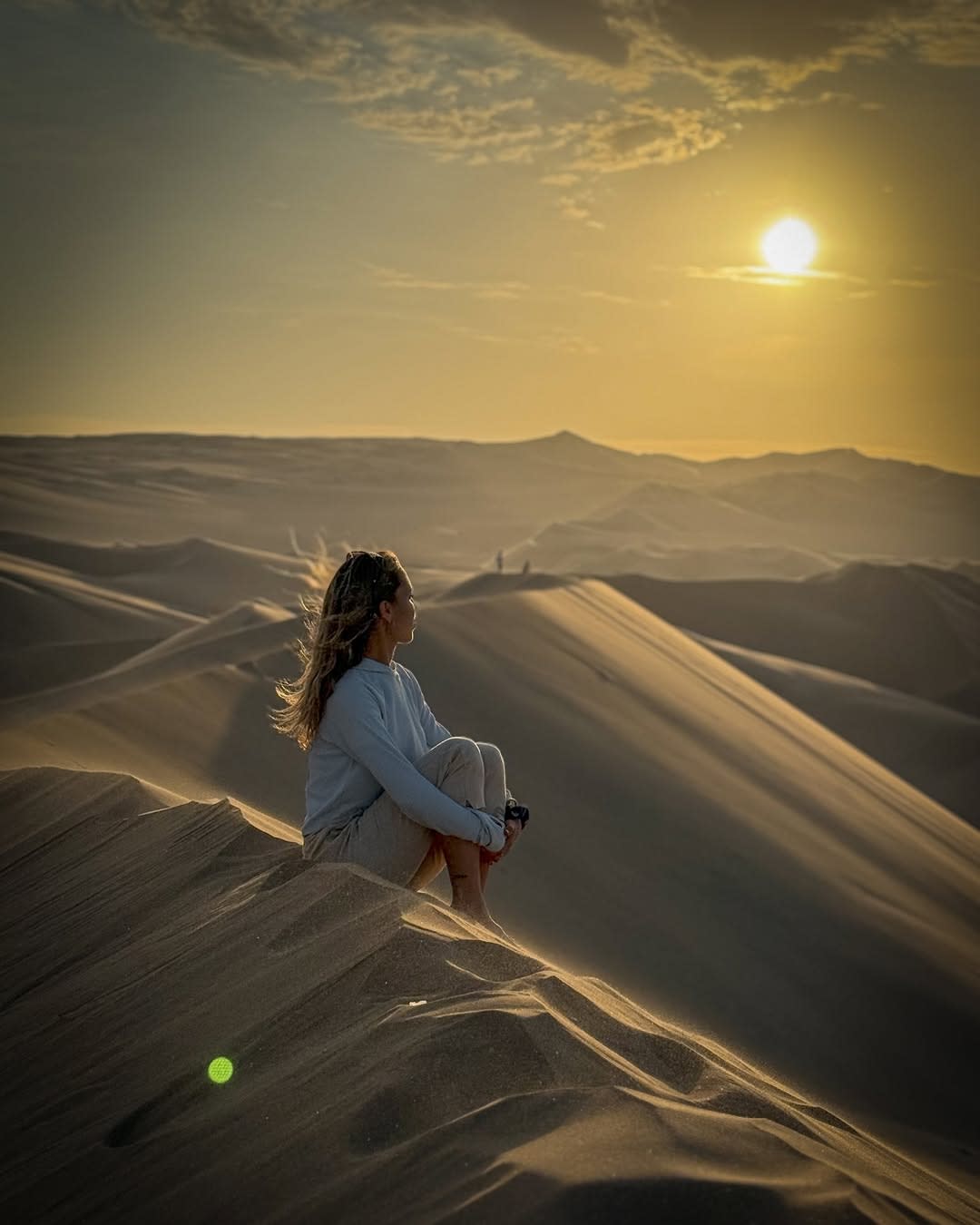
A private pre-dawn ascent of Cerro Blanco, near Nazca — among the tallest sand dunes on Earth, climbed in darkness for a summit view over the Nazca Valley at first light.
By Kada Travel Editorial
Near Nazca, rising abruptly from the surrounding desert, Cerro Blanco stands among the tallest sand dunes on Earth — a genuinely enormous accumulation of wind-deposited sand reaching well over two thousand metres in total elevation from base to peak, drawing a small but serious community of sandboarders and dune climbers, though considerably less known internationally than Huacachina's more accessible, more commercialised dune fields further north.
A Dune of Genuine, Rare Scale
Cerro Blanco's exact ranking among the world's tallest dunes is debated depending on measurement methodology, but it sits firmly among the largest examples on the planet — a single, massive accumulation rather than the smaller dune fields more commonly climbed elsewhere. The scale means a genuine physical undertaking to summit, considerably more demanding than a casual sandboarding excursion, and correspondingly more rewarding for guests prepared for real exertion.
Why the Pre-Dawn Timing Matters
Climbing Cerro Blanco in daylight means confronting the desert's full heat across a multi-hour ascent — genuinely punishing rather than simply challenging. A pre-dawn departure, climbing largely in darkness and reaching the summit as the sun rises, avoids the worst heat entirely while delivering a considerably more dramatic payoff: first light breaking across the Nazca Valley from a genuinely rare vantage point, the desert's colours shifting in real time as the sun climbs.
What Kada Arranges
We arrange a private pre-dawn ascent with an experienced local guide who knows the dune's specific terrain and safest ascent line, timed to reach the summit for sunrise. For guests wanting the descent as its own experience, sandboarding down provides a considerably faster and more exhilarating return than the walk up.
Expert Insight
"This is one of the more physically demanding things we arrange, and we're upfront about that — but the guests who do it tend to describe the sunrise from the summit as one of the most singular moments of their entire Peru trip. There's something about earning a view through real effort, in the dark, that a drive-up viewpoint simply can't replicate."
— Gustavo Arenas, Travel Director, KADA Travel
A Practical Note
This is a genuinely demanding physical experience — a multi-hour ascent on loose sand, requiring reasonable fitness and appropriate preparation (headlamp, layered clothing for the cold pre-dawn start, ample water). We assess each guest's fitness level honestly before confirming this itinerary.
Written by Kada Travel Editorial
Frequently Asked
Genuinely demanding — a multi-hour climb on loose sand at elevation gain considerably greater than most day hikes. We recommend this for guests in good general fitness and honest about their limits.
Roughly four to five hours total, including the pre-dawn departure, ascent, summit time, and descent (faster if sandboarding down).
No — descent on foot is possible for guests who prefer it, though sandboarding is considerably faster and popular among guests who complete the ascent.
Cerro Blanco is taller, more remote, and considerably more physically demanding — Huacachina offers a more accessible, resort-adjacent dune experience, while Cerro Blanco is a genuine expedition-style climb.
Design Your Journey
Design your bespoke Peru journey
We talk. We listen. Then we design an itinerary that belongs only to you.
Start Planning