Unfolded· 7 min read·5 July 2026
The Experiment That Outlasted the Empire
Moray and Maras — the Inca's circular agricultural terraces and the salt cooperative that has worked the same brine spring for a thousand years, visited before the morning buses arrive.
By Kada Travel Editorial
The Moray terraces are circular. This is the first thing that separates them from every other Inca agricultural structure in the Sacred Valley — from the parallel terraces at Pisac, from the stepped retaining walls at Ollantaytambo, from the ten thousand metres of terracing that line every viable slope between Cusco and Aguas Calientes. The terraces at Moray descend in concentric rings into a natural bowl in the plateau above the valley, and the descent is not decorative. It creates, at the bottom of the deepest ring, a microclimate approximately fifteen degrees Celsius warmer than the plateau above — the equivalent, in growing terms, of being several hundred metres lower in altitude.
The working hypothesis — contested in the scholarly literature, not yet settled — is that Moray was an agricultural research station. The concentric design was intentional climate engineering: a way to replicate, within a single installation on a plateau at 3,500 metres, the full range of growing conditions that the Inca empire encompassed from coastal valleys to high puna. If the theory holds, Moray was the site where the Inca tested crop cultivation at altitudes the plants did not naturally reach — a systematic programme of agricultural development, running at scale, sustained across generations.
The system still functions. The temperature differential between the rim and the lowest terrace is measurable and consistent. What it was used for remains, to a degree that should make any honest interpreter pause, an open question.
Most visitors to Moray arrive after the first buses from Cusco, in groups that walk the rim and descend to the lowest terrace in forty-five minutes. The structure makes sense from the rim — the concentric geometry is legible and striking. The questions it generates — what was grown here, how was the climate differential used, what agricultural problem was this installation built to solve — require time at each level and someone whose frame of reference for the site is agronomic rather than ceremonial. The ethnobotanist Kada works with reads Moray not as a monument to Inca ingenuity but as an engineering solution to a specific agricultural problem whose full logic has not yet been recovered.
The Terraces
Moray has three principal concentric systems — three natural depressions in the plateau, each modified with terracing — of which the largest descends approximately thirty metres from rim to floor. The terraces are built in stone, following the same pirca ashlar tradition as the major Inca sites; the coursing is precise, the drainage engineered, and the walls maintained through centuries of seasonal use by local communities who planted the inner terraces after the collapse of the Inca administration.
The micro-climate differentiation has been confirmed by temperature monitoring at multiple levels of the main terrace system. The differential results from the bowl's sheltering of the inner terraces from wind, combined with the way the stone walls absorb and retain heat from the afternoon sun. The bottom terrace also shows evidence of irrigation channels — water brought from a spring to maintain growing conditions that would not otherwise be consistent at this altitude.
What was grown here, and in what sequence, and with what success, is a question the excavation record has not fully answered. Pollen analysis from the terrace soil has detected species associated with different altitude zones of the Andes — consistent with the experimental station hypothesis but not conclusive. The ethnobotanist we work with for this visit reads the terrace system not only as an archaeological object but as an agricultural logic: the question he brings to the site is not what the structure is but what problem it was designed to solve.
The Salt Spring
Twelve kilometres from Moray, on the western slope of the Sacred Valley above the village of Maras, a brine spring emerges from the earth at a constant temperature and mineral composition. It has been doing this for longer than the Inca empire existed. The Wari culture, which preceded the Inca in the Cusco region, worked this spring. The Inca incorporated it into their administrative territory. The Spanish colony left it alone because it was profitable and required no investment. The salt cooperative of Maras works it today.
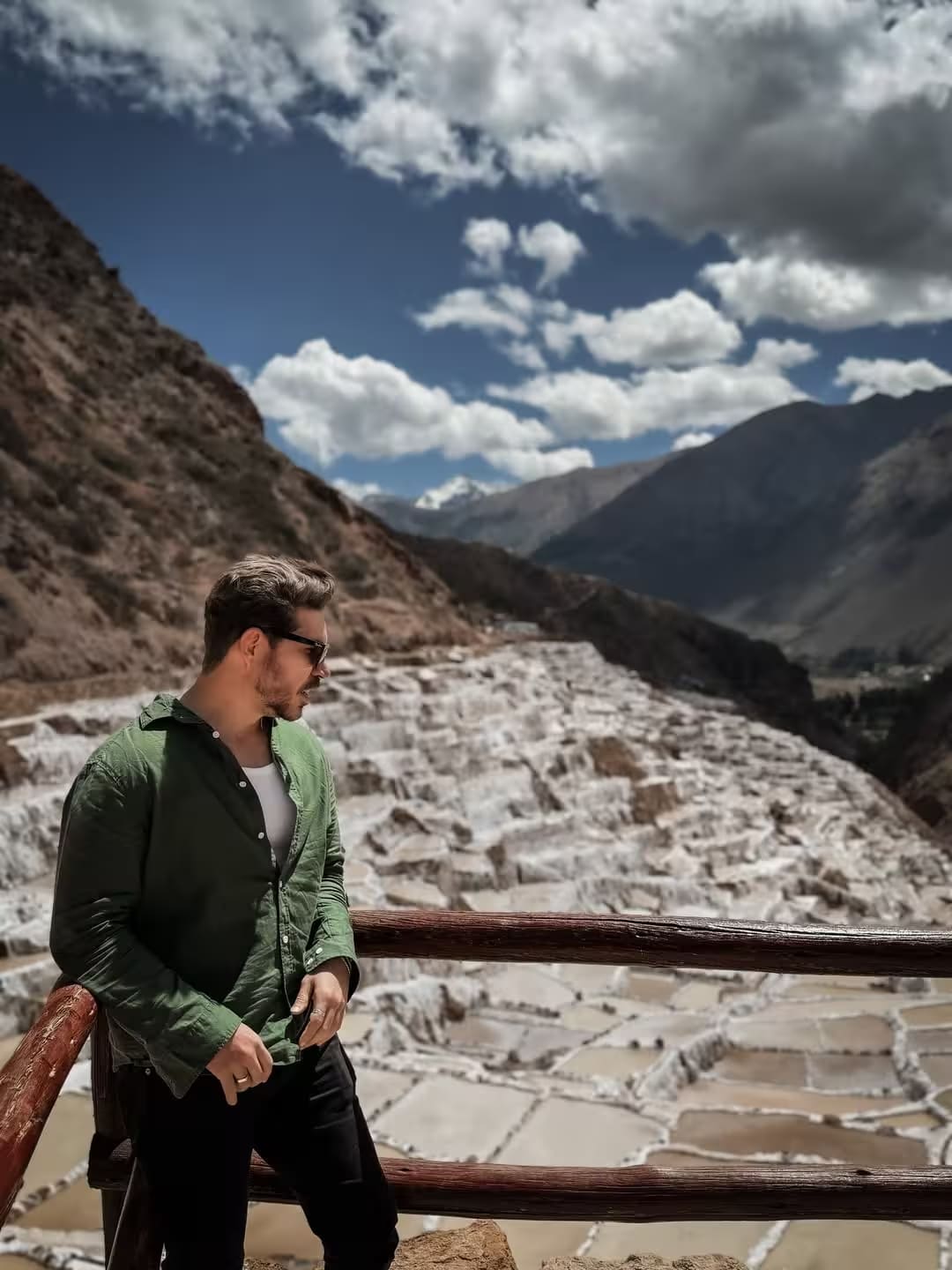
The salineras of Maras are approximately three thousand individual pans — shallow, flat-bottomed rectangles cut into the steep hillside, each fed by a channel from the central spring. The water enters each pan, evaporates in the high-altitude sun, and leaves its mineral content behind as salt. The salt is reddish-pink, the colour produced by the iron oxide and other minerals dissolved in the spring water. Each pan is worked by a specific family within the cooperative; the pan is inherited, the right to work it passed down through generations, the technique unchanged.
The salt tasted at the cooperative is not the product of industrial refining. It is mineral-dense in a way that commercially processed salt is not, and the flavour is specific to this spring in a way that has made Maras salt a known quantity in Peruvian gastronomy — present in significant kitchens in Lima and Cusco, sought by chefs who understand that salt can have terroir in the same way wine can. The ethnobotanist explains the mineral composition and the Wari origin of the technique; the cooperative family explains the inheritance. The argument the two sites make together — Moray as a system designed to solve an altitude problem, Maras as a system so well designed no altitude problem ever required solving it — is the argument of this plateau above the Sacred Valley, still making its case in working stone and salt.
What the Ethnobotanist Reads
The ethnobotanist we work with for this visit holds a graduate degree in Andean ecology and speaks Quechua as a working language. His approach to both Moray and Maras is the same: he reads them as systems in operation, not as monuments to a past technology.
At Moray, he works through the terrace levels from the rim to the floor, explaining what each level's thermal and moisture conditions would support and what the evidence suggests was grown there. He does not treat the "experimental station" theory as settled fact; he presents it as the best current explanation for a structure that has several features no other Inca agricultural installation shares. At the point where the evidence runs out, he says so. The conversation at the boundary of what is known is the most useful part of this visit.
At Maras, his frame shifts. The salt spring is not an Inca technology — it predates the Inca by centuries, possibly millennia. What the Inca did was recognise it, regulate access to it, and incorporate it into their redistribution economy. The ethnobotanist reads Maras as a case study in Andean resource management: how a pre-existing natural resource was administered across successive political systems, none of which fundamentally changed the technology because the technology was already optimal.
What Kada Arranges
The ethnobotanist Kada works with for this visit has spent years studying Andean crop ecology in the field zones above Cusco — not as a heritage guide interpreting monuments but as a researcher whose subject is the agricultural logic of the Andean plateau as a living system. He holds a graduate degree in Andean ecology with ongoing fieldwork in the Sacred Valley area; his Quechua is the working Quechua of someone who learned the botanical vocabulary from the communities who still use it. His relationship with Moray is that of a researcher who has been asking the same questions about the site for years — what problem the concentric geometry was designed to solve, what the pollen record confirms and does not confirm, where the evidence runs out and honest interpretation has to stop. What changes in that context is the quality of the pause at the point of uncertainty: the honest acknowledgment that the site has not yet yielded its full explanation, from someone who is actively engaged with why.
Both sites are accessible by road from Cusco in approximately ninety minutes. We depart early — arriving at Moray at 7:00 to 7:15 AM, when the site holds maintenance staff and no visitor groups. The principal tourist buses arrive from 9:00 AM onward. The ninety-minute window before the first groups arrive is the window in which the terraces can be read in conversation at a normal register, with the morning light on the concentric walls at an angle that makes the construction detail visible.
From Moray, the drive to Maras takes twenty minutes. The cooperative opens its visitor access from 8:00 AM; we arrive as the pans are catching the morning sun, before the midday heat that accelerates evaporation and brings the larger visitor groups. A guided walk through the working section of the pans, with the cooperative family explaining the pan inheritance and harvest cycle, concludes with a tasting of three salt grades from the same spring.
The visit covers roughly four hours total from departure to return to Cusco or the Sacred Valley. Maximum group size for the ethnobotanist session is six. Both sites involve walking on uneven terrain; the Moray rim-to-floor descent is approximately thirty metres on stone steps and compacted paths. The salt pans at Maras involve narrow paths between active pans — sturdy footwear required on both sites.
Expert Perspective
"What I find most interesting about this valley — the plateau above Urubamba — is that it contains two technologies that are still working. Moray is a research installation that no one fully understands. Maras is a salt operation that no one has felt the need to improve in a thousand years. Most of the Inca world that tourists come to see is a ruin — something we are looking at from the outside, trying to understand what it was. Moray and Maras are still doing what they were built for. The ethnobotanist we work with reads that continuity as evidence: the design was correct, and nothing that came after it — colonial, republican, modern — found a better solution. That is a different kind of encounter with the Andean past than standing at a monument."
— Jaime Ttito, Head of Guides & Cultural Interpreter, KADA Travel
A Practical Note
Both sites are at altitude — Moray is at 3,500 metres, the Maras plateau slightly above. A minimum of two full days in the Sacred Valley before this visit is required. The morning temperature on the Moray plateau, even in the dry season, is typically 6 to 10 degrees Celsius before 9:00 AM; the sheltered lower terraces are warmer but the approach and rim are fully exposed. Layers are standard equipment.
The Maras salt cooperative is a working agricultural operation. During harvest periods (primarily April through October), the pans are in active use — the workers who hold the pans may be present during the visit. The tasting and the family briefing are coordinated in advance; this is not an interruption to their work but a scheduled component of the cooperative's visitor programme, which they control.
The combination of Moray and Maras works as a half-day excursion from the Sacred Valley or as a morning component of a full day that includes Ollantaytambo or Pisac in the afternoon. We design the sequencing to avoid arriving at either site during the main visitor window.
Written by Kada Travel Editorial
Frequently Asked
It is the current dominant hypothesis among the scholars who have studied the site most closely, but it is not universally settled. The concentric terrace design, the measurable temperature differential, and the evidence of multi-altitude crop species in the soil are consistent with an experimental agricultural function. What remains uncertain is the specific protocol — what was tested, over what period, and with what administrative structure. The ethnobotanist presents the evidence and its limits, rather than a fixed interpretation. This is part of what makes the visit more useful than a standard guide narrative, which typically presents the theory as established fact.
Yes — the site has a maintained path from the rim to the lower terraces, accessible on foot. The descent is approximately thirty metres on stone steps and graded paths; it takes about fifteen minutes to reach the lowest level. The path is not steep but requires sturdy footwear, particularly when there is morning dew or frost on the stone. The lowest terrace, at the bottom of the thermal differential, has a notably different feel from the rim — warmer, more sheltered — that makes the engineering point physically rather than just intellectually.
Yes. The cooperative sells its product directly — both the coarser harvest salt and the finer processed grade — at the cooperative shop at the entrance to the salt pans. For guests who want to bring it back, it packages well. Note that any purchase goes directly to the cooperative, not to a tour operator intermediary; the revenue model is community-controlled.
The plateau above the Sacred Valley — where Moray, Maras, and Chinchero all sit — covers an area manageable in a single day with appropriate sequencing. Chinchero, which has both an important colonial church and a working weaving community, is thirty minutes from Moray by road. We design the combined day when guests want the full plateau — terraces, salt, and textiles — but the order matters: Moray at first light, Maras mid-morning, Chinchero in the late morning before the main tour groups arrive there. This is a full day's programme, not a half-day.
Design Your Journey
Design your bespoke Peru journey
We talk. We listen. Then we design an itinerary that belongs only to you.
Start Planning