Unfolded· 8 min read·16 July 2026
The Canyon That Makes Colca Look Crowded
A multi-day expedition into Cotahuasi — among the deepest canyons on Earth, a full day's drive past Colca's last tour bus, arranged for guests who have already done the accessible version and want the real one.
By Kada Travel Editorial
Colca Canyon has become, over the last two decades, a genuinely well-run piece of Arequipa's tourism economy — condors on schedule, lodges with hot water, a road good enough for a day trip. That accessibility is exactly why we recommend Cotahuasi to guests who have already done Colca, or who tell us plainly that they came to Peru for something roads have not yet made comfortable.
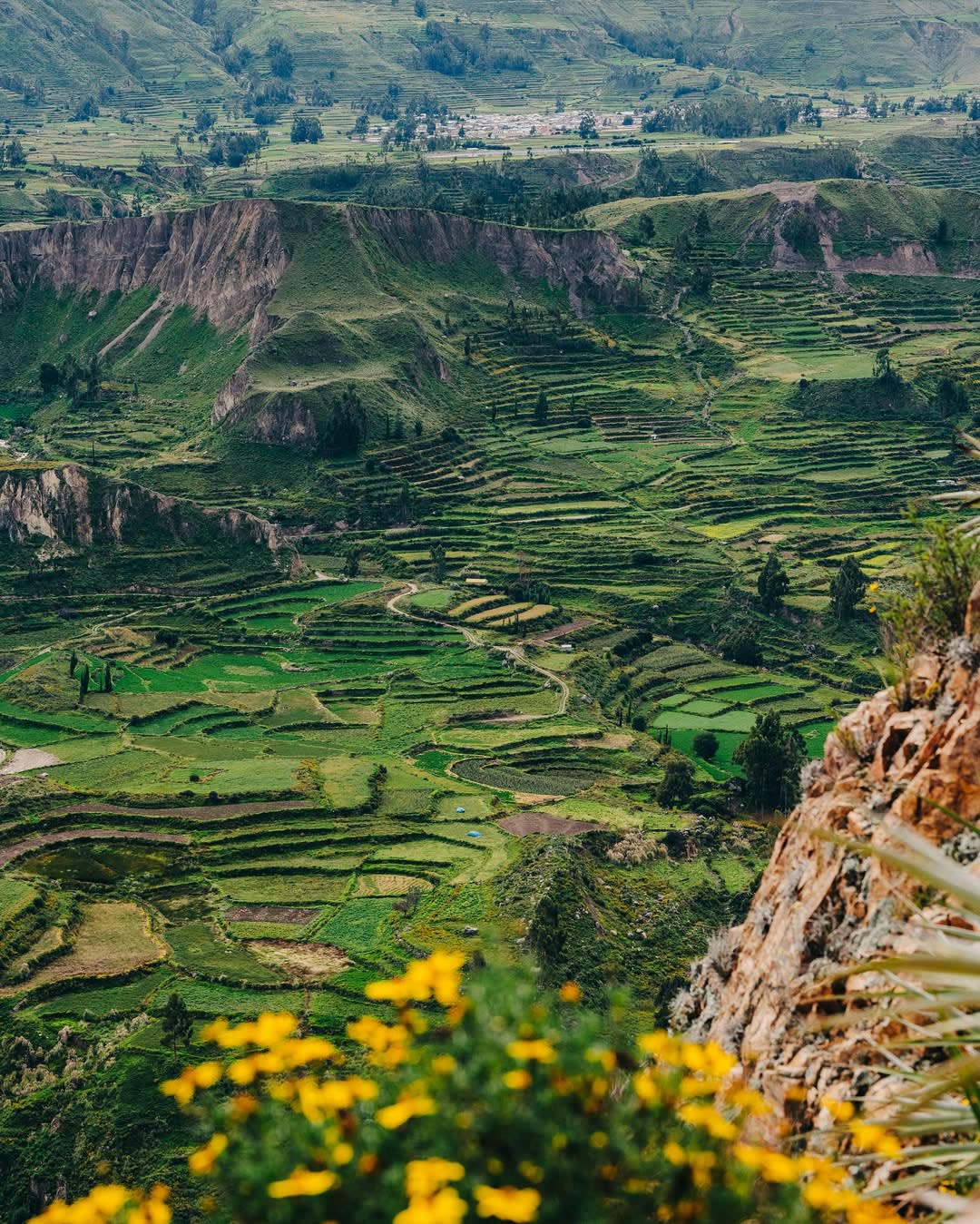
Cotahuasi sits roughly a full day's drive further from Arequipa than Colca, on a road that turns from asphalt to switchback dirt for its final stretches. The canyon it carved is contested for the title of deepest in the world — measurements at its deepest point put it at over three thousand metres from rim to river, deeper by most calculations than Colca itself, and deeper than the Grand Canyon by a wide margin. The number is less important than what it produces on the ground: a landscape that unfolds in vertical registers, from snow-dusted volcanic peaks at the rim to a warm, almost sub-tropical river valley at the bottom, with pre-Inca and Inca-era agricultural terracing stitched into the canyon walls at an angle that still looks improbable from a hundred metres away.
A Canyon With No Tour-Bus Infrastructure
What Cotahuasi does not have is the point. There is no scheduled condor viewpoint with a car park and a queue. Accommodation in the small towns along the route — Cotahuasi itself, Alca, Charcana — is basic, family-run, and not built around foreign visitors, because there are not enough of them to build an industry around. The villages that dot the canyon's upper terraces receive, by most estimates, a small fraction of Colca's annual visitor count — some see outside travellers only a handful of times a year.
That absence of infrastructure is precisely what we are arranging access to. It means a specialist local guide, not a driver reading from a script; it means flexibility built into the itinerary because roads here are subject to weather and condition in a way Colca's are not; and it means an expedition register rather than a day-trip register — multiple days, real distances, a landscape that does not resolve itself in a single viewpoint photograph.
The Bridge and the Waterfall
Two specific sites anchor most itineraries into Cotahuasi. The Puente de Sipia is a natural rock formation the river has carved into something close to a bridge, crossed on foot at a point where the canyon narrows dramatically — a place that communicates the canyon's scale more immediately than any overlook, because you are standing inside it rather than looking down into it. A short distance further, the Cataratas de Sipia drop in a broad curtain into a plunge pool, one of the few points along the route where the sound of the canyon changes registers, from wind and silence to the specific roar of falling water.
Beyond these two fixed points, the value of Cotahuasi is largely in the villages and terraces themselves — Quechua highland communities still farming the same stepped fields their ancestors cut into the canyon walls, hot springs at Luicho used by locals rather than curated for visitors, and a network of trails that a specialist guide reads the way a city guide reads streets.
What Kada Arranges
We build Cotahuasi as a genuine expedition, typically three to five days, with a private vehicle, a driver experienced on the route's harder stretches, and a guide with direct knowledge of the canyon's villages and trail conditions — not a general Arequipa guide extending their range. We stage the trip out of Arequipa with an acclimatisation day if a guest's itinerary allows it, since much of the route sits at altitude before it descends into the canyon itself.
Because Cotahuasi's accommodation is genuinely basic rather than boutique, we set expectations plainly before departure: this is the trip for guests who have told us that comfort is not the priority, distance from other travellers is. For guests who want Colca's landscape without Colca's crowds but are not ready for Cotahuasi's full remoteness, we would suggest instead a private, off-schedule Colca itinerary timed around the tour buses rather than this canyon.
Expert Insight
"Cotahuasi is the trip we recommend carefully, because it is not comfortable in the way most of what we arrange is comfortable — and it is exactly right for the guest who has said, in some form, that they have already seen the version of Peru that is easy to see. What they get instead is a canyon that has not been organised for them, villages that are not performing for a bus schedule, and a landscape that makes Colca — genuinely spectacular in its own right — look almost manicured by comparison."
— Daniel Ramos, Co-Founder & CEO, KADA Travel
A Practical Note
The road into Cotahuasi is long and, in places, unpaved and exposed — not recommended for guests prone to motion sickness on switchback roads, and best avoided entirely during the heaviest rains of the wet season (January–March), when sections can become impassable. Accommodation along the route is simple; we select the best available option in each town but ask guests to arrive with realistic expectations rather than a boutique-hotel standard. This is not an experience we recommend combining with a tight overall Peru itinerary — Cotahuasi wants the days it asks for, not a compressed version of them.
Written by Kada Travel Editorial
Frequently Asked
Cotahuasi is deeper, considerably harder to reach, and far less developed for visitors. Colca offers condors on a reliable schedule and comfortable lodges within a day's drive of Arequipa; Cotahuasi offers scale, remoteness, and a landscape still largely unorganised for tourism. We recommend Colca first for most guests, and Cotahuasi specifically for those who want to go further.
Yes, more than most experiences in our Arequipa catalogue. Expect long driving days on rough roads, moderate hiking at altitude, and basic accommodation. We assess fitness and expedition experience with guests before confirming an itinerary.
A minimum of three days from Arequipa and back is realistic; four to five allows a more unhurried pace and time to properly explore the villages and terraces along the route rather than treating it as a there-and-back drive.
The dry season, April through November, offers the most reliable road conditions. We generally avoid arranging Cotahuasi during the peak wet months of January and February.
Design Your Journey
Design your bespoke Peru journey
We talk. We listen. Then we design an itinerary that belongs only to you.
Start Planning