Unfolded· 8 min read·6 July 2026
The Town That Kept Its Shape
Ollantaytambo — the only settlement in the Americas still inhabited within its original Inca urban grid, where the street plan is fifteenth-century, the house walls are pre-Columbian, and a conversation with a family who has lived here for generations changes what a ruin means.
By Kada Travel Editorial
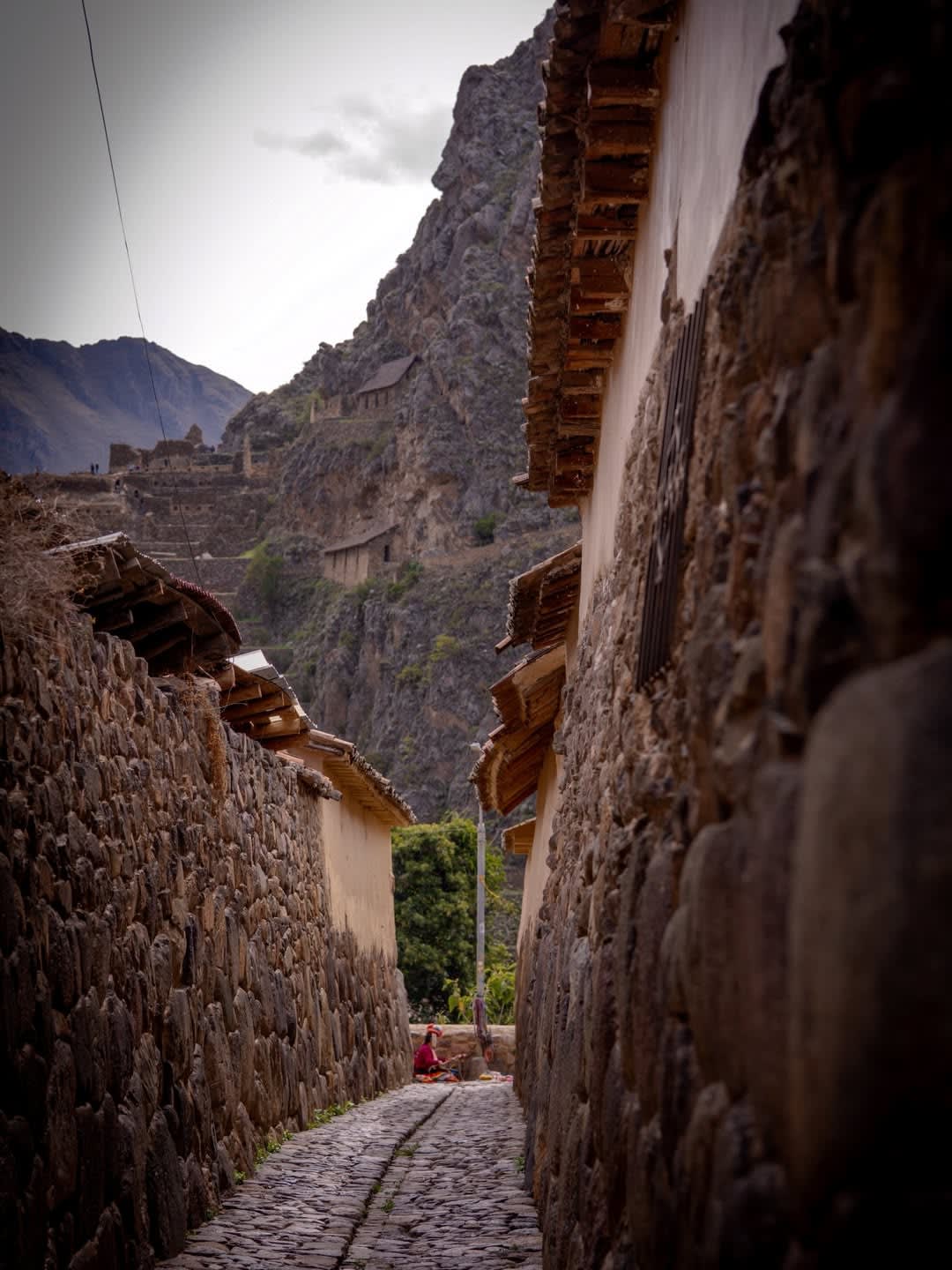
Every Inca site in the Sacred Valley is a ruin — a structure that was built, used, and then abandoned or dismantled, which visitors now walk through at a careful remove from the intended function. Ollantaytambo is the exception. The streets that Inca town planners laid in the fifteenth century are the streets that residents walk today. The canchas — the walled residential compounds that formed the basic unit of Inca urban organisation — still stand as they were built, and families still live within them. The doors open into working kitchens, not exhibit halls.
The town is small. A grid of four streets running north-south and four running east-west defines the inhabited Inca sector; the total area is walkable in twenty minutes. But what is compressed into that grid is the most complete surviving example of Inca urban planning in the world — not a reconstruction, not a re-creation, but the original plan, maintained by continuous habitation across five centuries.
The Town
The Inca organised their settlements in a system of canchas — rectangular walled compounds, each containing a group of buildings facing a central courtyard, each housing an extended family unit. In Ollantaytambo, the canchas are still intact: the outer walls, the internal courtyards, and the trapezoidal Inca doorways that lead into them. The masonry is Inca-period ashlar — not as refined as the royal stonework at the fortress above, but recognisably the same tradition, fitted without mortar, earthquake-tolerant by design.
What makes Ollantaytambo legible in a way that excavated sites cannot be is the continuity of use. Because families never left, the buildings were maintained rather than collapsed; because the layout was never reorganised by colonial administrators, the relationship between buildings, streets, and public spaces is intact. The water channels that the Inca cut along the street margins — carved stone channels that carried water from the mountains through the town — still carry water through Ollantaytambo today. They were maintained because the families who lived in the canchas needed them.
The town has two sectors, according to the Inca principle of moiety: the Hanan (upper) and Hurin (lower) divisions that organised Inca social space from Cusco outward. The division is spatial, not just social: the upper and lower sectors of Ollantaytambo have different orientations, different architectural characteristics, and different relationships to the main plaza. Jaime Ttito explains this organisation before we enter the town; understanding it changes the experience of walking the streets from a pleasant maze into a legible system.
The Fortress
The terraced complex above the town — the fortress that most visitors come to Ollantaytambo to photograph — is one of the most dramatic Inca military and ceremonial sites in the valley. Seventeen terraces rise from the town plaza to the Sun Temple at the summit: an ascending series of platforms that function simultaneously as defensive walls, as agricultural surfaces, and as the approach to a religious structure that was still under construction when the Spanish arrived in 1532.
The fortress is best known for what happened here in January 1537. Manco Inca — the last Inca emperor to hold effective military authority — had retreated to Ollantaytambo after the siege of Cusco. A Spanish force under Hernando Pizarro advanced up the valley. Manco Inca engaged them at the base of the terraces in a battle that combined the fortress's defensive position with a military tactic that no Spanish force in Peru had encountered: the Inca opened irrigation channels above the battlefield to flood the valley floor, making the Spanish cavalry charge impossible. Hernando Pizarro retreated. It was one of the only clear Inca military victories in open battle during the entire conquest period.
The Sun Temple at the top of the terraces was never completed. Six massive rose granite monoliths — each weighing more than fifty tonnes, transported from the quarry at Cachiqata across the Urubamba river and up the opposite bank — stand partially assembled at the summit, left in position when the conquest ended the construction programme. The joints between the completed sections of the Sun Temple are among the finest masonry in the Inca world; what was planned above them, and how the completed structure would have read from the valley below, is a question the stones leave open.
The Conversation
The resident we introduce our guests to in Ollantaytambo has lived in one of the original canchas for his entire life. His family's presence in the town predates the records of the colonial period — a thread of continuous habitation that connects the working kitchen to the same walls built five centuries before him.
The conversation is not a scheduled performance. Jaime Ttito has a long relationship with this family, and the meeting is what a long relationship makes possible: a genuine exchange in Quechua and Spanish, translated for guests who want to understand what it means to live inside a building that archaeologists study from the outside. The resident describes the cancha in practical terms — the problems of maintenance, the question of which repairs preserve and which alter, the fact that his children grew up in a courtyard that has not substantially changed since the Inca built it. He is not performing tradition. He is describing his house.
This conversation changes the character of the fortress visit that follows. The terraces, seen after an hour in the cancha, are a different scale of the same continuity: the same culture, the same building logic, the same relationship to the landscape — at a different order of ambition.
Lunch
Lunch in Ollantaytambo is in a family home in the town, not in a restaurant. The meal is prepared from local produce — ingredients sourced from the valley's own agricultural system — and served in a domestic setting that provides the context the fortress visit opened.
This is not a "cultural lunch" staged for visitors. It is the extension of the conversation that began in the cancha: the same hospitality register, at a longer table, with food that is specific to the valley and the season. We do not announce a menu in advance. We advise our guests that it is Andean home cooking — substantial, flavourful, rooted in the same altitude ecology the Moray terraces were engineered to study — and that the specific dishes will depend on what is available and what the family has prepared.
The visit to the fortress follows, or precedes, lunch depending on the timing of the morning train from Cusco and the afternoon connection to Aguas Calientes if Machu Picchu is the following day's destination.
What Kada Arranges
Ollantaytambo is at the upper end of the Sacred Valley, 72 kilometres from Cusco by road. The drive takes approximately ninety minutes; we depart early to arrive before the town fills with the tour groups that begin arriving by 9:00 AM. The principal square in the morning, before the groups arrive, belongs to the residents: the market stalls that line one edge of the plaza are set up by local vendors selling to each other before they sell to visitors.
The fortress ticket is included in the Boleto Turístico for the Cusco region. We manage the acquisition as part of the itinerary. Jaime Ttito guides the fortress visit directly — the military history, the architectural sequence from the base terraces to the unfinished Sun Temple, the specific features of the rose granite monoliths and what they indicate about the planned completion.
The cancha visit and the family lunch are coordinated by Jaime through his personal relationship with the family; they are not ticketed or publicly listed. Maximum group size for the full day programme is four to six guests.
Expert Perspective
"Most guests who come to Ollantaytambo focus on the fortress. The fortress is extraordinary. But what I always want guests to understand first is the town below it — because the town is where the living and the dead relationship between the Inca world and the present is most visible. When you walk into a cancha and the family offers you chicha and you are standing inside walls that were built in the fifteenth century, the relationship to the Inca is not in the past tense. It is the present condition of this building, this family, this morning. After that, when you climb the terraces and look down at the town, you are looking at continuity, not at ruin. That changes what the stones say."
— Jaime Ttito, Head of Guides & Cultural Interpreter, KADA Travel
A Practical Note
Ollantaytambo is at 2,792 metres — the lowest of the major Cusco-region sites, and the town from which the train to Aguas Calientes departs. For guests combining this visit with Machu Picchu, the day at Ollantaytambo fits naturally as the day before the Machu Picchu first-turn visit: the town in the morning, the fortress in the late morning, the train from Ollantaytambo station in the afternoon, overnight in Aguas Calientes.
The fortress involves a sustained ascent of the seventeen terraces — approximately 200 metres of vertical gain on stone steps, at moderate gradient. It is the most physically demanding climb among the Sacred Valley day sites, though well within the capacity of reasonably fit guests who have acclimatised for two or more days. The descent uses the same stone stairways; trekking poles are useful on both directions.
Ollantaytambo in the afternoon — after 11:00 AM — is significantly busier than Ollantaytambo in the morning. We structure the day to complete the town visit and the family conversation before the main visitor groups arrive, and use the fortress visit in the mid-morning when the light is still working in our favour.
Written by Kada Travel Editorial
Frequently Asked
They are different kinds of sites. Machu Picchu is a royal estate of exceptional architectural refinement, now visited by 4,500 people per day. Pisac is primarily an agricultural and ceremonial complex with the largest Inca cemetery in Peru. Ollantaytambo is a military fortress, an unfinished royal project, and — the element unique to it — a living town. Of the three, Ollantaytambo provides the most direct encounter with what Inca urbanism was: not a monument visited from outside, but a settlement inhabited from within.
Completely appropriate. Jaime Ttito provides a cultural briefing before the *cancha* visit, and the family is accustomed to receiving guests from outside the valley. No background knowledge is required or assumed. What is asked of guests is genuine curiosity and a willingness to be in someone's home rather than at a site — the same quality of presence that makes any personal encounter more valuable than a scheduled tour.
Yes, with some modifications. The town walk and the *cancha* visit are fully appropriate for children; the fortress ascent is manageable for children above ten who are in good physical condition. The family lunch is a natural setting for children. We discuss the specific group composition at the planning stage and design the day accordingly.
For guests staying in the Sacred Valley (Urubamba, Yucay, Chinchero) rather than Cusco, the drive to Ollantaytambo takes thirty to forty-five minutes, making an early arrival straightforward without the Cusco departure. For guests arriving from Cusco by road, we calculate departure time to arrive before 8:30 AM. The train from Ollantaytambo to Aguas Calientes has multiple departure times across the day; we book the service that best fits the morning programme rather than constraining the morning to meet a fixed departure.
Design Your Journey
Design your bespoke Peru journey
We talk. We listen. Then we design an itinerary that belongs only to you.
Start Planning