Destinations· 8 min read·9 February 2025
Maras, Moray and the Salt Pans: Private Visits with Guide
The Inca agricultural laboratory, the pre-Hispanic salt pans and MIL Centro — a day in the Sacred Valley.
By Kada Travel Editorial
There is a Sacred Valley day that stands on its own. It begins at Moray, an amphitheatre of concentric terraces the Incas built as agricultural laboratory. It continues to the Maras salineras, three thousand evaporation pools on a hillside, in continuous use since before Christ. It ends with a six-hour lunch at MIL Centro, Virgilio Martínez's restaurant on the archaeological site itself. A complete day, demanding, and the best lesson the Sacred Valley can give in a single outing.
Moray: the Inca amphitheatre
Moray is one of the few Incan sites whose function is documented with relative certainty. Archaeologists agree it was an agricultural laboratory: a system of twelve circular amphitheatre-shaped terraces, descending one hundred metres into a natural depression, where each level held a different microclimate. Temperature variation between upper level (3,500 metres) and lower (3,350) ranges three to five degrees —equivalent to the difference between Andean Peru's ecological tiers.
This difference allowed the Incas to experiment with crops under simulated conditions: coast-growing maize was planted in the lower level; high-altitude quinoa, in the upper; native potatoes were crossed at intermediate levels. The adaptations Moray produced were then transferred to the valley's agricultural terraces, multiplying productivity. The Incas, without knowing it in modern scientific terms, performed mass-scale genetic selection.
The site is visited in ninety minutes with agronomist guide. We recommend arriving at nine AM —oblique sunrise light makes the terraces visible in their full geometry. Walk the upper-edge path, then descend to the amphitheatre centre via the Inca step system (the famous sara-runa or "stone-man steps" projecting laterally without handrails).
To understand Moray, it helps to read two things on site. First: each terrace has its own underground drainage system, connected to the central spring, allowing independent irrigation by level. Second: terrace walls are not straight but slightly convex inward, increasing reflected solar radiation and improving microclimate. Details matter; without a guide the site looks like pretty holes. With a guide, it looks like engineering.
The salineras: three thousand years of salt
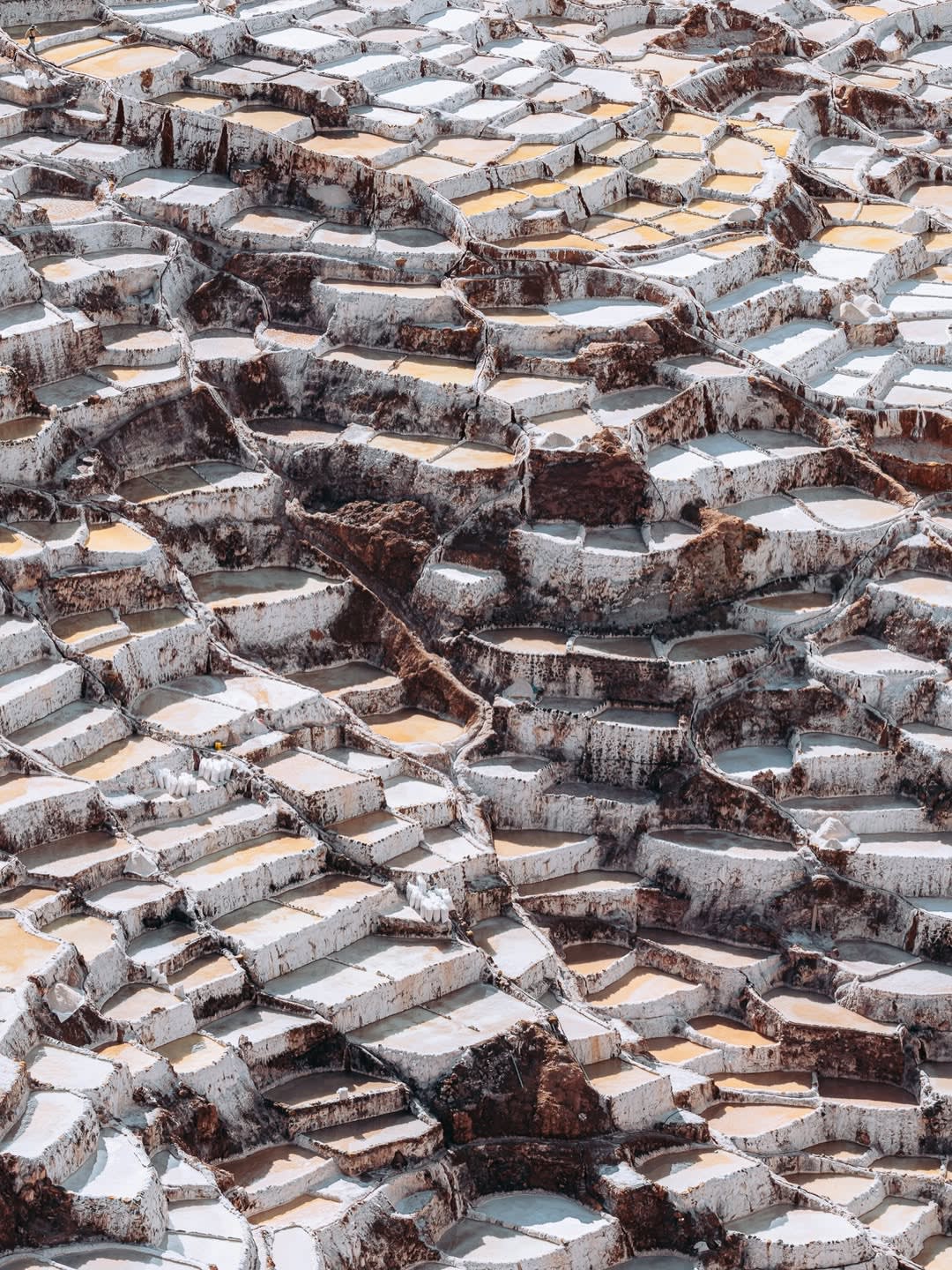
Moray to Maras is twenty minutes by car, descending an unpaved road to the Qaqawiñay slope. There the Maras salineras: three thousand stepped salt-evaporation pools on the hillside, fed by an underground spring rising heavily charged with sodium chloride. The system has worked since before the Incas —the Collagua culture was already harvesting salt here in the sixth century.
The site's social organisation is notable. Each pool belongs to a family of the Maras community, patrilineal inheritance. Five hundred owner families in total. Each pool produces twenty to thirty kilos of salt per harvest, four to five harvests yearly depending on season. Salt is sold at three levels: refined white (domestic, export), pink (mineral origin, high-end gastronomic), and fleur de sel (the first crystallising layer, USD 50 per kilo in Lima).
The guided visit with a community member allows descending among the pools (with permit, walking on raised borders), seeing the harvest process (manual, with wooden spades), and buying salt directly from the producer. The price difference versus Cusco's tourist shops is five to tenfold. It is the only Sacred Valley purchase where we recommend paying more, not less: the money goes directly to the peasant family.

MIL Centro: the six-hour lunch
The day culminates with lunch at MIL Centro, the restaurant by Virgilio Martínez (chef of Central, in Lima). The site sits on Moray's edge, in an adobe-and-stone building designed with archaeological criterion —you do not see volumes, you only feel the restaurant after entering. The concept is the "territory menu": eight to ten courses based on valley altitudinal tiers, ingredients gathered by the chef's team in neighbouring communities, and a medicinal-garden tour before the meal.
The garden tour, led by the chef de cuisine or a senior cook, lasts forty minutes. You see plants that will appear in the menu —kiwicha, ulluco, mashua, cushuro (edible Andean algae)—, the ancestral origin of each is explained, and you taste something raw: Maras salt with tree-tomato, Andean oregano leaves. The necessary preamble to understand the menu afterwards.
The menu itself takes four hours, unhurried. Each course is presented by the cook responsible. The cuisine is in the NOMA-Central line: local produce, contemporary technique, restrained presentation. Some courses are extraordinary (the ember-cooked ulluco with paria cheese, the goat seco with cushuro, the oca dessert with Cusco chamomile); others are more experimental than tasty. The experience, in any case, is not evaluated as restaurant: it is evaluated as installation.
Reservation requires three months' notice in high season (June-September). Lunch only, no dinner. Cost: USD 350 per person without pairing; USD 480 with pisco and Peruvian-wine pairing. Combine lunch with the Moray visit: the restaurant facilitates site access before public opening.
The Maras-Moray-MIL day is the most complete gastronomic-archaeological experience in the Sacred Valley. Not just food, not just archaeology: a reading of Peruvian territory in a single outing.
Kada Travel
How to build the day
Hotel departure at eight thirty AM. Arrival at Moray by nine. Ninety-minute guided visit. At ten thirty, transfer to Maras (twenty minutes). Forty-five-minute salinera visit. At eleven forty-five, return to Moray for MIL lunch (garden tour entry at twelve). Four-hour lunch, restaurant exit at four thirty. Hotel return by five.
The day is physically demanding —Moray walk, salinera descent, three to four hours seated in altitude restaurant— but rewarding. We recommend not programming another activity that day: the traveller arrives at the hotel with a full head.
Alternatives if MIL doesn't fit
If MIL is inaccessible (no reservation, day trip from Cusco without booking time, budget), we recommend lunch at La Casa de la Hacienda in Maras: a restored colonial hacienda with traditional Cusco cooking and valley view. One-tenth the cost of MIL and a completely different experience —home-style cooking, hacienda dining room, far less protocol.
For travellers who already did MIL on a previous visit and return to the valley, we recommend the inverse combination: lunch at El Albergue in Ollantaytambo (cuisine with produce from the Randall family garden) and Moray-Maras excursion in the afternoon. A different day, and a good complement if the trip allows revisiting the area.
Written by Kada Travel Editorial
Frequently Asked
The site sits at 3,350-3,500 metres, comparable to Cusco. For travellers coming from coast, we recommend two nights in valley or Cusco before the excursion.
Moray yes, up to the upper viewpoint; the descent to the bottom is not. Salineras require walking on narrow edges, not advisable. MIL is fully accessible. For limited mobility, skip the Moray descent and the salineras; keep MIL.
Eight to nine hours, departure and return from valley hotel. From Cusco it is eleven hours (includes two hours of road). We recommend doing it from valley hotel, not from Cusco.
Worth it for the integrated experience —garden tour, prior Moray visit, architectural atmosphere. For travellers indifferent to fine dining, the menu may feel long. The La Casa de la Hacienda alternative is more suitable.
Moray and salineras: yes, children over five. MIL: does not admit under-twelves. For families with younger children, we recommend lunch at La Casa de la Hacienda and keep Moray-Maras.
Salt is legal in checked luggage and for entry to most countries. Buy in sealed packaging. For international shipping, use specialised courier services —we do not recommend standard postal mail.
Design Your Journey
Design your bespoke Peru journey
We talk. We listen. Then we design an itinerary that belongs only to you.
Start Planning