Unfolded· 8 min read·15 July 2026
The Altitude Menu
Mil — Virgilio Martínez and Pía León's restaurant at 3,680 metres above the Moray terraces, where each course represents a specific Andean ecological floor and the Mater Iniciativa research centre next door makes the meal a working argument about what Andean cuisine knows.
By Kada Travel Editorial
Central is in Barranco. For guests who have eaten at the Mater Table in Lima before arriving in Cusco — which is the itinerary we design when scheduling allows — the encounter with Virgilio Martínez and Pía León's argument about Peruvian biodiversity has already happened at sea level, with the coastal and Amazonian ecosystems present alongside the Andean ones, and the full vertical range of the country's ecology on the menu.
Mil is the next chapter of the same argument, written at 3,680 metres.
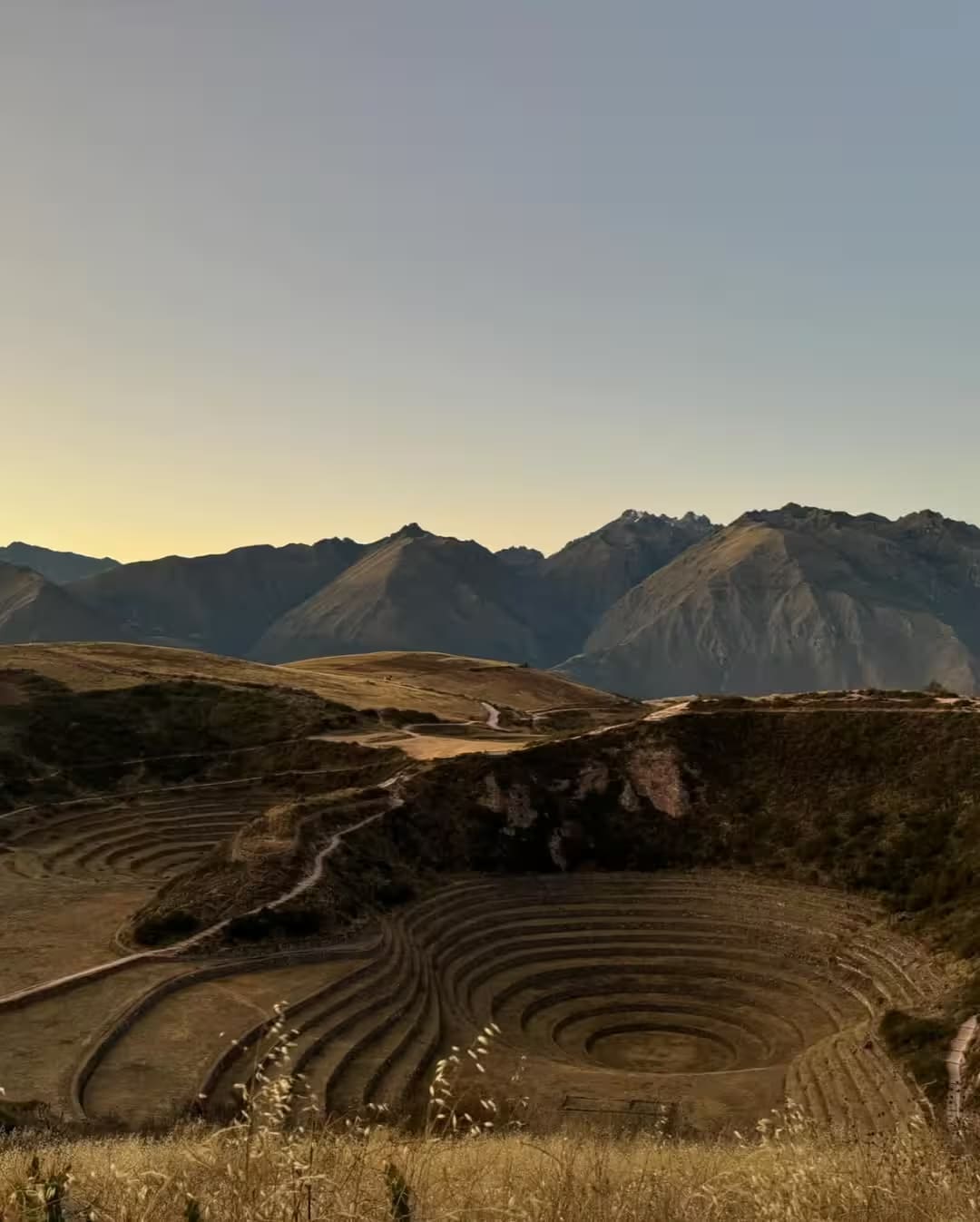
The two restaurants share the same intellectual project — the Mater Iniciativa, the research centre that investigates Peruvian biodiversity and translates what it finds into culinary material — but the ecological base is entirely different. Central works with Peru's full altitude range from coast to summit; Mil works with one zone, exhaustively. The restaurant sits above the Moray terraces on the plateau where the Inca conducted their own systematic research into altitude agriculture, and the ingredients in its menu come from the specific ecological floors visible within an hour's walk of the building. The Inca asked which crops would grow at which altitudes. Mil asks the same question, and answers it at table.
The Project
Mater Iniciativa is not a kitchen garden or a culinary brand. It is a research operation: a team of chefs, botanists, anthropologists, and foragers who document the biodiversity of Peru's ecosystems and develop the connections between that documentation and what can be put on a plate. The Mater building adjacent to Mil — on the plateau above Moray — functions as a laboratory, library, and archive: the place where what the field team finds is processed, classified, and made available for the kitchen programme.
The connection between Mater Iniciativa and Mil's menu is direct and verifiable. A guest eating at Mil in a specific season is eating the ingredients the Mater team has been working with in the weeks before that service: the specific potato and tuber varieties from the communities in this altitude range, the mountain herbs whose pre-colonial culinary use has been documented by the project's anthropologists, the grains and legumes native to the puna and k'eswa zones above 3,500 metres. This is not a chef drawing on a general Andean ingredient palette; it is the menu the research produces.
Virgilio Martínez and Pía León built the Mil concept on a specific premise: that the most intellectually serious approach to the Andean altitude ecosystem was to cook from within it, at the altitude where the ingredients exist, rather than to cook about it from elsewhere. The restaurant does not claim to represent the full range of Peruvian biodiversity. It claims to represent one zone, at this elevation, in this season, with the specificity that proximity makes possible.
The Menu
The Mil tasting menu runs eight to twelve courses depending on the current season and research cycle. The structure maps altitude floors: courses named for specific ecological zones — Muna (3,200m), Muña Muña (3,780m), Qocha (4,200m) and others that shift as the Mater team's work moves through the seasons — each drawing its primary ingredients from the zone it names.
The range of ingredients encountered in a full Mil menu is not replicable in a restaurant without the research infrastructure behind it. Some preparations involve ingredients with no common-name equivalent: native tuber varieties documented by the Mater team in specific highland communities, mountain plants whose culinary use was last recorded in pre-colonial contexts, varieties of quinoa and kiwicha maintained only in the seed stocks of families working above 3,500 metres. This is the full implication of the Mater programme applied to a tasting menu: the kitchen serves what the research finds, not what the market offers.
The physical experience of the meal is inseparable from the altitude. Mil is at 3,680 metres — above Cusco city and considerably above the Sacred Valley floor — and appetite at this elevation is different from what guests experience lower down. The courses are calibrated for this: smaller, more intensely concentrated, designed to function in the body's high-altitude physiology rather than to defeat it with volume. The experience of eating at Mil is the experience of being fed by the land at the altitude where you are sitting. The coherence between what is on the plate and what is outside the window is not aesthetic. It is literal.
The Mater Visit
The Mater Iniciativa building is adjacent to the restaurant and accessible for a guided tour before lunch. The tour runs forty-five minutes to an hour, conducted by a member of the research team, and covers the active projects: which altitude zones are currently being documented, which ingredient families are under investigation, how field documentation translates into a kitchen application. The tour is not always offered to standard reservations; it is included in the visits we arrange, and we specify in advance that it is part of the programme.
The content of the Mater tour changes with the season. In the dry months — May through October — the field team is most active in the high-altitude zones above the plateau, and the current work is at its most physically visible: samples arriving from the field, identification in process, the documentation of varieties in active use by highland communities. In the wet season — November through April — the processing and classification work happens at the centre, providing a different set of visible operations: the archive, the fermentation experiments, the development of new culinary applications from documented materials.
For guests who have already eaten at Central in Lima, the Mater tour provides the institutional backstory to both restaurants. At Central, the menu's relationship to the research programme is implied but not explained. At the Mater building, it is made explicit: here is the methodology, here is the archive, here is the specific preparation that appears on today's Mil menu and the documentation that produced it. The argument that the tasting menu makes becomes, after the Mater tour, legible as an argument rather than as a culinary statement.
What Kada Arranges
Mil operates a tasting menu at lunch only — a single midday seating — which aligns with the altitude consideration. A full tasting menu in the evening at 3,680 metres produces a different result than one at noon; the body manages the sustained effort of digestion at high altitude more effectively in the afternoon recovery than in the evening compression toward sleep. We secure the reservation as part of the itinerary, typically four to eight weeks in advance for dry-season dates.
The sequence we recommend for guests who have eaten at Central: Mil as the penultimate or final lunch of the Cusco segment, after a minimum of three days in the Sacred Valley at lower altitude. The meal is most productive when the body has had time to adjust to the elevation and when the Sacred Valley landscape has become familiar enough that the menu's relationship to the terrain is readable. A guest who has seen the Moray terraces that morning with the ethnobotanist, who has understood what the Inca were testing at that site, who has spent a week in the valley — that guest reads the Mil menu differently from a guest who arrives directly.
We do not schedule Mil before the third day in the Cusco region. The altitude constraint is medical, not aesthetic; a guest who arrives at the Moray plateau before their body has adjusted will not have a productive meal, and a poor experience at this level of quality and price is something we treat as a planning failure on our side.
The drive from Cusco to Mil is approximately seventy-five minutes; from the main Sacred Valley hotels, forty to sixty minutes. The approach road — the same route that passes Chinchero and continues to the Maras plateau — is itself a transition from valley floor to plateau, and the morning Moray visit that precedes lunch is included in the itinerary design as preparation for the meal, not as an add-on.
Expert Perspective
"If a guest has eaten at Central in Lima — which is how we prefer to sequence the itinerary — Mil is the explanation of what they ate. At Central, the menu represents Peru's full vertical range: the coast, the Amazon, the Andes together, the biodiversity argument made at maximum scale. At Mil, the argument narrows to one zone and deepens. The ingredient in the bowl was growing a few hours from where you are sitting. The team that found it, documented it, and decided what to do with it works in the building next door. The Inca ran an experiment on the terraces below the restaurant — which crops would grow at which altitude, under which conditions — and concluded this plateau was the right place to study that question. Mil is still running the experiment. The tasting menu is the current data."
— Daniel Ramos, Co-Founder & CEO, KADA Travel
A Practical Note
The altitude constraint for Mil is real and specific. Three full days at Sacred Valley altitude — approximately 2,800 metres — before the Mil lunch is the minimum; four days is better. A guest who arrives at the Moray plateau on their second day in Peru, having flown in from Lima the previous day, is in the physiological suppression phase: reduced appetite, slower digestion, blunted sensory response. The careful menu calibration that the Mil kitchen applies is designed for a body that has adjusted, not one that is still adjusting.
We schedule Mil as a dedicated event. The morning is the Moray visit and the Mater tour; the afternoon, after the meal, is unstructured. No other demanding activity is scheduled on the same day. The meal is the day.
Mil is at altitude with no shelter from the wind on the plateau approach. The restaurant interior is warm; the walk from the vehicle and the pre-lunch Mater tour involve open exposure at 3,680 metres. A mid-weight layer for the exterior portions is sufficient in the dry season; more substantial insulation is required in the shoulder and wet months.
Written by Kada Travel Editorial
Frequently Asked
For dry-season dates — June through October — four to eight weeks depending on the specific date and group size. July and August at the height of the Cusco season require the longer end of that range; groups larger than four should plan for a minimum of six weeks. For shoulder and wet season dates, four weeks is usually sufficient. We hold the reservation as part of the itinerary confirmation; guests do not contact Mil directly.
No. Mil is fully self-contained; the Mater tour provides enough context to make the menu's structure comprehensible for guests encountering the Mater Iniciativa project for the first time. What the Central experience adds is the comparative frame: the full-range argument at sea level makes the altitude specificity of Mil more legible. For guests whose itinerary includes both Lima and Cusco segments, we design toward the Central-then-Mil sequence when timing allows.
Different from lower altitude in ways that are worth understanding before arriving. After three or more days of acclimatisation, appetite returns to near-normal for most guests, though digestion remains slightly slower than at sea level. The Mil menu is calibrated for this: smaller courses, more concentrated, with a progression that works with high-altitude physiology rather than against it. Guests who have acclimatised properly consistently report the meal as fully functional. Guests who arrive too soon from lower altitude should not attempt it; we prevent this through sequencing rather than relying on guests to self-assess.
Yes. The team works in Spanish and English; the tour is conducted in the guest's language. The technical content — the research methodology, biodiversity documentation, culinary development process — is available at whatever depth the guest wants. We specify the language and approximate depth of interest in advance so the appropriate team member is assigned.
Design Your Journey
Design your bespoke Peru journey
We talk. We listen. Then we design an itinerary that belongs only to you.
Start Planning