Unfolded· 8 min read·1 July 2026
The World at Five Thousand Metres
A visit to the Q'ero communities in the highlands above Cusco — honestly described, logistically demanding, and unlike any encounter Peru makes available at lower altitude.
By Kada Travel Editorial
There is no easy version of this visit. The Q'ero communities in the highlands above the Cusco valley sit between 4,400 and 5,000 metres above sea level — a zone where the body's efficiency degrades, where the cold is a serious variable year-round, and where the road ends several hours before the community begins. We are direct about what this requires, because the visit is only worth making if the person making it is genuinely prepared for where they are going and what they will find when they arrive.
The Q'ero communities are not a museum of pre-Hispanic culture, a reconstructed village, or a performance of tradition for external visitors. They are a place where approximately six hundred to seven hundred families live in a specific way, and where the cosmovision, the textile tradition, and the ceremonial practice that most of Peru lost during the colonial period survived — because no colonial institution ever reached this altitude with enough force to displace them.
The Q'ero
Anthropologists began documenting the Q'ero communities in systematic detail in the 1950s and 1960s, and the findings produced a significant reorientation in the study of Andean culture: here were communities living in the high puna above the Cusco valley, speaking Quechua in a form closer to the Inca-era register than any lowland community, practicing a cosmovision that the colonial period had not interrupted. The Q'ero were identified, cautiously and with all the necessary caveats, as the most intact living carriers of pre-Hispanic Andean tradition.
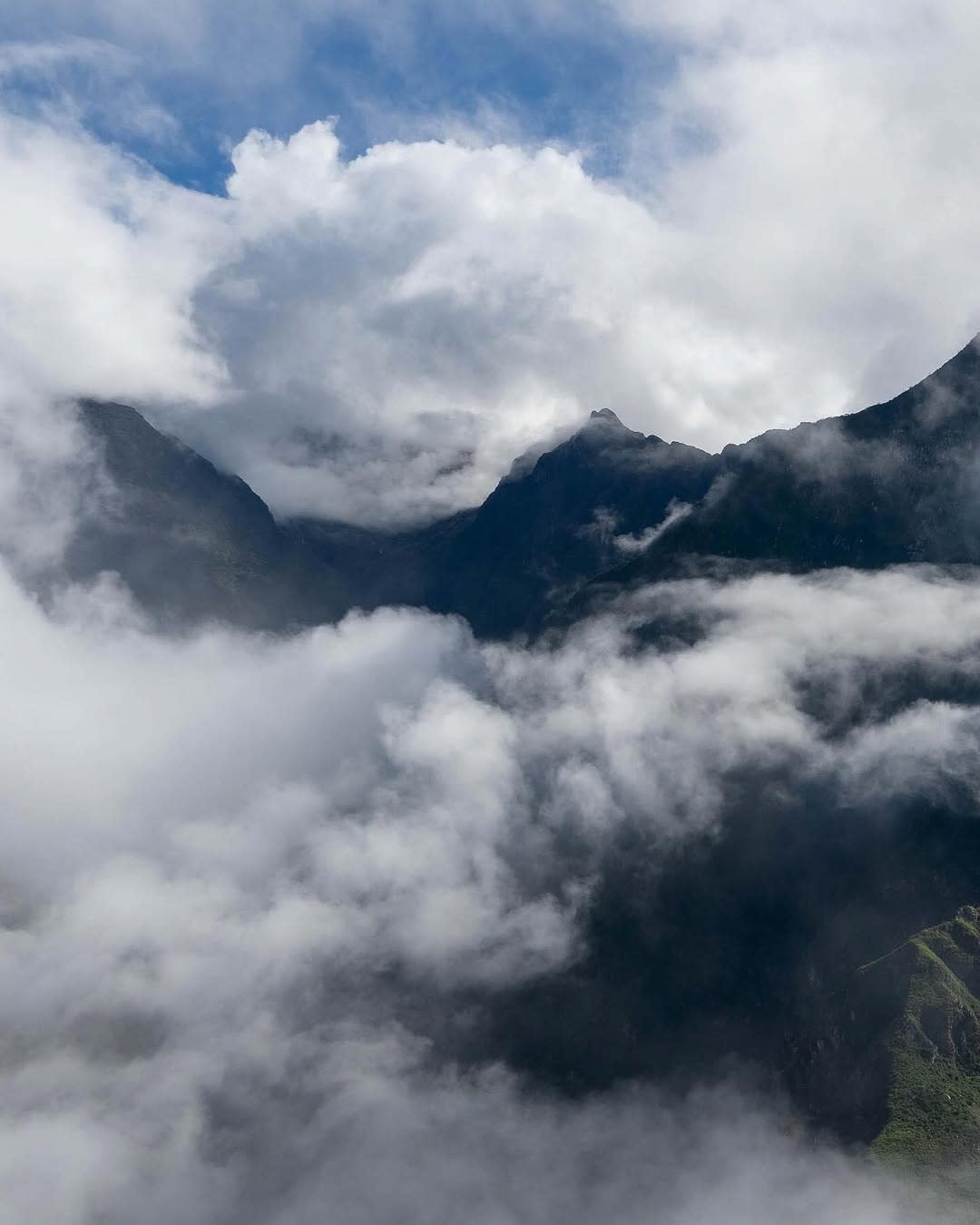
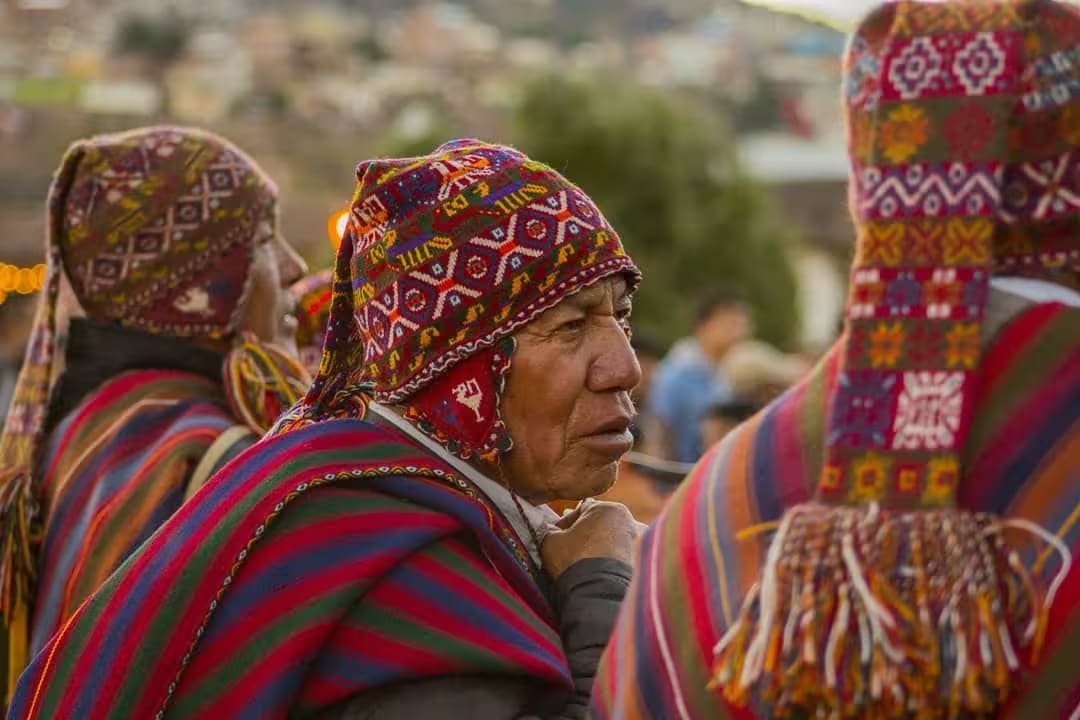
What that means, in practical terms, is not a frozen past. The Q'ero live in the twenty-first century — children attend school, some members have moved to Cusco, mobile phones reach the lower settlements. What has survived is not isolation from modernity but a specific relationship with the landscape that modernity has not replaced: the Apus are not symbols they invoke in ceremony; the mountain is a person whose moods they read by the behaviour of the clouds above it. The earth is not a resource; it is a relationship. The textile work of the Q'ero women uses techniques and patterns that have not changed in the recognisable sense of having been designed and redesigned — they have been transmitted, generation to generation, because the transmission is the point.
Jaime Ttito's connection to the Q'ero communities is biographical, not professional. He grew up speaking Quechua in Cusco; his first visits to the high communities happened before he became a guide. The relationships he has with Q'ero community leaders are long-term relationships, not tourism arrangements. This is not a small distinction.
What the Visit Actually Is
The visit is authorized by the community's own leadership. This is not a formality. The Q'ero have encountered many categories of external attention — researchers, NGOs, New Age tourism, documentary filmmakers — and they distinguish between them. The visits Kada arranges are cleared with specific individuals whose trust Jaime has built over years; on the very few occasions when a Q'ero leader has said the timing is not right for a visit, we have accepted that decision without appeal.
What guests encounter during the visit is daily life at this altitude. The textile production that occupies a large portion of women's time in the community — the spinning of alpaca fleece on a hand spindle, the weaving at a back-strap loom with patterns encoded in the ayllu's specific colour vocabulary. The herding of the alpaca and llama that provide both fibre and food. The architecture of the settlement: stone structures built for warmth and wind resistance, with thatch, at an altitude where trees do not grow. Children at play in conditions that would be considered extreme weather at sea level.
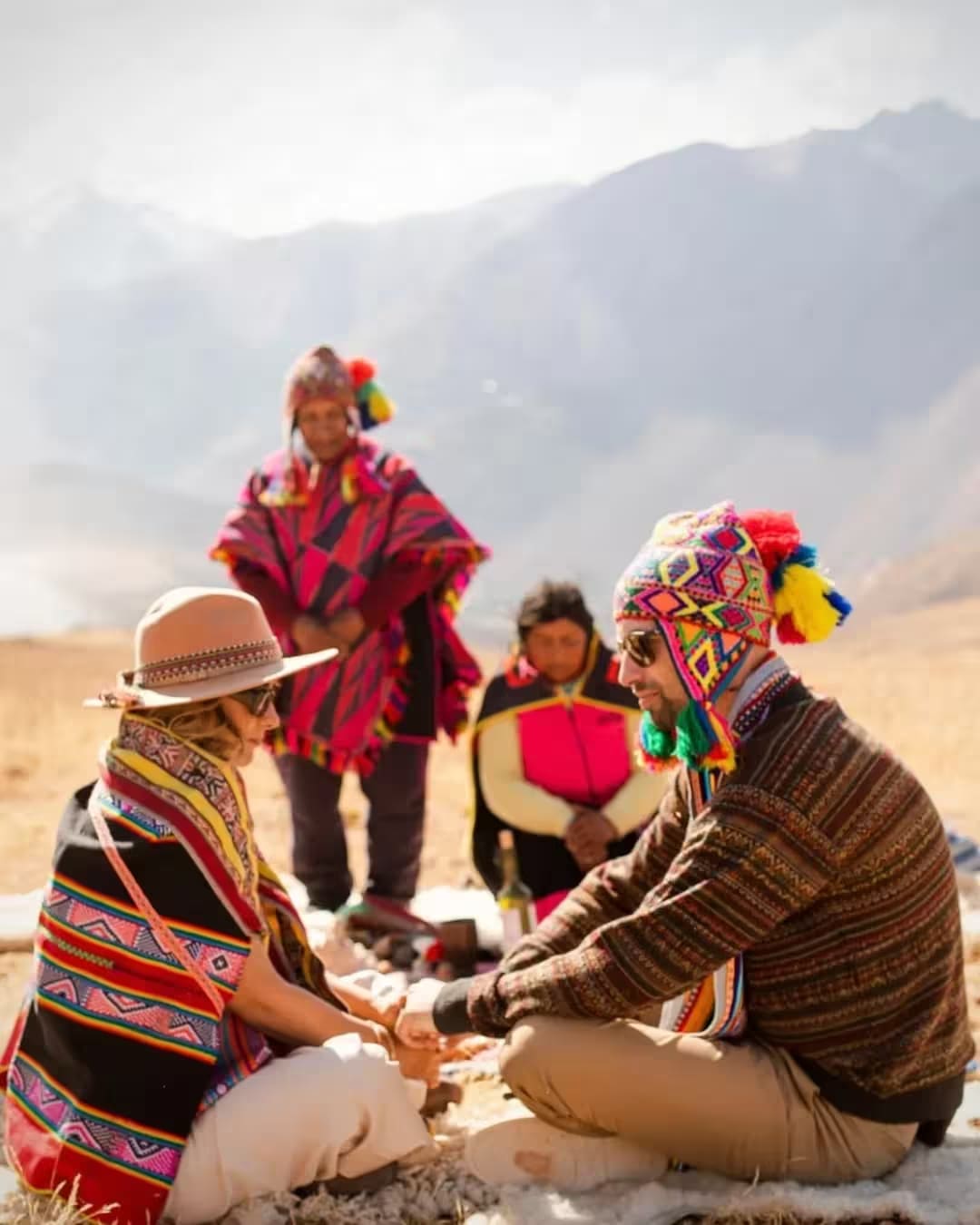
If the visit is arranged to include a ceremonial session — a despacho, a brief mesada — this is coordinated separately as an addition, not as the main purpose of the visit. The community is not a backdrop for spiritual tourism. The community is the visit.
The Logistics, Honestly Stated
Getting to the Q'ero communities from Cusco requires approximately four hours by 4WD vehicle on roads that become tracks, followed by a trek of two to four hours on foot at altitude — the specific duration depending on which community is visited and the current condition of the access paths. The total travel time from Cusco to the community is six to eight hours one way.
The trek is at 4,400m and above from the moment the vehicle road ends. At this altitude, the distance covered on foot in a given hour is approximately half what it would be at sea level; the body is working significantly harder per step. Guests with any history of cardiac or pulmonary conditions, or with no prior experience at altitude above 4,000m, should consult a physician experienced in altitude medicine before this visit. This is not a disclaimer; it is practical information.
The acclimatisation requirement is the most important logistical constraint: a minimum of five days in the Cusco region (at least three nights in the Sacred Valley at 2,800m, then two nights in Cusco at 3,400m) before attempting the Q'ero visit. Guests who have acclimatised properly find the trek demanding but manageable; guests who have not find it beyond them before they reach the community.
Cost: the Q'ero visit is one of the more expensive single-day experiences in the Kada catalogue. The cost includes the community fee paid directly to the community leadership (not to a tour operator intermediary), guide fees for Jaime Ttito personally (he guides this visit himself; it is not delegated), vehicle hire, and operational logistics. We communicate the full cost at the time of planning, because it is a significant investment and should be understood as such.
What Kada Arranges
Jaime Ttito leads every Q'ero visit personally. The community relationships are his; a substitute guide is not an option for this experience. Maximum group size is six guests, typically four.
We carry altitude first-aid equipment including supplemental oxygen, though most guests who have acclimatised properly do not need it above 4,400m. We provide altitude-appropriate cold-weather gear briefing and a packing list specific to the conditions — the high puna in the early morning and evening is genuinely cold year-round, and guests who are underdressed are uncomfortable in a way that reduces their presence.
A minimum of six weeks advance notice is required to coordinate the visit with the community leadership. Some dates are not available because of the community's own ceremonial calendar; we work around these without attempting to override them.
For guests with limited mobility or specific health constraints who want to encounter the Q'ero without the physical demands of the high visit, Jaime can arrange a meeting with Q'ero representatives who make periodic visits to Cusco — a meaningful encounter, though a different one from the visit at altitude.
Expert Perspective
"I grew up speaking Quechua, and the first time I went to the Q'ero communities I thought I understood what I would find — the tradition I knew from the valley, preserved at altitude. What I found was something more complete than what I knew. The Q'ero don't practice the cosmovisión. They live inside it. The mountain is not a symbol they invoke in ceremony; it is the neighbour whose moods they know. That difference — between knowing about something and living inside it — is what the visit communicates, and it cannot be communicated in any other way. I take very few guests there. The ones who go always say, afterward, that it changed what they thought 'intact tradition' meant."
— Jaime Ttito, Head of Guides & Cultural Interpreter, KADA Travel
A Practical Note
This is the most physically demanding experience in the Kada Cusco catalogue. The altitude, cold, and six-to-eight-hour trek round trip at 4,400m require an honest assessment of current fitness and health before booking. We ask that guests are direct with us about any health conditions, recent illnesses, or altitude history; we would rather redesign the itinerary than send a guest into conditions they are not prepared for.
The visit changes nothing in the community's daily life. This is the correct posture for the entire day: present, attentive, and continuously aware that what is being witnessed is not arranged for the benefit of the witness. The most valuable quality a guest can bring to the Q'ero is the willingness to receive what is there, rather than to project what they came to find.
Written by Kada Travel Editorial
Frequently Asked
We are in direct relationship with Q'ero community leaders who have the authority to accept or decline visits. A community fee is paid directly to the leadership — not to a tourism intermediary — and the amount is set by the community, not by us. Jaime Ttito maintains these relationships on a basis that is accountable to the community first. We do not operate a volume-based tourism product at the Q'ero; the small group size, the personal guide, and the community-controlled access are not amenities — they are the conditions under which the visit is ethical.
For extended visits of two to three days, accommodation within a community structure can be arranged — basic, cold, and entirely off the grid. We do not offer this as a luxury overnight. We offer it for guests with a specific research or extended-encounter interest who have asked explicitly for the longest version of the engagement. The preparation for this visit is more extensive, and the briefing is more detailed.
Jaime will brief guests fully before the visit, and we ask that guests follow his guidance throughout the day. The basics: do not photograph individuals without explicit consent (communicated through Jaime); do not distribute gifts to children (this creates expectations that persist after every visitor group); do not interpret a lack of eye contact or speech as coldness — this is a cultural register difference, not unfriendliness. The appropriate posture is respectful observation.
Yes, if a Q'ero *paqo* within the community is available and willing to conduct a ceremony during the visit. This is not guaranteed and is not the primary purpose of the trip. For guests who want both the community visit and the ceremonial engagement, we usually arrange the *despacho* or *mesada* on a separate day in the Sacred Valley with the *paqo* we work with regularly — and the Q'ero community visit as a separate experience. Doing both in the same day at altitude is too much for most guests.
Design Your Journey
Design your bespoke Peru journey
We talk. We listen. Then we design an itinerary that belongs only to you.
Start Planning