Unfolded· 8 min read·19 July 2026
The City That Rose While Egypt Built Its Pyramids
Three hours north of Lima, the oldest city in the Americas is still mostly empty of visitors — which is exactly why it belongs on an itinerary, not a day-trip brochure.
By Kada Travel Editorial
Most travellers who come to Peru for the deep past go to Cusco. That is the country's oldest story told through the Incas — a civilization that is, in the arithmetic of this valley, extraordinarily young.
Three hours north of Lima, in a stretch of desert where the Supe River cuts a thin green line toward the Pacific, eighteen hectares of stepped pyramids and sunken circular plazas have been standing since roughly 2627 BC. That is not a rounding error. It places the main pyramid at Caral under construction in the same centuries as the Great Pyramid of Giza — a civilization rising on the Peruvian coast while Egypt's Old Kingdom was still perfecting its own monuments, with no contact between the two, no shared origin, no trade route connecting them. Caral built its case for itself.
It is one of only a handful of places on Earth where a civilization is understood to have appeared independently — without the influence of an older neighbour, without imported ideas of writing or architecture or governance. Mesopotamia, Egypt, the Indus Valley, China, Mesoamerica. And here, on a river terrace in the Supe Valley, a sixth.
A City Built Without a Reason to Fight
The detail that turns Caral from an archaeological curiosity into something guests remember for years is what has never been found there: no weapons. No fortification walls. No mass graves, no evidence of the violent power struggles that define the origin stories of most early civilizations. The prevailing interpretation among the archaeologists who have spent three decades excavating the site is that Caral organised itself around trade, agriculture, music, and ceremony rather than conquest — a founding city built on cotton, not swords.
The cotton matters specifically. Caral's economy appears to have run on an exchange with fishing communities on the coast: cotton grown inland, woven into the nets that Pacific fishermen needed, traded for the anchoveta and sardine that fed a population working too far from the sea to fish for itself. It is one of the earliest documented economic systems in the Americas, and it was built on cooperation between a farming city and a coastal one, not on the domination of one by the other.
The Knot That Predates the Incas by Millennia
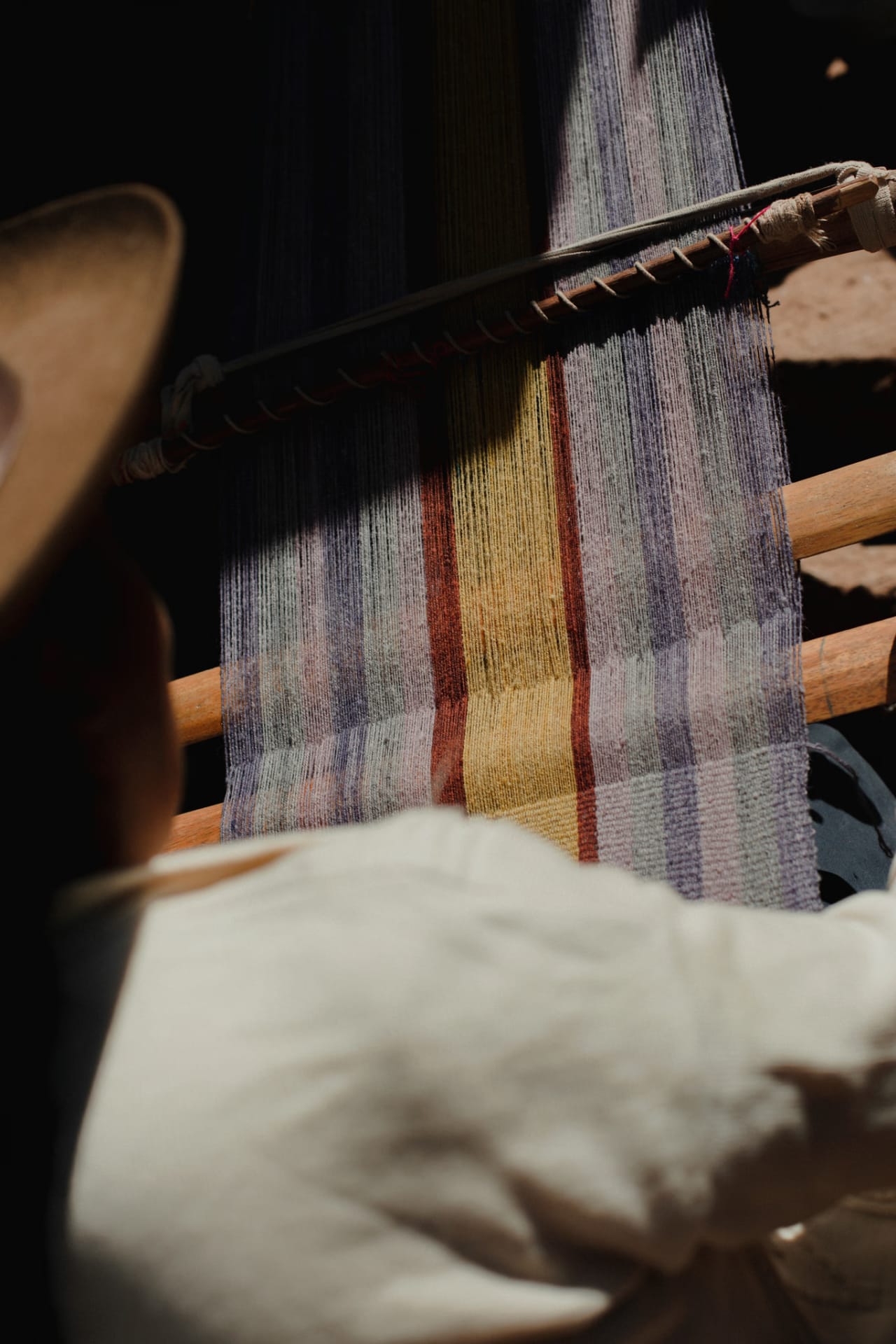
Inside one of Caral's residential sectors, excavators found a quipu — the knotted cord system of coloured strings that most visitors to Peru associate with the Inca, who used it as an empire-wide accounting and record-keeping technology four thousand years later. The quipu at Caral is the oldest ever recovered in the Americas. It means the Inca did not invent this system; they inherited it, refined it, and scaled it to an empire, working from a Andean tradition of recording information in knots that had already existed for four millennia by the time Cusco became a capital.
A flute carved from condor and pelican bone was found in the same excavations — evidence, alongside dozens of other wind instruments recovered at the site, that this was a city that made music as a matter of civic life, not as a footnote to survival.
What the Site Actually Looks Like
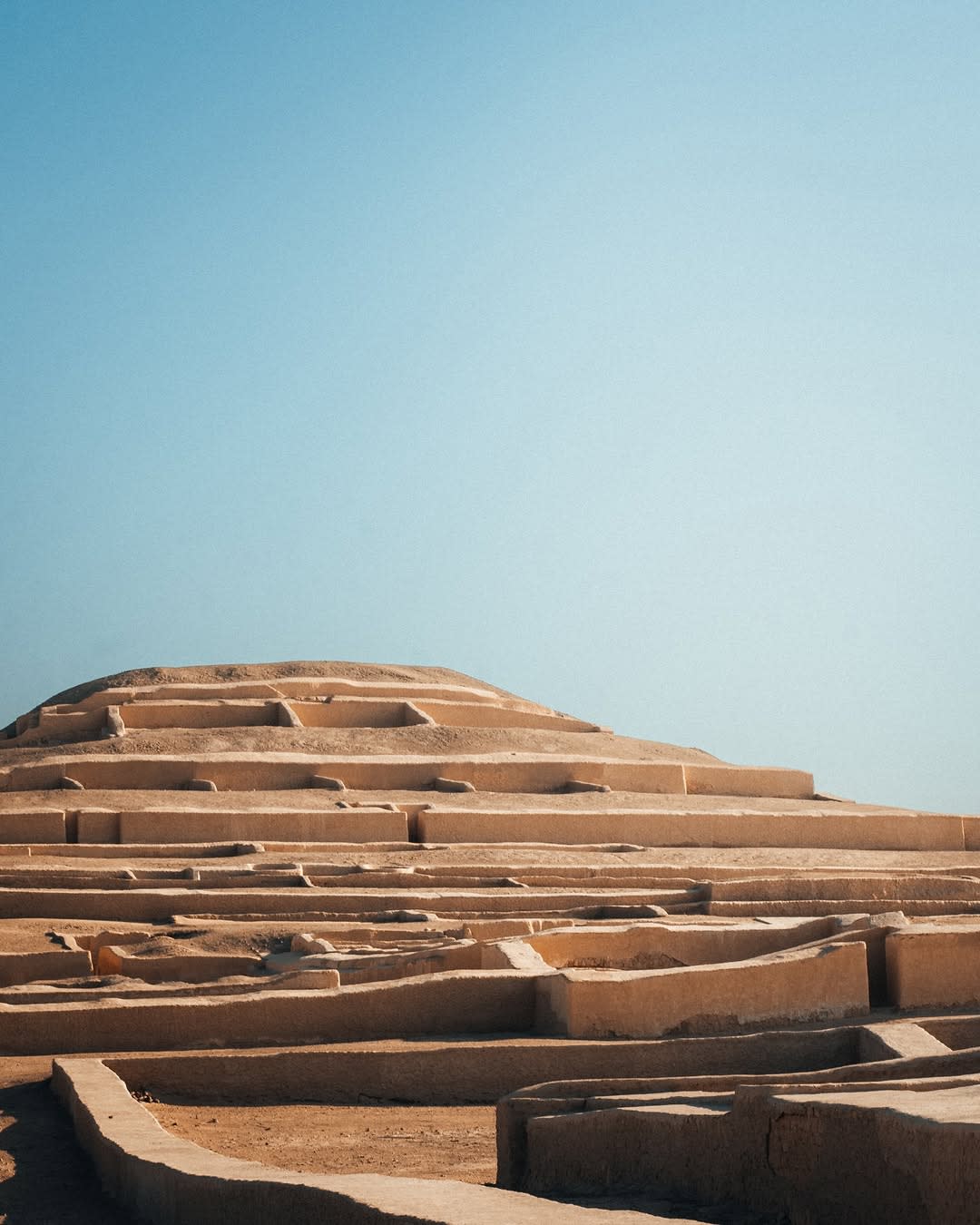
Caral is not reconstructed the way Machu Picchu has been rebuilt into its familiar silhouette. What stands today is closer to what came out of the ground: six main pyramidal structures arranged around a central plaza, two sunken circular amphitheatres cut below grade for ceremonies whose exact nature is still debated, and clearly stratified residential zones — an elite sector near the temples, more modest housing further out, a settlement pattern that speaks to social organisation without needing an inscription to explain it.
The Pirámide Mayor, the largest structure, rises in a series of platforms that guests are permitted to climb, under supervision, to the summit — a vantage from which the full geometry of the sacred city becomes legible in a way it is not from the ground. From there, the Supe Valley opens out in both directions: green agricultural land running toward the Andes on one side, the pale line of the desert running toward the ocean on the other. Caral sat, deliberately, at the hinge between the two.
What Kada Arranges
Caral receives a fraction of the visitors that Peru's more familiar heritage sites do, and the infrastructure reflects that: no gift shop circuit, no scripted twenty-minute walkthrough, no crowd to route around. That absence is the opportunity. We arrange a full day from Lima with a private vehicle and a specialist in Peruvian pre-Columbian archaeology — not a general tour guide reciting dates, but someone whose own research sits inside this period, able to answer the questions that come up once a guest has actually stood on the plaza floor: how did a society without writing coordinate the labour to move these stones, what does the current dating evidence actually establish versus theorise, why here, at this bend of this river, and not somewhere else.
For guests with a genuine interest in the archaeology rather than a passing curiosity, we can request time with a member of the excavation team when their field calendar allows — a conversation that moves the visit from observation to something closer to a briefing.
We route the day so that Caral does not feel like an addition bolted onto a Lima stay. Guests typically leave the city before dawn, are at the site by mid-morning while the light is still low and the heat has not yet built across the desert plain, and are back in Lima in time for dinner — the entire arc bookended by a city considered five thousand years old and a capital that, by comparison, has existed for the blink of an eye.
Expert Insight
"We send guests to Caral expecting a ruin and a photograph. What they come back with is closer to a recalibration — a sense that the story of civilization in the Americas did not begin with the Inca, or even close to it. It began on this river, with a city that chose cotton and music over walls. That is not a small thing to carry with you for the rest of a trip through Peru."
— Katherine Cjuiro, Founder, KADA Travel
A Practical Note
The road to Caral is unpaved for the final stretch, and the site sits in open desert with little shade — we recommend the visit for guests comfortable with a full day outdoors, and we build in water, sun cover, and a proper midday pause as a matter of course, not an afterthought. The site is best visited as a single dedicated day from Lima rather than folded into a rushed itinerary; the value of Caral is largely in the quiet, and a rushed visit trades that away for very little in return.


Written by Kada Travel Editorial
Frequently Asked
They are not comparable, and we would discourage thinking of one as a substitute for the other. Machu Picchu is a citadel, dramatically sited, extensively restored, and visited by thousands daily. Caral is older by roughly three thousand years, minimally reconstructed, and visited by a fraction of that number. Guests who go to both tend to describe Caral as the more contemplative of the two.
Moderately. The Pirámide Mayor's summit is reached via a series of stepped platforms, manageable for most fitness levels but not wheelchair accessible. The site is flat and open otherwise, walked at a slow pace across packed desert ground.
Yes — the scale and openness of the site tends to work well for families, and the "oldest city in the Americas" framing is one that older children in particular respond to. We adjust pacing and depth of explanation for younger guests.
Yes. The desert climate means conditions are dry for most of the year; we advise against the hottest midday hours in the summer months (December–March) and route visits for early morning accordingly.
Design Your Journey
Design your bespoke Peru journey
We talk. We listen. Then we design an itinerary that belongs only to you.
Start Planning