Unfolded· 6 min read·12 October 2026
The Larco, Without a Script
A private visit to Lima's greatest pre-Columbian archive — no fixed route, following whatever the collection asks of you.
By Kada Travel Editorial
Some objects are understood standing up, and some ask you to sit down. The Larco Museum has both, and the most common mistake of a visit is to treat them the same.
With tens of thousands of pieces, the museum cannot be seen in full in a morning, or in two. Any fixed route — the ten essential pieces, the forty-minute circuit — is therefore a choice someone else made for you about what deserves your attention. The visit we arrange starts from the opposite premise: that you decide where to stop, and that the museum should be able to follow.
A Collection That Asks for No Route
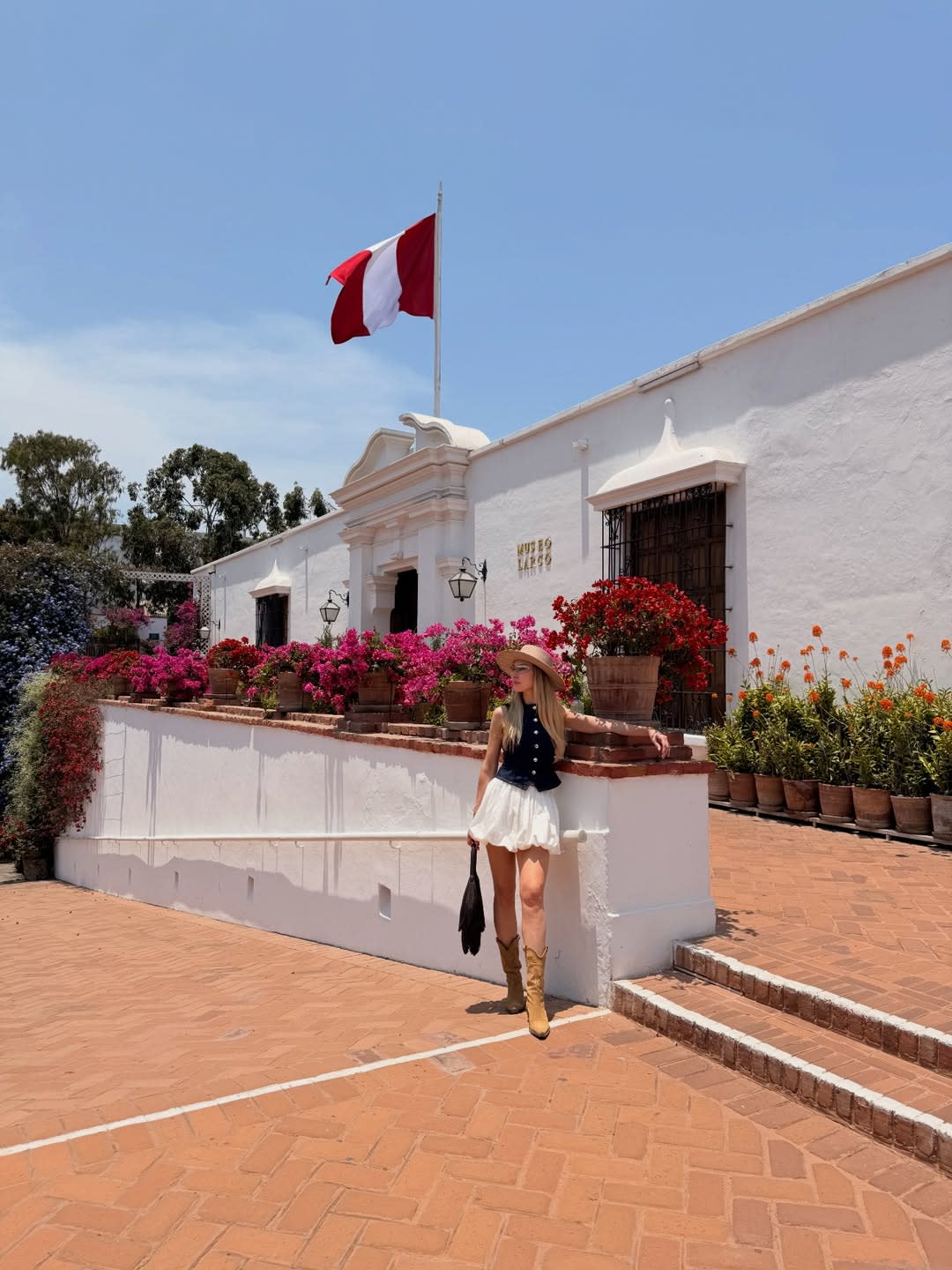
Rafael Larco Herrera began collecting in 1925, on the family hacienda in the Chicama valley of northern Peru, where farm workers regularly turned up ceramics as they worked the soil. What began as a regional archive grew over three generations into material from more than forty Andean cultures, now housed in an eighteenth-century viceregal hacienda in Pueblo Libre.
What matters most to anyone walking through it is how it is arranged: not by dynasty or by the sequence of conquests, but by the objects themselves — ceramics in one wing, metals in another, textiles in a third. That arrangement has a practical consequence: there is no obligatory order. You can start with the gold and end among the vessels, or spend the whole morning in a single room. Each one answers a different question, and the museum favours none over the others.
Three Rooms, Three Questions
In the ceramics room, the question is the face. The Moche (100–800 CE) modelled portrait vessels with a startling specificity: the pronounced jaw, the scar beneath the eye, the broken nose that never healed straight. In front of a single one, given time, things appear that five minutes would never show: the same face repeated across several pieces, as though someone had been portrayed over the course of years.
In the gold room, the question is purpose. The ear ornaments of the Chimú Empire (900–1470 CE), the ceremonial tumi knife inlaid with turquoise, the pectorals: they were made to accompany someone in death, not to be displayed, and that condition changes the way they are seen.
In the textile room, the question is writing. The Chancay gauzes (900–1450 CE), woven by hand on backstrap looms, encode clan, rank and origin in a system as precise as an alphabet, now almost entirely lost. It is the room that receives the least attention, and perhaps the one that deserves the most.
The Visit, Without a Script
A private visit has no prepared route to complete. A senior guide accompanies our guests and begins by asking what brings them to the museum: Moche ceramics, goldwork, textiles, or simply curiosity about what they do not yet know. From there, the collection sets the itinerary.
If a vessel stops a guest, they stay in front of it as long as it takes. If the textiles ask for the middle of the morning, they have it. And whatever does not spark interest is passed over without guilt. The Erotic Gallery, for those who wish to see it, is one more collection within the museum and is approached with the same conversation; for those who prefer to skip it, it simply does not enter the route.
What Kada Arranges
The visit is private: we do not combine our guests with other groups. We coordinate the day and the time, brief the guide on the areas most relevant to their interests, and weave it into the Lima itinerary. For guests with specific interests — Moche ceramics, Andean goldwork, the textile traditions of the coast — the route is weighted accordingly. The itinerary is not fixed: it is structured around the collection, not around a script.
We recommend placing the Larco at the start of the stay in Lima. The faces and codes learned here reappear later at Casa de Aliaga, where the portrait archive reads in dialogue with the Moche portrait vessels, and at the archaeological sites of the coast; the comparison is more interesting when it unfolds slowly. For guests who prefer the museum at night, we also arrange a private evening with dinner in its garden.
Expert Insight
"The mistake at the Larco is arriving with a list. The collection is so large that any list is a surrender. When the guide stops following a script and starts following the guest's gaze — what stops them, what they return to look at again — the visit becomes a conversation with the museum rather than a tour of it. What people remember afterwards is rarely the most famous piece. It is the one they did not expect."
— Katherine Cjuiro, Founder & Travel Director, KADA Travel
A Practical Note
The Larco Museum is in Pueblo Libre, twenty to thirty minutes from Miraflores depending on traffic. We recommend comfortable clothing and walking shoes, and leaving the visit free of immediate appointments: with no script, the route can extend towards whatever draws the most interest.
If you wish to prolong it, the museum's bougainvillea garden is a good place to pause and talk over what you have seen before continuing with the day.
Written by Kada Travel Editorial
Frequently Asked
The evening programme combines the visit with dinner in the museum garden and has its own sequence: objects first, table afterwards. This private visit concentrates solely on the collection and has no predefined order: the route is set by each guest's interests. Some guests choose both, with the visit at the start of the stay and the evening towards the end.
No. The guide starts from your interests, not from a syllabus. Guests who arrive with no prior knowledge usually leave with a clear sense of the cultures that held them longest; those who arrive with deep knowledge can go straight to what interests them.
Yes. Because the route follows no script, it can be devoted to one culture, one room or one kind of object — ceramics, goldwork, textiles — for the whole visit. Please mention it when booking so the guide can prepare.
Yes. With no fixed route, the guide can adjust the pace and the content to the age of the group, and the Erotic Gallery is optional: it can be omitted without changing the rest of the visit.
Design Your Journey
Design your bespoke Peru journey
We talk. We listen. Then we design an itinerary that belongs only to you.
Start Planning